
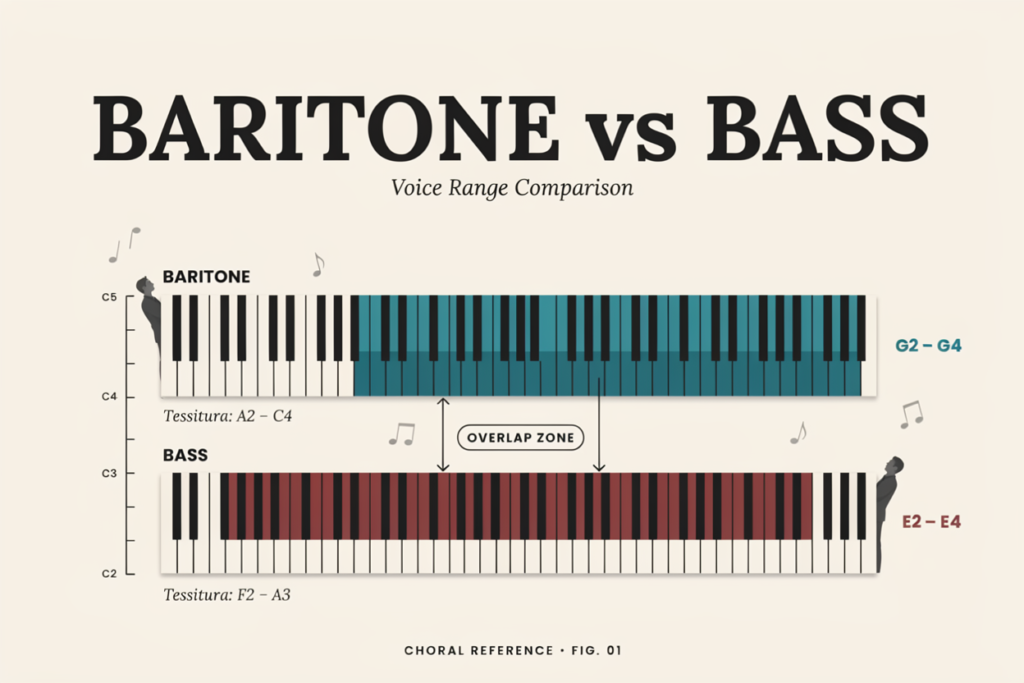
Baritone and bass are neighboring low male voice types that differ mainly in tessitura, tone, and vocal weight. A baritone generally has a higher center, while a bass is more at home sustaining low phrases. Your lowest note alone cannot identify either voice type.
If you are comparing your own notes, start with a broad male voice range reference, then pay closer attention to the pitches you can repeat clearly without pressing or tiring.
Baritone vs Bass: What Is the Main Difference?
A conventional baritone range is approximately A2 to A4, while bass spans about E2 to E4. In equal temperament, those boundaries correspond to about 110–440 Hz and 82.4–329.6 Hz. These are reference points, not limits.
| Feature | Baritone | Bass |
|---|---|---|
| Conventional range | About A2–A4 | About E2–E4 |
| Boundary frequencies | About 110–440 Hz | About 82.4–329.6 Hz |
| Comfortable center | Middle-low | Low |
| Typical sound | Warm, full, sometimes bright or weighty | Dark, substantial, often resonant in low phrases |
| Upper extension | Usually easier and more usable | Usually lower-centered and less comfortable at baritone highs |
| Low-note behavior | May reach low notes without sustaining them easily | Low notes tend to remain clearer and more reliable |
| Common subtypes | Lyric, dramatic, Verdi, heldenbaritone | Basso cantante, basso profondo, buffo |
Typical baritone range and sound
The baritone sits between tenor and bass. A baritone may have a warm, dark color, but the defining clue is not darkness alone; it is the voice’s comfortable center and behavior across phrases. Many baritones can touch E2, yet their strongest, most flexible singing occurs higher. The detailed baritone range guide explains why usable notes matter more than occasional extremes.
Typical bass range and sound
Bass is the lowest standard male voice category. A bass typically sustains low notes with more resonance, stability, and carrying power than a baritone, especially when the musical line remains low rather than visiting one isolated bottom note.
Not every bass sounds enormous. Basso cantante voices can combine flexibility with a low tessitura, while a basso profondo has exceptional depth and weight. A fuller breakdown of the bass voice category shows how distinct sounds can share one classification.
Why Do Baritone and Bass Ranges Overlap?
Baritone and bass reference ranges overlap from approximately A2 through E4. One singer could therefore produce every pitch in that shared span and still be either a baritone or bass. Classification depends on how the voice functions, not merely which piano keys it can match once.
Total range versus comfortable tessitura
Range includes the lowest and highest pitches you can phonate. Tessitura is where your voice remains comfortable and controllable for extended singing. A reliable performance range is narrower because every note must work repeatedly in phrases and on different vowels.
Suppose a singer can briefly growl an E2 but loses clarity below A2. If he sings comfortably from B2 through F4, he may behave more like a baritone. Another singer may share the same E2 but sustain melodies around F2–C4 with a clear tone and little effort; that pattern is more consistent with bass characteristics. For a focused look at these overlapping boundaries, compare the bass and baritone note ranges.
Timbre, vocal weight, and register transitions
Timbre is the tonal color that makes two voices sound different on the same pitch. Vocal weight describes the perceived lightness or heaviness of the sound. Register transitions, often called passaggi in classical pedagogy, are areas where vocal coordination and resonance adjust as pitch rises.
These clues work together. A baritone can have a dark timbre, and a trained bass may sing upper notes smoothly. Speaking pitch is insufficient because habit, language, and emotion affect how low someone sounds.
Are You a Baritone or a Bass?
To estimate whether you are a baritone or bass, compare your comfortable tessitura, sustained low phrases, upper-range ease, tone, and transition areas. Treat a home test as provisional; a qualified voice teacher can assess how your voice behaves across exercises and repertoire.
Find your consistently comfortable notes
Warm up gently, then sing five-note patterns downward at moderate volume. Stop when the tone becomes breathy, pressed, or unstable. Repeat on several vowels. A usable bottom note should be reproducible.
Next, move upward without shouting or dragging heavy chest coordination higher. The distinction between registers can be confusing, so review how chest voice and head voice coordinate before counting an upper pitch as part of your current modal singing range.
Test phrases instead of isolated notes
Sing short passages that remain low for several measures. A bass-like pattern is more likely when low vowels stay focused, words remain intelligible, and volume does not collapse. A baritone may reach the same bottom pitch but feel more responsive when the melody sits higher.
Record the passage on two or three days because fatigue or illness can distort one result. Never force the larynx downward; stop if you develop pain or persistent hoarseness.
Compare both ends of the voice
Low notes provide only half the evidence. Observe where ascending scales become effortful and which songs allow free phrasing. Ask not only “Can I hit E2?” but “Where can I sing an entire piece freely?”
What Is a Bass-Baritone?
A bass-baritone is an intermediate category combining bass-like color or low authority with greater access to baritone territory. The label does not simply mean “a baritone who can sing one low note” or “a bass with a high note”; it describes a functional combination of tessitura, weight, range, and repertoire suitability.
How it differs from a standard baritone
A bass-baritone generally carries more weight and comfort into low passages than a typical baritone. Some roles also have substantial upper demands, so the bottom alone is inconclusive.
How it differs from a true bass
A true bass usually has a lower-centered tessitura and greater ease sustaining the deepest writing. A bass-baritone may sound dark and powerful yet lack the same comfort in prolonged low repertoire. Listening to recognized bass performers alongside well-known baritone singers can train your ear, although imitation cannot classify your own instrument.
Can a Baritone Sing Bass and Can a Bass Sing Baritone?
A baritone can often sing some bass notes, and a bass can often sing some baritone notes because the categories share a large pitch area. Singing the pitches, however, is different from performing a part whose tessitura, dynamics, and dramatic demands consistently favor another voice.
Flexible choir placement may be practical. A low baritone might cover a comfortable bass line, while a bass with accessible high notes might assist baritones. Solo classical repertoire is more specialized because sustained tessitura exposes mismatches.
Transposing a contemporary song can make it comfortable without changing the singer’s voice type. Classical labels describe functional tendencies, not a ranking system.
Does Voice Training Change a Baritone Into a Bass?
Voice training can improve coordination, resonance, stamina, and access to low notes, but it does not guarantee that a baritone will become a bass. Anatomy and maturation influence the instrument, while technique determines how efficiently the available instrument is used.
A young singer’s classification may change with maturation, and tension can initially hide part of an untrained range. Training may reveal a lower natural center, but forcing depth creates fatigue. Healthy development should make singing more stable. Review the signs of healthy deep-voice practice if low-range work causes recurring roughness.
Frequently Asked Questions
Is a baritone voice higher than a bass voice?
Yes. Baritone is the middle-low standard male category, while bass is the lowest. Their conventional ranges overlap, but the baritone’s comfortable tessitura generally sits higher.
Does reaching E2 mean you are a bass?
No. Many baritones can produce E2 briefly. Bass classification is more likely when low notes remain resonant and dependable throughout sustained musical phrases, alongside appropriate timbre and register behavior.
Is bass-baritone closer to bass or baritone?
It can lean toward either, depending on the singer and repertoire. Bass-baritone describes an intermediate functional profile rather than an exact midpoint on a frequency scale.
Can a baritone sing in the bass section of a choir?
Often, yes, if the part stays within the singer’s comfortable range and does not demand prolonged low notes that lose clarity. A choir director should place the singer according to the specific music and vocal balance.
Is bass rarer than baritone?
True low bass voices are generally considered less common than baritones, but reliable population percentages are difficult to establish. Classification practices also differ across opera, choir, musical theatre, and popular music.
Can your voice type change as you get older?
Voice classification can shift as the larynx matures, training improves coordination, or aging changes vocal-fold tissue and muscle function. The underlying voice may also have been classified incorrectly at first, so a revised label does not always mean the instrument fundamentally changed.

Williams is a vocal depth and voice analysis writer at Deep Voice Test. He focuses on deep voice analysis, vocal frequency testing, pitch detection, and voice classification tools for singers, creators, speakers, and voice enthusiasts.