
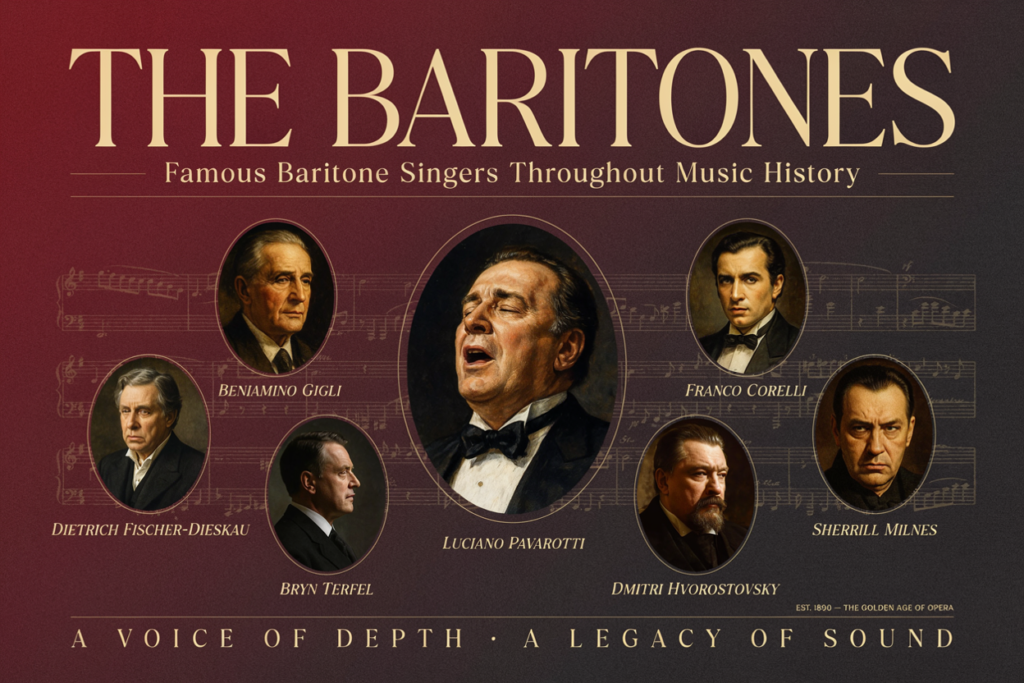
Famous baritone singers range from operatic masters such as Dietrich Fischer-Dieskau, Tito Gobbi, Robert Merrill, Sherrill Milnes, and Dmitri Hvorostovsky to popular vocalists associated with the category, including Frank Sinatra, Elvis Presley, Nat King Cole, Neil Diamond, David Bowie, and Hozier. Baritone voices can be light and lyrical, dark and dramatic, or intimate and conversational.
The useful comparison is how each artist used tessitura, timbre, phrasing, and vocal weight. Start with the typical range and traits of a baritone rather than copying one singer’s lowest recorded note.
What Is a Baritone Singer?
A baritone is a male voice that generally sits between tenor and bass. A conventional classical reference range is about A2 to A4, but professional classification depends more heavily on tessitura—the area where a singer can perform comfortably and consistently—along with timbre, vocal weight, and register transitions.
Typical range and tessitura
Baritone ranges overlap with neighboring categories, so endpoints alone do not settle the question. The male voice-type chart shows why voice categories cannot be separated by rigid borders.
Why not every low male singer is a baritone
Opera uses structured categories, often called fachs, that account for range, color, weight, and suitable roles. Popular music does not apply them consistently; microphones, transposition, falsetto, and production make labels less exact. A crooner or rock singer may reasonably be called baritone-associated without a formal operatic classification.
Who Are the Most Famous Operatic Baritone Singers?
Dietrich Fischer-Dieskau, Tito Gobbi, Robert Merrill, Sherrill Milnes, Cornell MacNeil, Dmitri Hvorostovsky, Thomas Hampson, and Peter Mattei are among the best-known operatic baritones. Each demonstrates a different balance of lyricism, dramatic force, textual detail, and tonal weight.
Masters of text, character, and lyric line
Dietrich Fischer-Dieskau became a defining interpreter of German art song. His precise diction, dynamic control, and attention to poetry make Schubert’s Winterreise valuable listening for singers studying text.
Tito Gobbi brought a theatrical approach to Scarpia in Tosca and the title role of Rigoletto, changing vocal color to serve the character while retaining an operatic line.
Thomas Hampson’s broad repertoire and Peter Mattei’s elegant Don Giovanni show that a baritone need not sound uniformly heavy. A baritone and tenor comparison clarifies the difference between baritone brightness and tenor ease.
Verdi power and dramatic authority
Robert Merrill, Sherrill Milnes, Cornell MacNeil, and Dmitri Hvorostovsky are closely associated with Verdi repertoire. Merrill offered rounded tone, Milnes a bright dramatic edge, and MacNeil became especially celebrated as Rigoletto. Hvorostovsky combined polished legato with a silvery-dark timbre in Eugene Onegin and Verdi roles.
Which Famous Popular Singers Are Associated With the Baritone Voice?
Frank Sinatra, Elvis Presley, Nat King Cole, Neil Diamond, David Bowie, and Hozier are frequently associated with baritone singing in popular music. These descriptions are useful shorthand, but they are less formal than operatic classifications and should not be treated as exact fach assignments.
Crooners and early popular icons
Frank Sinatra’s “I’ve Got You Under My Skin” demonstrates breath management, legato, diction, and conversational timing.
Nat King Cole used warm tone and clear phrasing in “Unforgettable.” Elvis Presley moved among crooning, blues, gospel, and rock; baritone describes much of his comfortable center, but not his full stylistic range.
Johnny Cash is often identified more specifically as a bass-baritone. His low-centered delivery in “Ring of Fire” makes him useful for contrast, but a closer look at bass and baritone differences explains why he should not simply be placed in a standard baritone list.
Rock and contemporary voices
Neil Diamond’s grounded, speech-like “Sweet Caroline” is an accessible popular baritone example. David Bowie’s “Life on Mars?” illustrates expressive range and theatrical phrasing rather than a fixed operatic sound.
Hozier uses a resonant lower center and textured intensity in “Take Me to Church,” although production affects what listeners hear. Compare these artists with other singers known for deep vocal color.
How Do These Famous Baritone Voices Differ?
Famous baritones differ in vocal weight, timbre, repertoire, and projection. Opera requires unamplified projection, while close-miking can make a quiet or speech-like phrase immediate.
| Singer | Genre or category | Defining quality | Representative listening |
|---|---|---|---|
| Dietrich Fischer-Dieskau | Classical lyric baritone | Textual detail and dynamic nuance | Schubert’s Winterreise |
| Tito Gobbi | Operatic dramatic baritone | Character-driven vocal color | “Cortigiani” from Rigoletto |
| Robert Merrill | Operatic Verdi baritone | Rounded tone and broad legato | “Di Provenza il mar” |
| Sherrill Milnes | Operatic Verdi baritone | Bright authority and dramatic thrust | “Eri tu” from Un Ballo in Maschera |
| Dmitri Hvorostovsky | Operatic lyric/Verdi baritone | Silvery-dark timbre and smooth line | Eugene Onegin’s aria |
| Frank Sinatra | Popular crooner | Breath-led, conversational phrasing | “I’ve Got You Under My Skin” |
| Nat King Cole | Jazz and popular song | Warm intimacy and clear diction | “Unforgettable” |
| Hozier | Contemporary popular music | Resonant weight and textured intensity | “Take Me to Church” |
Lyric warmth versus dramatic weight
A lyric baritone emphasizes flexibility and warmth; a dramatic or Verdi baritone usually carries greater density through demanding orchestration. Bass-baritones combine bass depth with baritone mobility, as the bass-versus-baritone range guide explains.
Classical projection versus microphone technique
Operatic resonance must carry through a hall; recording artists can exploit proximity, breath noise, compression, and amplification. Copying a crooner’s airy onset in opera—or operatic scale at a close microphone—misses the context.
Which Baritone Singers Should You Study?
Choose a singer according to the skill you want to hear. Fischer-Dieskau demonstrates text, Merrill and Hvorostovsky legato, Milnes and MacNeil dramatic authority, and Sinatra and Cole conversational phrasing.
Match the recording to your goal
For classical legato, listen for connected vowels. In Verdi, notice that power comes from resonance and breath, not throat pressure. In popular music, observe where Sinatra or Cole delays a word or changes volume.
Do not imitate only surface features such as darkness, rasp, or volume. Compare multiple singers performing similar material and ask what remains efficient. Register coordination also affects what you hear, so understanding chest voice and head voice behavior is more useful than trying to hold every note in a heavy setting.
Use listening as analysis, not impersonation
Select a short phrase, mark its breaths and strongest word, then sing it in a comfortable key. This transfers phrasing ideas without forcing your anatomy to imitate another singer’s.
How Can You Tell Whether You Are a Baritone?
You may be a baritone if your most comfortable, resonant singing area sits between typical tenor and bass tessituras, but a home range check provides only a provisional estimate. Voice type is better judged from sustained comfort, timbre, vocal weight, passaggio locations, and suitable repertoire than from one low or high note.
Warm up, find your clear lowest and highest notes without pushing, then use scales and phrases to locate the reliable middle. Compare that zone with tenor, baritone, and bass references, revisiting the result as technique develops.
An instructor experienced in voice classification can evaluate how the instrument behaves across registers. If bass and baritone both look plausible, the bass voice profile provides useful context, but comfort and long-term vocal health should take priority over earning a lower label.
Frequently Asked Questions
Who is considered the greatest operatic baritone?
There is no objective single greatest baritone. Dietrich Fischer-Dieskau is often celebrated for art-song interpretation, while Tito Gobbi, Robert Merrill, Sherrill Milnes, and Dmitri Hvorostovsky are prominent choices for operatic character, Verdi repertoire, or vocal beauty.
Is Frank Sinatra a baritone?
Frank Sinatra is commonly described as a baritone because of his comfortable vocal center, warm color, and recorded repertoire. The label is informal in popular music and does not imply that he was classified through the operatic fach system.
Was Elvis Presley a tenor or a baritone?
Elvis Presley is commonly characterized as a baritone, but his wide stylistic and usable range makes rigid classification difficult. Recorded extremes do not reveal where he could sustain an operatic tessitura, so the label should be understood broadly.
Is Johnny Cash a baritone or a bass?
Johnny Cash is usually described as a bass-baritone rather than a standard baritone or true bass. That term reflects his low-centered sound while acknowledging baritone qualities and flexibility.
What is the difference between a baritone and a bass-baritone?
A baritone generally has a higher tessitura and easier upper extension, while a bass-baritone combines baritone flexibility with a lower, heavier center. The categories overlap, and repertoire, passaggi, timbre, and sustained comfort help distinguish them.
Can a baritone learn to sing tenor notes?
A trained baritone may sing some notes found in tenor repertoire, especially because the ranges overlap. Reaching a tenor note does not make the singer a tenor; the key question is whether the higher tessitura remains comfortable, resonant, and repeatable throughout a song or role.

Williams is a vocal depth and voice analysis writer at Deep Voice Test. He focuses on deep voice analysis, vocal frequency testing, pitch detection, and voice classification tools for singers, creators, speakers, and voice enthusiasts.