
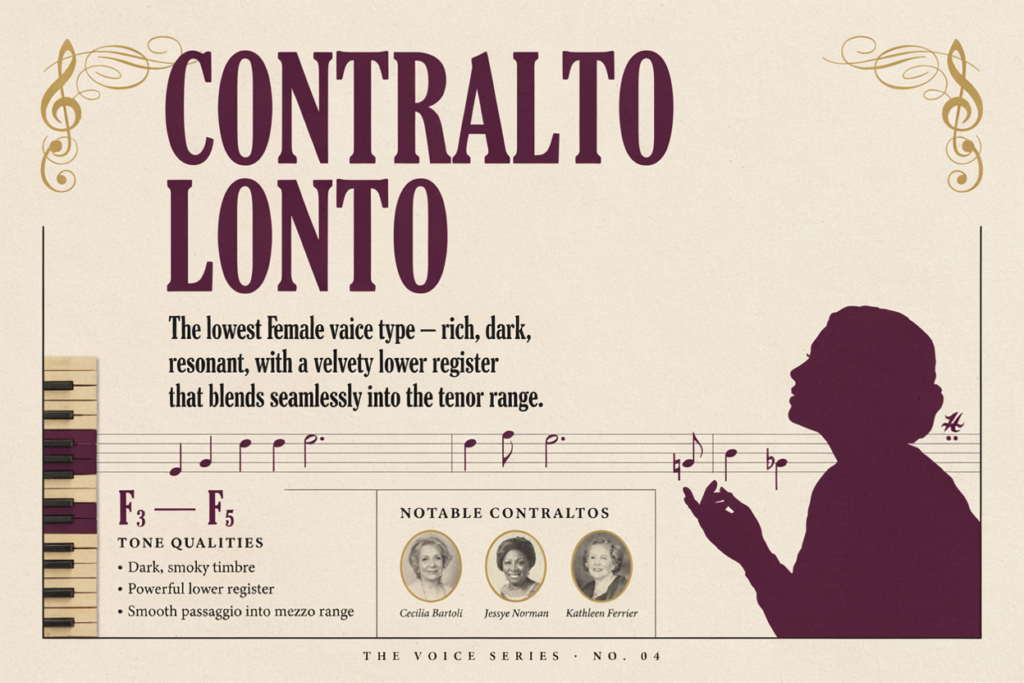
A contralto is the lowest standard female classical voice type. It is commonly associated with an approximate F3–F5 range, a low tessitura, and a weighty lower register. Reaching F3 does not make a singer a contralto; tessitura, tone, register transitions, vocal weight, and repertoire matter more than one extreme note.
The term is often confused with “alto,” but the two aren’t interchangeable. Contralto describes a solo voice classification, while alto names the lower treble part in a choir. A female voice range reference provides context, but it cannot replace listening across your whole range.
What Is a Contralto Voice Type?
A contralto voice sits lower than a typical soprano or mezzo-soprano and usually sounds most settled in the lower and middle parts of the female range. In classical singing, voice type reflects where the voice works comfortably, not simply the highest and lowest notes a singer can produce.
What does a contralto sound like?
Contraltos are often described as dark, full, earthy, or androgynous in timbre. Timbre is the tone color that lets two singers sound different even on the same pitch. A contralto may carry unusual strength below middle C while retaining body through the middle register.
Those qualities are tendencies, not a checklist. A dark voice is not necessarily low, and a woman with a naturally deep speaking voice is not automatically a contralto.
Why are true contraltos considered rare?
True contraltos are considered rare because relatively few female singers combine a consistently low tessitura, substantial lower-register resonance, characteristic register transitions, and the vocal weight needed for contralto repertoire. Many singers assigned alto lines in choirs are mezzo-sopranos whose ranges overlap the part.
What Is the Typical Contralto Vocal Range?
The commonly cited contralto range is approximately F3 to F5, with middle C labeled C4. That two-octave reference is a useful orientation, not a rigid entrance test. Trained singers may extend beyond it, while a genuine contralto may not use every note equally comfortably.
| Category | Common reference range | What the label describes | Main identifying clue |
|---|---|---|---|
| Contralto | About F3–F5 | Classical solo voice type | Low tessitura with a strong lower and middle register |
| Mezzo-soprano | About A3–A5 | Classical solo voice type | Centered higher than contralto, with substantial middle-register strength |
| Soprano | About C4–C6 | Classical solo voice type | Higher tessitura and repertoire |
| Alto | Varies by composition | Choral part | The lower treble harmony line, not necessarily a solo voice type |
These ranges overlap. The distinctions in an alto and contralto comparison become clearer when musical function and comfort are considered alongside pitch limits.
Range versus tessitura
Range is the span between your lowest and highest producible notes. Tessitura is the region where you can sing repeatedly with reliable tone, control, and endurance. A mezzo-soprano might touch F3 during a warm-up but feel most capable around the middle and upper range; a contralto is more likely to remain comfortable and resonant lower for sustained passages.
Passaggi also matter. A passaggio is a transition area where vocal coordination shifts between registers. Teachers listen for where these transitions occur, how the tone changes across them, and which repertoire permits the voice to remain balanced.
Why one low note cannot determine voice type
An isolated low note may result from vocal fry or a temporary registration choice. It says little about whether you can sustain phrases there clearly. The relationship between chest voice and head voice also influences how the range feels and sounds.
Lowest-note videos can therefore be misleading. Classical classification considers tessitura, timbre, vocal weight, passaggi, stamina, age, training, and repertoire together.
How Is a Contralto Different From an Alto or Mezzo-Soprano?
A contralto is a classical solo voice type, an alto is a choral assignment, and a mezzo-soprano is a neighboring classical voice type with a generally higher tessitura. All three may sing some of the same notes, but they describe different things or different centers of vocal comfort.
Contralto versus alto
Choir directors assign alto parts according to ensemble balance and the notes in a score. A soprano with a secure lower extension or a mezzo-soprano may sing alto effectively. Saying “I sing alto” identifies your current section; saying “I am a contralto” makes a broader claim about your instrument and suitable solo repertoire.
Contralto versus mezzo-soprano
Contralto and mezzo-soprano ranges overlap heavily. A mezzo often has more natural ease higher in the staff, while a contralto tends to preserve depth, clarity, and carrying power lower down. Young voices should be classified cautiously as they mature.
What Are the Main Types of Contralto?
Contraltos are often described as coloratura, lyric, or dramatic, although subtype systems vary. These terms describe agility, weight, projection, and dramatic function rather than fixed ranges.
Coloratura contralto
A coloratura contralto combines a low-centered instrument with flexibility for rapid runs, ornaments, and wide leaps. Ewa Podleś is frequently associated with this rare category.
Lyric contralto
A lyric contralto generally has a smoother, less massive sound suited to sustained melodic writing and expressive phrasing.
Dramatic contralto
A dramatic contralto has greater vocal weight and projection. Erda in Wagner’s Ring cycle is a well-known role calling for low authority and tonal presence.
No subtype should be self-assigned from tone descriptions alone. Recordings of women known for low voices can illustrate variety, but popular and classical labels do not always follow the same standards.
How Can You Tell If You Are a Contralto?
You may be a contralto if your voice remains clear, resonant, and comfortable through a consistently low tessitura, your lower register has usable strength, and contralto repertoire fits without pushing. The safest conclusion comes from repeated observation with a qualified voice teacher, not one online test.
Use this assessment sequence:
- Warm up gently before measuring anything.
- Note your lowest and highest clear, repeatable pitches without vocal fry or strain.
- Sing scales and short phrases in several keys to locate your most comfortable region.
- Observe where register transitions occur and where tone loses stability.
- Repeat the check on different days rather than relying on one session.
- Test appropriate repertoire with a teacher who can hear resonance, weight, and endurance.
A browser-based recording can help you estimate where your voice sits, but microphone response, background noise, and pitch-detection errors affect results. The limitations explained in a voice-test accuracy guide are especially relevant near quiet low notes.
Avoid pressing the larynx down to sound “more contralto.” Pain, persistent hoarseness, or lost upper notes signals a technique or health issue.
Which Singers and Roles Demonstrate the Contralto Voice?
Marian Anderson, Kathleen Ferrier, Ewa Podleś, and Nathalie Stutzmann are widely cited examples. Anderson and Ferrier are remembered for concert singing, Podleś for coloratura agility, and Stutzmann for a dark, focused tone.
Representative listening includes Erda in Wagner, Handel contralto parts, and selected Rossini roles. Listen for lower-middle comfort, consistent register transitions, and clarity rather than merely the lowest note.
Popular singers described as contraltos should be treated more cautiously because contemporary genres do not use the classical Fach system consistently. A list of deep-voiced female performers is useful for hearing low timbres, but it does not prove that every artist would be classified as a classical contralto.
Frequently Asked Questions
Is contralto the rarest female voice type?
Contralto is generally regarded as the rarest standard female classical voice type. True classification requires more than a low range; the singer must also have a characteristically low tessitura, suitable timbre, register behavior, and repertoire fit.
Is contralto lower than alto?
Not in a simple rank order. Contralto is a solo voice type, while alto usually means the lower treble part in a choir. Many mezzo-sopranos sing alto parts without being contraltos.
Can a mezzo-soprano sing contralto notes?
Yes. Mezzo-soprano and contralto ranges overlap, and many mezzos can produce notes within the typical F3–F5 contralto reference. The difference is where the voice remains most comfortable and capable across complete phrases and repertoire.
How do I know whether I am a contralto?
Track your comfortable tessitura, tone, register transitions, and stamina after a proper warm-up, then discuss the pattern with an experienced teacher. A range test offers preliminary data but cannot determine a classical voice type by itself.
Can your voice type change with age or training?
The underlying instrument does not switch categories on command, but maturation and healthier technique can reveal its natural classification more clearly. Teachers may revise a label as a singer’s voice develops and repertoire demands expose its true center.
Are all women with deep speaking voices contraltos?
No. Speaking pitch and singing voice classification are related only indirectly. A woman can have low speech yet sing as a mezzo-soprano or soprano, while a contralto’s everyday speaking voice need not sound exceptionally deep.

Williams is a vocal depth and voice analysis writer at Deep Voice Test. He focuses on deep voice analysis, vocal frequency testing, pitch detection, and voice classification tools for singers, creators, speakers, and voice enthusiasts.