
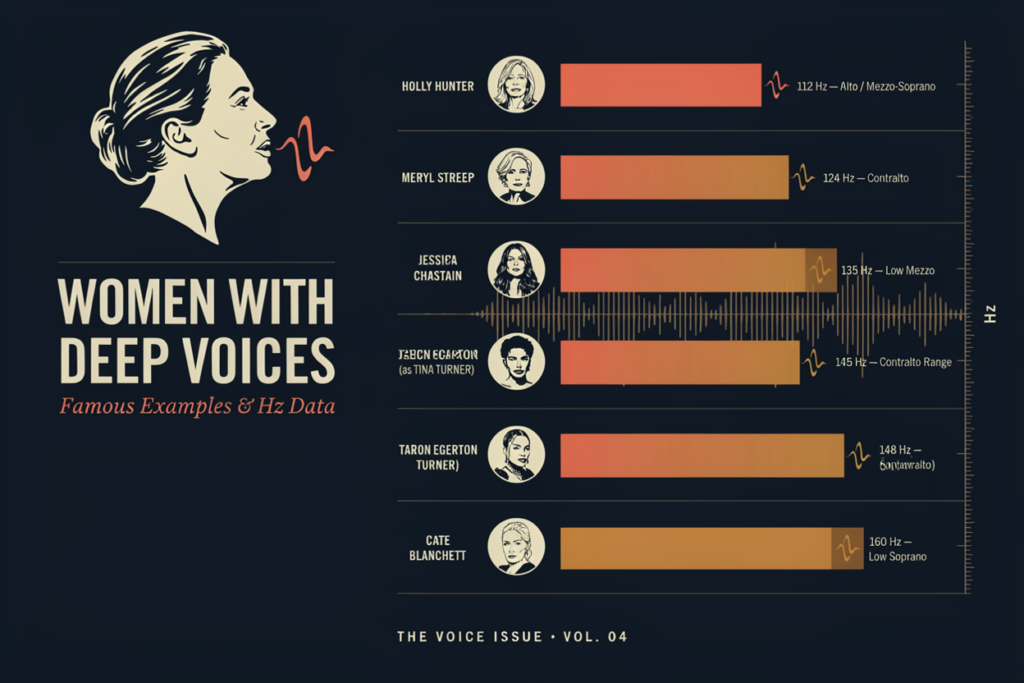
Women with deep voices generally have a lower speaking pitch, darker resonance, or heavier timbre than average. A low voice can be natural and healthy. It does not automatically mean contralto, a singing classification based on range, tessitura, and vocal quality rather than speech.
What Does It Mean When a Woman Has a Deep Voice?
A woman is usually described as having a deep voice when her habitual speaking pitch sounds low relative to other adult female voices. Frequency contributes to that impression, but listeners also respond to resonance, vocal weight, and speech style. That is why a voice can sound rich and deep without producing an exceptionally low average frequency.
Speaking pitch versus perceived vocal depth
Fundamental frequency, or F0, is the rate at which the vocal folds repeat their vibration. It is measured in hertz (Hz), or cycles per second. Research on adult voices often places average female speaking F0 roughly in the 188–221 Hz region, but this is a group-level reference rather than a cutoff for an individual.
There is no universally accepted Hz boundary that turns a female voice from “average” into “deep.” Age, emotion, and the selected recording sample affect the number. A voice Hz chart provides context, not a diagnosis or rigid scorecard.
Why resonance and timbre matter
Resonance describes how sound is shaped by the throat, mouth, and other spaces above the vocal folds. Timbre is the overall sound quality that lets two people remain recognizable even when they speak at the same pitch. Stronger low-frequency harmonics, a longer-feeling vocal tract, and a relaxed speech pattern can all make one voice sound darker than another with a similar F0.
“Deep” is therefore partly an acoustic measurement and partly perception. The guide to a deep female voice explores that combination further.
Which Famous Women Are Known for Deep Voices?
Singers such as Nina Simone, Tracy Chapman, Toni Braxton, Cher, and Annie Lennox are frequently cited for low, dark, or weighty vocal qualities. In spoken performance, Lauren Bacall, Kathleen Turner, and Shohreh Aghdashloo are widely recognized for distinctive low voices. These examples illustrate different kinds of depth rather than one identical voice type.
Singers with low or dark vocal qualities
Nina Simone combined a substantial lower register with dark tonal color. Tracy Chapman is known for a warm, grounded tone, while Toni Braxton often uses a low, breathy color. Popular singers are not always formally classified under classical categories; calling every low-sounding singer a contralto goes beyond what recordings establish.
Actresses and speakers with distinctive low voices
Kathleen Turner, Lauren Bacall, and Shohreh Aghdashloo show how a voice can sound deep without a singing label. Pitch, texture, resonance, pacing, and articulation all contribute. Celebrity “voice type” lists remain informal unless supported by reliable training or performance evidence.
Why Do Some Women Naturally Have Deeper Voices?
Some women naturally have deeper voices because vocal-fold anatomy, vocal-tract shape, genetics, hormones, and learned speech patterns vary from person to person. Thicker or longer vocal folds generally vibrate more slowly, producing a lower fundamental frequency. A naturally low voice is not inherently unhealthy or unfeminine.
Vocal anatomy and inherited traits
The vocal folds are tissue inside the larynx. Their length, mass, tension, and coordination influence pitch. Resonating spaces above the larynx then shape the tone.
Inherited anatomy can contribute, although there is no single “deep voice gene.” Family similarities may reflect anatomy, hormones, language, and learned habits together. Whether a deep voice is inherited is more nuanced than a simple yes or no.
Hormones, age, and speaking habits
Hormonal development affects the larynx and vocal folds, especially during puberty. Adult voices can also change gradually with aging, menopause, general health, and vocal use. These effects differ considerably among individuals.
Speech habits matter too. A person may use less upward pitch movement, a slower pace, or more chest-dominant resonance. Language and regional patterns can influence conversational pitch without changing anatomy.
For a wider explanation of anatomical, hormonal, and behavioral influences, see what causes a deep voice.
Does a Deep Female Voice Mean Contralto?
No. A deep speaking voice does not automatically mean contralto. Contralto is the lowest standard classical female singing category, commonly associated with an approximate F3–F5 range, a low tessitura, and a characteristically dark or rich timbre. Tessitura means the part of the range where a singer can perform comfortably and consistently.
| Label | What it describes | Main criteria | What it does not prove |
|---|---|---|---|
| Deep speaking voice | Everyday speech | Habitual F0, resonance, timbre, speech pattern | Classical singing category |
| Alto | Usually a choir part | The lower female harmony line assigned in an ensemble | A specific biological voice type |
| Mezzo-soprano | Classical singing voice | Middle female tessitura, range, passaggi, and tone | That the singer cannot produce low notes |
| Contralto | Lowest classical female voice | Low tessitura, usable range, passaggi, and vocal color | That every low-speaking woman belongs here |
Range is not the same as voice type
Touching a low note once cannot classify a singer. Teachers also assess tessitura, tone, register transitions, projection, and endurance. The female vocal range chart gives approximate references, while the contralto voice type guide explains why comfort and color matter.
Alto and contralto are often used interchangeably online, but they answer different questions. Alto commonly names a choral part; contralto names a classical solo voice type. The alto versus contralto comparison shows where the terms overlap and where they do not.
How Can a Woman Measure Her Voice Depth?
A woman can estimate voice depth by recording natural speech in a quiet room and checking the median or average fundamental frequency across several samples. The result should be interpreted as an estimate, not a permanent label. A sustained vowel helps test steady pitch, while connected speech better represents an everyday voice.
Use a consistent recording method
Keep microphone distance consistent, avoid background noise, and speak comfortably. Record 20–30 seconds of ordinary speech without forcing the voice downward. Repeat on three occasions and compare the middle result to reduce the influence of an unusual reading.
Pitch trackers can occasionally report an octave error, identifying a harmonic instead of the true fundamental. A voice near 100 Hz might then appear near 200 Hz, or the reverse. If one result is roughly double or half the others, repeat the sample before drawing a conclusion.
Interpret the number in context
Frequency alone cannot measure resonance, warmth, roughness, or perceived authority. Compare several natural samples. A browser-based test offers orientation, but microphone quality and pitch-detection errors limit precision.
When Can a Newly Deep Voice Signal a Health Issue?
A long-standing, comfortable deep voice is often normal. A sudden or persistent pitch drop with hoarseness, pain, fatigue, breathing difficulty, or trouble swallowing deserves medical attention. The key distinction is whether the voice has always been low or recently changed.
Temporary lowering can follow a respiratory infection, heavy voice use, or vocal-fold irritation. Reflux, smoking-related irritation, hormonal changes, some medications, and vocal-fold lesions can also affect pitch or texture.
If hoarseness or an unexplained change persists for several weeks, consult an ear, nose, and throat doctor or speech-language pathologist. The guide to deep voice and health explains warning signs without treating naturally low pitch as a problem.
Frequently Asked Questions
What Hz is considered a deep voice for a woman?
There is no universal cutoff. Adult female speech often averages around 188–221 Hz in research samples, but lower results can be normal, and resonance may deepen the perceived sound.
Is every woman with a low singing voice a contralto?
No. Contralto classification depends on tessitura, register transitions, usable range, and timbre, not merely the lowest note produced. Many mezzo-sopranos can sing low notes.
Can a woman naturally have a voice as low as a man’s?
Yes, female and male speaking-pitch distributions overlap. A woman can naturally speak within a region common among some men, though pitch alone does not make the voices identical.
Why has my voice become deeper with age?
Gradual changes in vocal-fold tissue, muscle coordination, and hormones can alter pitch and tone with age. A sudden change or persistent hoarseness should be assessed rather than attributed to aging automatically.
Are deep female voices rare?
Very low female voices are less common than voices near the female population average, but “rare” has no precise boundary because deepness lacks a universal cutoff. True classical contraltos are generally considered uncommon, though a deep speaking voice and a contralto singing voice are not the same thing.
Can a deep voice be healthy and normal for a woman?
Yes. A naturally deep voice can be completely healthy and normal. Concern is more appropriate when the voice changes unexpectedly or comes with persistent hoarseness, pain, fatigue, breathing difficulty, or swallowing problems.

Williams is a vocal depth and voice analysis writer at Deep Voice Test. He focuses on deep voice analysis, vocal frequency testing, pitch detection, and voice classification tools for singers, creators, speakers, and voice enthusiasts.