
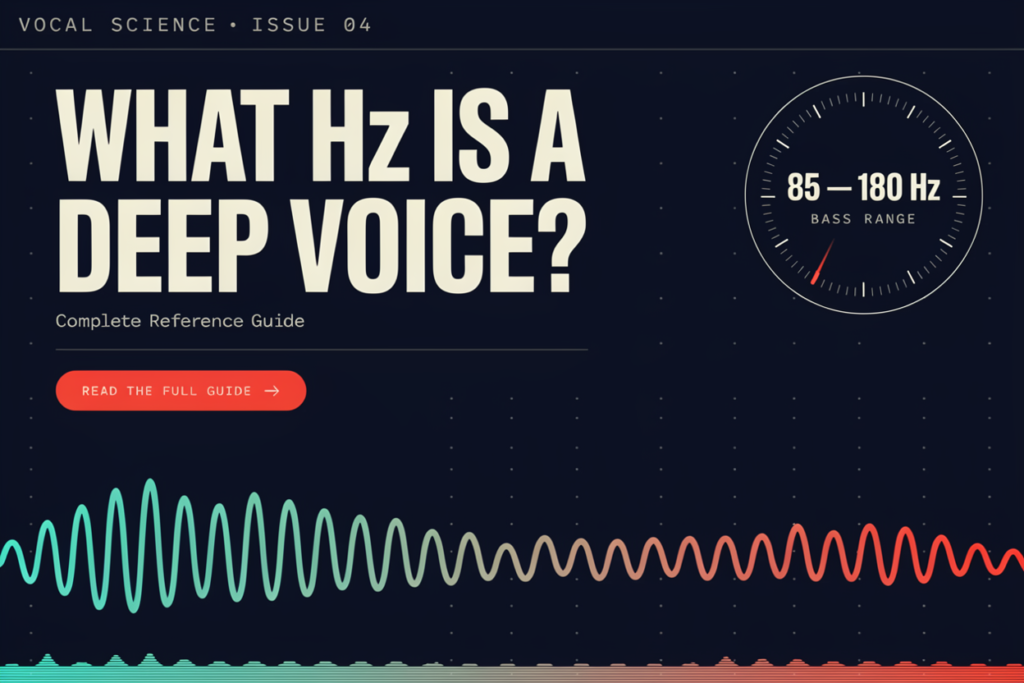
A deep voice is usually identified by a relatively low habitual speaking fundamental frequency, not by the lowest sound someone can produce. As a practical reference, adult male speech centered around 85–100 Hz is often perceived as notably deep, while adult female speech near or below roughly 165 Hz may sound comparatively deep. These are useful comparison zones, not universal biological or clinical cutoffs.
Frequency is only part of what listeners hear. Resonance and vocal weight can make two people with the same measured pitch sound different. Compare your result with a reference chart for speaking frequencies rather than treating one number as a verdict.
What Hz Is a Deep Voice?
A habitual speaking pitch of about 85–100 Hz commonly sounds deep for an adult male voice. For an adult female voice, a conversational pitch around 165 Hz or lower may sound deep relative to common female averages. No single value defines a deep voice for everyone because age, anatomy, speaking style, language, and measurement method all influence the result.
The National Center for Voice and Speech gives broad averages of approximately 125 Hz for adult male speech and 200 Hz for adult female speech. These are population tendencies, not boundaries. Datasets also vary with the speakers and recording task.
Practical ranges, not fixed categories
The following chart is a conversational reference for adults. The boundaries intentionally overlap because naturally occurring voices do too.
| Conversational pitch zone | Adult male context | Adult female context | Approximate musical reference |
|---|---|---|---|
| Very low | Below 85 Hz | Below 150 Hz | Below F2 for men; below D3 for women |
| Comparatively deep | 85–100 Hz | 150–165 Hz | About F2–G2; about D3–E3 |
| Near broad average | 100–140 Hz | 165–220 Hz | About G2–C#3; about E3–A3 |
| Comparatively high | Above 140 Hz | Above 220 Hz | Above C#3; above A3 |
The table cannot classify sex, hormone levels, health, or singing voice type. The average male speaking-pitch guide explains why a population average is not an individual target.
Speaking pitch is not your lowest note
Your habitual speaking pitch is the central frequency used during ordinary connected speech. Your lowest note is an endpoint you may touch briefly during a glide, while vocal fry is a separate low, irregular register. Neither represents how your voice normally functions in conversation.
A reading of 60 Hz may therefore be misleading if it captures only the end of a sentence, a creaky pulse, or a pitch-tracking error. To describe voice depth, a median taken from a full speech sample is more representative than a single minimum.
What Does a Voice Frequency Reading Measure?
A voice-frequency reading usually reports fundamental frequency, abbreviated F0: the rate at which the vocal folds repeat their vibration cycle. If the folds complete 100 cycles per second, the fundamental frequency is 100 Hz, and listeners generally perceive a pitch close to G2.
Fundamental frequency and vocal-fold vibration
Longer or more massive vocal folds tend to vibrate more slowly. Tension, airflow, and tissue properties also affect vibration. The relationship is more complex than “larger folds equal a specific pitch,” as this overview of how vocal-fold anatomy shapes depth explains.
F0 is not the complete frequency range of the human voice. Speech contains harmonics at multiples of the fundamental and resonances extending much higher. This is why the full frequency spectrum produced by human voices should not be confused with a speaking-pitch measurement.
Pitch, resonance, and timbre are different
Pitch is the perceptual correlate of F0. Resonance describes how the throat and mouth amplify or reduce parts of the sound spectrum. Timbre is the broader tone quality created by harmonics, resonance, breathiness, vocal-fold closure, and articulation.
A voice can have a 100 Hz fundamental yet sound less deep than another 100 Hz voice if its resonances are brighter and its low harmonics are weaker. Conversely, a well-resonated 115 Hz voice may sound fuller or darker than its frequency alone suggests.
How Can You Measure Your Speaking Voice in Hz?
Measure 20–30 seconds of comfortable connected speech, discard obvious tracking errors, and use the median F0. Repeat the same passage under similar conditions on several days. This approach captures habitual speech more reliably than sustaining one vowel or trying to reach the lowest possible note.
Record a representative speech sample
Sit or stand naturally, place the microphone a consistent distance from your mouth, and speak at normal conversational volume. Avoid deliberately lowering the larynx, adding fry, or imitating a character voice. A neutral passage is preferable because emotional emphasis and sentence melody can shift the result.
Browser and phone measurements are estimates. Noise, echo, microphone processing, and octave errors can distort readings. A consistent voice-depth testing method makes comparisons more useful.
Use the median instead of the minimum
Imagine that a 30-second recording produces a median F0 of 96 Hz, an average of 101 Hz, and a minimum of 54 Hz. The 96 Hz median best represents the speaker’s central conversational pitch. The 54 Hz minimum may be a brief fry pulse or a tracking error, while the average can be pulled upward by a few emphasized words.
Median F0 is useful for a personal check because isolated extremes affect it less. Repeat the sample three times and seek a stable band. If results jump an octave or change dramatically, review common sources of pitch-test inaccuracy.
Why Can Two 100 Hz Voices Sound Different?
Two voices measured at 100 Hz can differ in perceived depth because F0 describes repetition rate, not the entire acoustic signal. Vocal-tract length and shape influence formants, the resonance peaks that help define vowel quality and perceived vocal size. Harmonic strength, breathiness, projection, and articulation further change the result.
Resonance changes perceived size
Lower formant patterns can make a voice sound larger or darker without changing its fundamental. Efficient resonance may also sound richer than a thin, constricted tone at the same pitch.
This distinction explains why deep and average-sounding voices cannot always be separated by a single Hz threshold. Listeners respond to a package of acoustic cues rather than a frequency counter alone.
Fry and breathiness change the impression
Vocal fry contains slow, irregular pulses and can generate extremely low readings. Classic research has measured fry frequencies around 31–44 Hz, but that does not mean a person using a few creaky sentence endings has a 35 Hz habitual voice. Breathiness can have the opposite perceptual effect by weakening harmonic definition even when F0 stays low.
Is an Extremely Low Hz Reading Better?
An extremely low reading is not automatically healthier, stronger, more masculine, or more attractive. A useful speaking pitch is comfortable, clear, and sustainable. Forcing the voice below its easy modal range can produce tension, reduced projection, fatigue, or hoarseness.
Use frequency as feedback, not a score to minimize. Combine several speech samples with this practical deep-voice self-check. Stop lowering your pitch if you notice pain, persistent roughness, lost range, or increasing effort.
Frequently Asked Questions
Is 100 Hz a deep voice?
For an adult male speaker, a habitual pitch around 100 Hz is generally on the low side and may be perceived as deep. For an adult female speaker, 100 Hz would be unusually low. Resonance and vocal quality still affect how either voice sounds.
Is 85 Hz a deep voice?
Yes, 85 Hz is a very low conversational fundamental frequency for most adults and is commonly perceived as deep in a male voice. Confirm that 85 Hz is the median of ordinary connected speech rather than one brief low note or vocal-fry segment.
Is 120 Hz a deep male voice?
An adult male speaking at 120 Hz is near a commonly cited population average, though the voice may still sound deep because of resonance and timbre. The number alone cannot determine whether listeners will describe the voice as deep.
What Hz is considered a deep female voice?
An adult female conversational pitch around or below 165 Hz may be considered comparatively deep, but there is no universal cutoff. Naturally low female voices vary widely, and a comfortable stable pitch is not inherently abnormal.
Why does my voice app sometimes show 50 Hz?
A 50 Hz result often comes from vocal fry, background noise, or an octave-tracking error rather than habitual modal speech. Check the median from a longer, clean recording and compare repeated samples before accepting the number.
Should voice depth use average, median, or minimum Hz?
For a personal connected-speech test, median F0 is usually the most practical measure because brief pitch extremes influence it less. Average F0 can also be informative, but minimum F0 should not define voice depth because it may capture fry or an error.
Williams is a vocal depth and voice analysis writer at Deep Voice Test. He focuses on deep voice analysis, vocal frequency testing, pitch detection, and voice classification tools for singers, creators, speakers, and voice enthusiasts.