
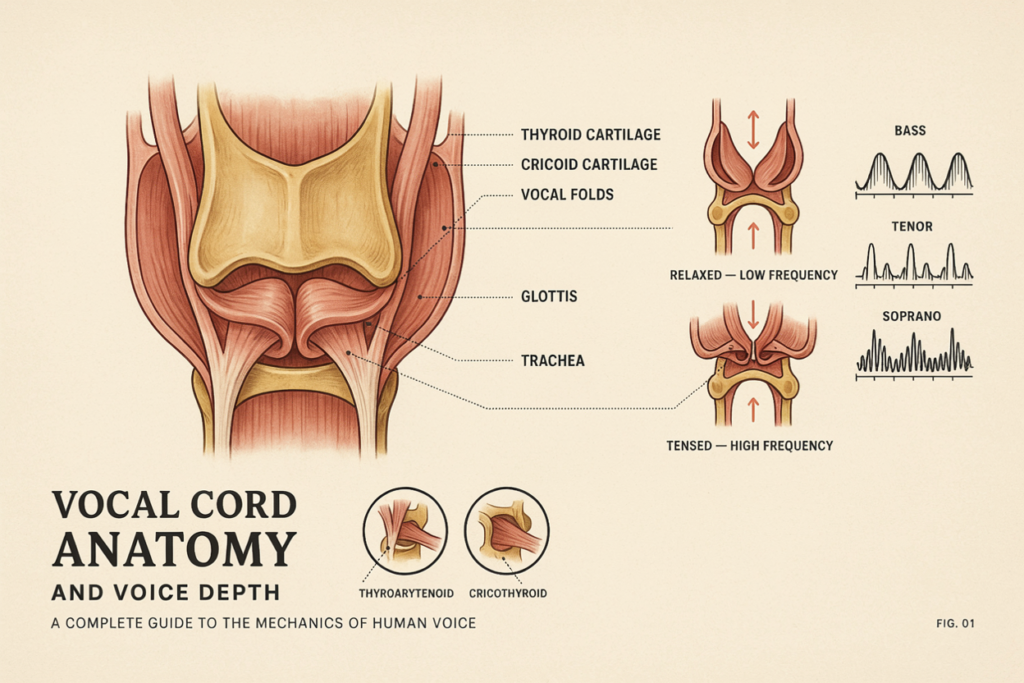
Your vocal folds—often called vocal cords—help determine voice depth through their length, thickness, vibrating mass, tension, and stiffness. Longer and thicker folds generally vibrate more slowly, producing a lower fundamental frequency, but anatomy isn’t the whole story. Muscle coordination and the shape of your vocal tract also affect how deep, dark, or full your voice sounds.
This explains why two people can speak at a similar pitch yet sound noticeably different. One may have stronger low-frequency resonance or lower formants, while the other sounds brighter. If you’re exploring what creates a naturally deep voice, it helps to separate the sound source in the larynx from the filter formed by the throat and mouth.
How Does Vocal Cord Anatomy Affect Voice Depth?
Vocal-fold anatomy sets the foundation for pitch. Longer folds with more vibrating mass generally oscillate fewer times per second, creating a lower fundamental frequency, or F0. Greater tension and stiffness usually raise F0.
Length, thickness, and vibrating mass
The vocal folds are paired bands of layered tissue within the larynx, or voice box. Cleveland Clinic gives approximate adult vocal-fold lengths of 1.75–2.5 centimeters for males and 1.25–1.75 centimeters for females. These are broad population ranges rather than diagnostic thresholds, and individuals vary considerably.
Human tissue is more complex than an instrument string. Only part of a vocal fold may vibrate at a given moment, and muscular adjustments change its effective mass, length, and stiffness.
A single number can’t capture an entire voice. A human voice frequency overview provides context for F0, harmonics, and speech’s wider frequency range.
Tension, stiffness, and vibration speed
Pitch isn’t fixed by fold size. The cricothyroid muscles lengthen and tense the folds, generally raising pitch. The thyroarytenoid muscles form much of the folds’ muscular body and can shorten, thicken, or stiffen them depending on how they contract and interact with other muscles.
That active control lets you vary pitch for speech and singing. Anatomy establishes limits and tendencies; neuromuscular coordination determines how the instrument is used.
What Parts of the Larynx Produce Your Voice?
The larynx turns airflow from the lungs into a buzzing sound through vocal-fold vibration. Cartilages position the folds, intrinsic laryngeal muscles adjust them, and layered tissue supports the flexible wave that makes phonation efficient.
True folds, false folds, and the glottis
The true vocal folds are the structures normally responsible for voiced sound. The glottis is the space between them. During breathing, the glottis opens; during ordinary phonation, the folds move close enough for airflow and tissue elasticity to sustain repeated opening and closing.
The false vocal folds sit above the true folds and usually don’t create ordinary voiced sound. Squeezing them can add roughness and effort, so gravel isn’t proof of a naturally low voice.
The cover, ligament, and muscular body
Each true fold has layered anatomy rather than a uniform cord-like structure. A pliable outer cover moves over deeper tissue, the vocal ligament contributes support, and the thyroarytenoid muscle forms the body. This organization permits the mucosal wave—a ripple that travels across the fold surface during healthy phonation.
Air pressure helps start vibration; tissue elasticity and aerodynamic forces maintain it. The resulting signal contains F0 plus harmonics at multiples of that frequency.
How Does Air Become a Deep-Sounding Voice?
The vocal folds establish the raw pitch and harmonic pattern, while the vocal tract filters that sound. A deep-sounding voice therefore depends on both source and filter: relatively slow fold vibration can lower F0, and the throat, mouth, and tongue shape resonance and formants.
Fundamental frequency versus perceived depth
Fundamental frequency is the rate at which a repeating vocal-fold vibration cycle occurs, measured in hertz. A frequency of 100 Hz means roughly 100 cycles per second. Lower F0 is usually perceived as lower pitch, but perceived depth also includes vocal weight, resonance, and spectral balance.
Formants are resonant frequency bands shaped by the vocal tract. They can make a voice seem larger or darker without a major F0 change. A voice frequency chart is therefore acoustic context, not a verdict about voice type.
How the vocal tract shapes the sound
After sound leaves the glottis, the pharynx, mouth, tongue, lips, and jaw alter which frequencies are reinforced or reduced. This is the filter side of the source–filter model.
Training may improve resonance efficiency and reduce constriction, but it doesn’t simply enlarge the throat or permanently lengthen the folds. Well-designed voice resonance exercises focus on an easy, clear sound rather than forcing the larynx downward.
Why Do Vocal Folds Change During Puberty and Aging?
Hormones and growth can change the larynx and vocal-fold tissue across life. During androgen-driven puberty, the larynx commonly grows and the folds become longer and thicker, often causing a substantial reduction in speaking F0. Aging can later alter muscle bulk, tissue flexibility, lubrication, and closure.
Puberty and hormone-related growth
Testosterone is associated with laryngeal growth during typical male puberty, though the degree varies. Voice breaks partly reflect the need to coordinate a changing instrument. The relationship between testosterone and voice deepening also depends on age, tissue responsiveness, dose, and anatomy.
Hormones aren’t a do-it-yourself voice treatment. Discuss potentially irreversible voice effects with a qualified clinician.
Changes across adulthood
Adult voices continue to change. Hormones, muscle loss, tissue elasticity, illness, medication, hydration, and use can affect phonation. Some voices become weaker or breathier; others sound rougher or lower.
A voice depth by age guide can show general patterns, but age alone can’t predict an individual’s pitch. Persistent hoarseness, pain, loss of range, or an unexplained change deserves assessment by an ear, nose, and throat physician or a voice-specialized speech-language pathologist.
Does Anatomy Completely Determine How Deep You Can Speak?
No. Anatomy influences your available pitch range, but speaking habit, language, emotion, hearing, posture, breath management, and muscular coordination influence the pitch you use day to day. Training can help you find a comfortable lower part of your existing range; it cannot safely guarantee permanent anatomical change.
Anatomical potential versus habitual pitch
Habitual speaking pitch is the region you repeatedly choose in conversation. Tension, learned patterns, and expressive style affect it. Pressing far below a comfortable range can create constriction and fatigue rather than a healthy deep tone.
An at-home check of your voice depth can estimate F0 under one recording condition, but microphone quality, background noise, vowels, and vocal effort affect results. A reading isn’t a medical test or a complete assessment of vocal health.
Myths and anatomical reality
| Claim | Reality | Anatomical explanation |
|---|---|---|
| Longer folds always mean a deep voice | Length creates a tendency, not a guaranteed sound | Tension, stiffness, vibrating mass, and vocal-tract filtering also matter |
| A large Adam’s apple proves someone has a low voice | External prominence is an unreliable predictor | Visible thyroid cartilage doesn’t reveal fold properties or muscular coordination |
| A bigger body always produces a deeper voice | Body size alone is not dependable | Laryngeal dimensions and vocal-tract proportions vary independently |
| Exercises permanently thicken the folds | Ordinary training mainly changes coordination and habit | Forcing extra mass through swelling is injury, not healthy development |
Safe practice shouldn’t hurt. Stop if lowering your voice causes soreness, persistent raspiness, or lost upper notes. Compare useful technique with warning signs in deep-voice health guidance.
Frequently Asked Questions
Are longer vocal cords always responsible for a deeper voice?
No. Longer vocal folds generally support slower vibration, but tension, stiffness, effective vibrating mass, and vocal-tract resonance also influence the result. Speaking habits can make someone use a pitch above or below the center of their comfortable range.
Do thicker vocal cords produce a lower pitch?
Greater vibrating mass generally favors a lower frequency when other variables are similar. Thickness alone doesn’t predict pitch because muscular activation can change which tissue participates in vibration and how stiff the folds become.
Does a larger Adam’s apple mean a deeper voice?
Not reliably. The Adam’s apple is the front prominence of the thyroid cartilage, and its visibility doesn’t directly measure vocal-fold length, mass, tension, or vocal-tract resonance.
Which muscle lowers the pitch of the voice?
There is no single pitch-lowering switch. The thyroarytenoid muscles can shorten and thicken the vocal folds, while reduced cricothyroid-driven lengthening may also favor lower pitch; coordinated action across several laryngeal muscles determines the outcome.
Can exercises permanently make the vocal folds thicker?
Healthy voice exercises don’t reliably create a permanent anatomical thickening of the vocal folds. Training can improve coordination, resonance, and access to comfortable lower pitches, while swelling caused by overuse is an injury risk rather than a useful adaptation.
Why can two people at the same pitch sound different?
Two voices sharing the same F0 can have different harmonic strengths, formant frequencies, breathiness, closure patterns, and vocal-tract shapes. Those differences change timbre—the perceived color or character of a sound—even when measured pitch is similar.

Williams is a vocal depth and voice analysis writer at Deep Voice Test. He focuses on deep voice analysis, vocal frequency testing, pitch detection, and voice classification tools for singers, creators, speakers, and voice enthusiasts.