
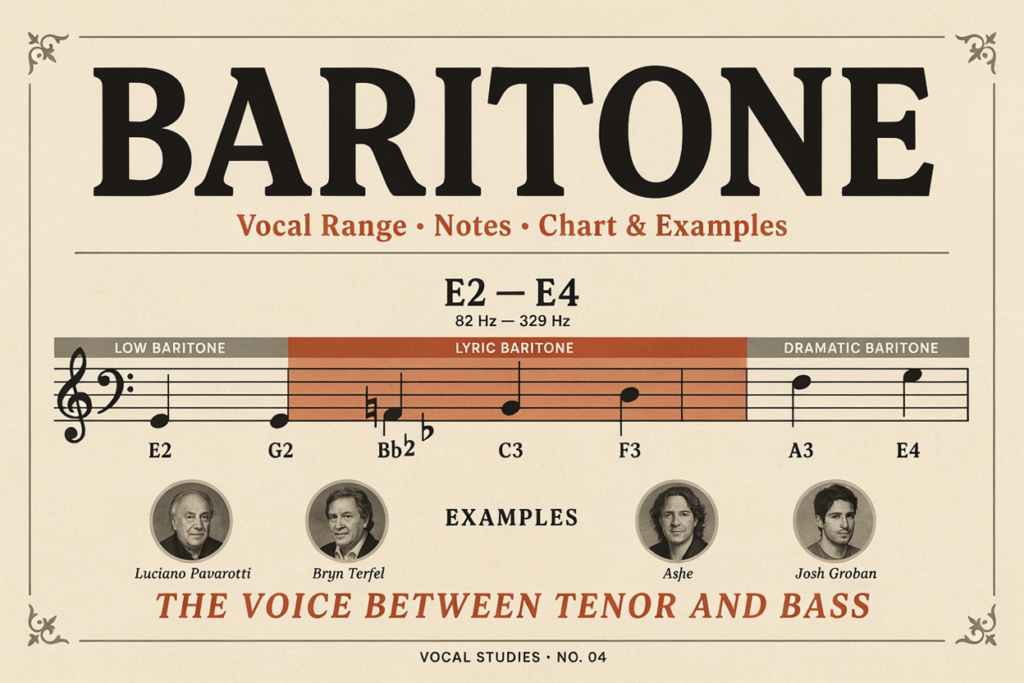
A typical baritone vocal range is A2 to A4, spanning two octaves. Some trained baritones sing beyond those limits, but voice type depends more on comfortable tessitura, tone, vocal weight, and register transitions than on extreme notes.
Baritone is the middle male voice category, between tenor and bass. Because the types overlap, one extreme note cannot classify your voice. A chart of typical male voice types provides context for the ranges below.
What Is the Typical Baritone Vocal Range?
The commonly cited range is A2–A4 in scientific pitch notation. Middle C is C4, so A2 lies below the bass clef staff, while A4 is above middle C. Boundaries vary with the singer, training, and subtype.
Baritone notes on the piano
On an 88-key piano, A2 has a fundamental frequency of 110 Hz and A4 has a fundamental frequency of 440 Hz in standard equal temperament. These figures describe pitch, not the voice’s full frequency content; a sung note also contains harmonics that help create its recognizable color.
Extended range versus reliable range
A total range includes any pitch briefly produced. A usable range includes repeatable notes with stable pitch and clear tone. A performance-ready range is narrower: notes must remain reliable in musical phrases.
A baritone might touch F2 and reach B4 in a light head-dominant coordination without making either note dependable in repertoire. This explains why published ranges for well-known baritone singers may look wider than their classified range.
How Does a Baritone Compare With a Tenor and Bass?
A baritone generally sings lower than a tenor and higher than a bass, but their ranges overlap substantially. The practical difference is where each voice sounds and feels most comfortable, not an uncrossable boundary between sets of notes.
| Voice type | Approximate classical range | Relative tessitura | Typical tonal tendency |
|---|---|---|---|
| Tenor | C3–C5 | Highest of the three | Brighter, lighter, or ringing |
| Baritone | A2–A4 | Middle | Warm, substantial, balanced |
| Bass | E2–E4 | Lowest of the three | Darker, heavier, or weightier |
These are reference ranges rather than diagnostic limits. Repertoire, vocal tradition, and individual anatomy can shift the practical boundaries. A detailed comparison of baritone and tenor voices shows why singers with many shared notes can still require different keys and roles.
Where the three ranges overlap
C4 can be sung by all three types. It may feel lower for a tenor, central for a baritone, and relatively high for a bass. Likewise, a baritone who reaches C5 once has not necessarily become a tenor; the test is whether the surrounding tessitura remains sustainable. The same principle separates a low baritone from a bass, as this bass and baritone range comparison illustrates.
Why the same note sounds different
Timbre is the perceived color or quality of a voice. It is shaped by the vocal folds, vocal tract, resonance, intensity, and distribution of harmonics. Vocal weight refers to the impression of lightness or substance in the sound, not the singer’s body weight.
A lyric baritone may sound bright and flexible, while a dramatic baritone may sound denser. Neither can be identified reliably from range alone.
What Determines Whether You Are a Baritone?
You are more likely to be a baritone when the middle male tessitura feels sustainable, your tone retains characteristic weight there, and your register transitions occur in a baritone-like area. Classification should combine range, tessitura, timbre, vocal weight, passaggio, and the demands of actual songs.
Tessitura matters more than your lowest note
Tessitura is the zone in which your voice can sing comfortably for extended periods. Suppose two singers both produce G2–B4. One feels most at ease from C3 to G4, while the other thrives from E3 to B4. The first may function as a baritone and the second as a tenor despite their matching extreme notes.
Mark each tested pitch as touched, repeatable, or performance-ready, noting where the tone becomes breathy, pressed, or unstable. Browser-based checks and keyboard tests provide estimates; a teacher can assess vocal function in context.
Timbre, vocal weight, and passaggio
Passaggio means a transition region where the voice must gradually adjust resonance and registration. Vocal pedagogue Richard Miller commonly places the two principal transitions for many lyric and dramatic baritones around B3 and E4, although individual voices and classification systems vary.
Upper baritone singing usually requires coordination rather than simply carrying a heavy chest-dominant sound upward. Understanding the functional differences between chest voice and head voice can help explain why a healthy upper note may feel different without becoming weak or disconnected.
What Are the Main Types of Baritone Voices?
Classical singing divides baritones into subtypes according to range, tessitura, weight, color, agility, and suitable roles. Common labels include lyric baritone, dramatic baritone, Verdi baritone, and bass-baritone, but these operatic categories do not map neatly onto every pop, rock, or musical-theatre singer.
Lyric, dramatic, and Verdi baritones
A lyric baritone usually has a smoother, lighter, more flexible quality suited to lyrical lines. A dramatic baritone generally carries greater vocal weight and intensity. Verdi baritone describes a demanding operatic specialization associated with Giuseppe Verdi’s roles, which often require a strong upper range, dramatic authority, and endurance.
Bass-baritone and related classifications
A bass-baritone combines baritone-like strength in the upper range with greater access to lower notes and a darker tonal profile. Its relationship with bass can be subtle, because repertoire and comfortable tessitura matter as much as the bottom note. A focused baritone versus bass guide explains those practical distinctions beyond the overlapping pitch chart.
Contemporary genres use labels more loosely. Microphones, key changes, and stylistic effects let singers perform outside traditional operatic expectations.
How Can You Test Your Baritone Range Safely?
Test a possible baritone range by warming up, matching pitches in semitone steps, and recording only notes produced comfortably and repeatedly. Stop if you feel pain, burning, persistent tightness, or increasing hoarseness; range testing should never require shouting or forcing the larynx downward.
- Warm up with gentle humming, lip trills, or comfortable five-note patterns.
- Begin near the middle of your speaking and singing range rather than at an extreme.
- Descend by semitones and record the lowest clear, stable note you can repeat.
- Return to the middle, then ascend by semitones without pushing chest voice upward.
- Repeat the test on several days and identify the notes that remain consistent.
- Sing short phrases across the middle to estimate your tessitura, not just your endpoints.
Use moderate volume and a comfortable vowel. Artificially darkening the sound can create an unstable low, while yelling can produce a misleading high. For context, review the bass range and its practical limits rather than assuming every note below A2 belongs exclusively to basses.
Can a Baritone Extend His Vocal Range?
A baritone can often expand his usable range through consistent technique, but training does not necessarily change his underlying voice type. Progress usually comes from improving coordination, breath management, resonance, and register balance so existing edge notes become more stable.
For upper notes, use gradual scales rather than forcing a speech-heavy chest quality higher. For lows, maintain easy airflow instead of pressing or adding vocal fry merely to claim another pitch. Measure growth over months, and consult a teacher or voice-specialized clinician for recurring hoarseness, pain, or sudden range loss.
Frequently Asked Questions
Is C2 considered a baritone note?
C2 is below the standard A2–A4 baritone reference range and is more commonly associated with a very low bass extension. A baritone may produce C2 through vocal fry or an unusually low extension, but one note does not redefine the voice type.
Can a baritone sing tenor notes?
Yes. Baritone and tenor ranges overlap, and a trained baritone may sing several pitches commonly found in tenor music. Classification depends on where those notes sit in relation to the singer’s tessitura, passaggio, tone, and endurance; the standard tenor range reference helps show how much overlap exists.
Is G2 to G4 a baritone range?
G2–G4 is compatible with a baritone, especially if the voice is comfortable through the middle and has baritone-like register transitions. It may also describe an incompletely developed range, so tessitura and vocal quality should be assessed before choosing a classification.
What is the most comfortable range for a baritone?
There is no universal comfortable range for every baritone. Many baritones feel strongest through the central portion of A2–A4 rather than at either endpoint, but the exact tessitura changes with subtype, training, age, and repertoire.
Can a woman have a baritone vocal range?
A woman can sing pitches that overlap the baritone range, particularly with a naturally low voice or an extended lower register. In conventional classical classification, however, baritone refers to a male voice category; a low adult female voice is generally classified by its own tessitura, timbre, and register behavior rather than renamed baritone.

Williams is a vocal depth and voice analysis writer at Deep Voice Test. He focuses on deep voice analysis, vocal frequency testing, pitch detection, and voice classification tools for singers, creators, speakers, and voice enthusiasts.