
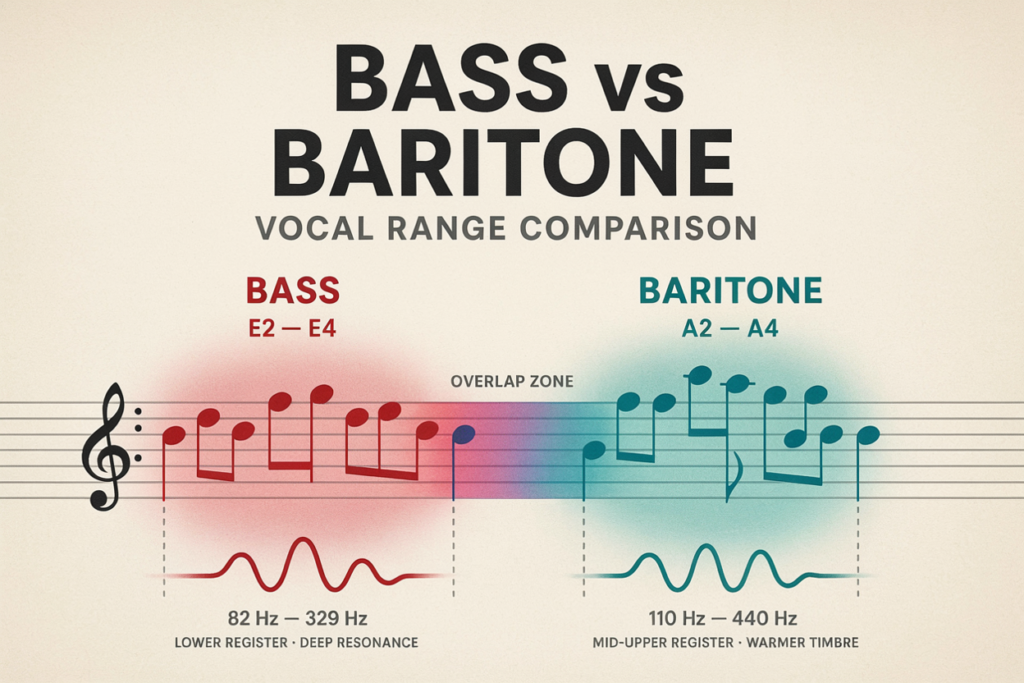
A bass typically has a reference range of about E2 to E4, while a baritone commonly spans about G2 to G4. These ranges overlap, so the decisive difference is not the lowest note a singer can touch. Tessitura, timbre, vocal weight, register transitions, and the ability to repeat notes comfortably provide much stronger evidence.
Bass is the lowest standard male classical voice type. Baritone sits between bass and tenor and generally has easier access to higher notes than a bass. If you are comparing your own voice, use a male voice range reference as a starting point rather than a final diagnosis.
| Feature | Bass | Baritone |
|---|---|---|
| Common reference range | About E2–E4 | About G2–G4 |
| Typical strength | Low register | Lower-middle and middle register |
| General tone | Dark, weighty, resonant | Warm, full, often more flexible above the staff |
| Upper range | Usually requires earlier register adjustment | Often remains comfortable higher |
| Common choir placement | Often Bass 2 | Often Bass 1, sometimes Bass 2 |
| Frequent mistake | Being labeled bass for one low note | Being labeled tenor because of a few high notes |
The figures are conventions, not biological borders. Repertoire, style, age, and training can shift the useful range expected from a singer.
What Is a Typical Bass Range?
A commonly cited bass singing range is E2 to E4. Some basses sing below E2, while trained voices may extend above E4. A true bass normally does more than produce low pitches: the lower register carries usable volume, stable tone, and enough resonance to function in music.
A basso profondo is exceptionally low and heavy, while a basso cantante has more upper-range mobility. The broad bass label describes function, not a rigid two-octave box.
What Is a Typical Baritone Range?
A common baritone range reference is G2 to G4. Some baritones have reliable notes below G2, and many trained baritones sing above G4 depending on style and technique.
The baritone’s center of gravity sits higher than the bass’s. Its middle register often sounds substantial, but the voice can negotiate upper phrases with less heaviness. Baritone subtypes place different demands on weight, color, and upper extension.
How Do Bass and Baritone Voices Sound Different?
Bass voices generally sound lower, darker, and heavier, while baritones usually sound warmer through the middle and more comfortable at higher pitches. Tone alone cannot classify a voice, but tone combined with tessitura and register behavior can reveal where it naturally belongs.
Tessitura Matters More Than Extreme Notes
Tessitura is the pitch area where you can sing repeatedly with a stable, resonant tone and manageable effort. It is more useful than total range because songs and roles keep a singer in a region for many phrases; they rarely consist of one isolated lowest or highest note.
A baritone may touch E2 early in the morning or with vocal fry yet struggle to project it. That does not necessarily make the singer a bass. Conversely, a bass may reach G4 during an exercise but lack the comfort to sustain baritone repertoire around F4 and G4.
Timbre and Vocal Weight Add Context
Timbre is the characteristic color of a sound, while vocal weight describes its perceived lightness or heaviness. A bass voice profile commonly has substantial low-frequency energy and a dense quality. A baritone may still sound dark, but its resonance often remains more balanced and mobile in the upper-middle register.
These qualities are relative. A dark baritone can sound lower than a light bass in conversation. Classification should reflect sustainable singing function rather than one recording.
Passaggio Shows How the Registers Behave
Passaggio refers to the transition zones where a singer must adjust resonance and coordination while moving between registers. These transitions generally occur lower in bass voices than in baritones, although exact pitches vary by singer and pedagogical system.
A teacher may listen for where the voice resists, spreads, lightens, or requires a vowel adjustment. Passaggio evidence is useful when it agrees with tessitura, tone, and repertoire.
Are You a Bass or a Baritone?
To estimate whether you are a bass or baritone, identify the notes you can sing clearly, then observe where your voice remains comfortable across complete phrases. Repeat the check on several days and judge tone, effort, and consistency—not just the displayed lowest pitch.
Test Usable Notes, Not Vocal Fry
Warm up gently, then descend by semitones on a comfortable vowel. Count a note only if it has a clear pitch, steady airflow, and enough volume to sing in context. A creaky sound with irregular vibration may be vocal fry rather than a usable sung note.
Next, ascend without shouting, pressing, or dragging heavy chest voice upward. An at-home or browser-based range check is an estimate because the microphone, background noise, vowel, and detection errors can affect the result.
Use Complete Phrases and Repertoire
Sing short passages that sit low, then passages that remain in the upper-middle range. If E2 to F2 is full and repeatable while sustained notes near E4 demand careful management, bass repertoire may fit better. If low G2 is reliable and phrases around E4 to G4 remain freer, baritone may be more plausible.
Songs chosen for developing a lower singing voice should let you evaluate resonance without forcing the larynx down. Transposing a song is sensible during exploration; it does not change your underlying voice type.
Get a Trained Evaluation When It Matters
Self-testing can narrow the possibilities, but a qualified voice teacher can hear coordination patterns that a pitch meter cannot. Classification is especially important before choosing demanding classical repertoire, where an unsuitable tessitura can encourage fatigue and inefficient technique.
Young singers should avoid rushing into a permanent label. Voices continue developing, and technique may expand usable range without changing the underlying category.
What Is a Bass-Baritone?
A bass-baritone is a voice that combines bass-like depth and weight with more upper-range facility than many true basses. It occupies the functional territory between bass and baritone, so it is not simply an indecisive label for anyone with a wide range.
A bass-baritone may have strong low notes and a dark color yet handle upper phrases more comfortably than a low bass. Repertoire often determines whether a singer is described as bass-baritone, dramatic baritone, or high bass. A baritone and tenor comparison likewise needs more than note endpoints because neighboring types overlap.
Does Bass 1 or Bass 2 Reveal Your Voice Type?
Bass 1 and Bass 2 describe choral assignments, not definitive solo voice classifications. Bass 1 usually takes the higher part when the bass section divides, while Bass 2 carries the lower line. A baritone can therefore sing Bass 1, and a bass may be assigned wherever the ensemble needs balance.
Choral placement depends on the score, available singers, blend, and the conductor’s priorities. It may show comfortable range, but it does not establish classical fach, the system used to match voices with operatic repertoire.
Listening to accomplished singers known for bass roles and well-known baritone performers can help you notice differences in weight and tessitura. Do not imitate another singer’s darkness by depressing the larynx or manufacturing a hollow tone.
Frequently Asked Questions
Is a bass voice lower than a baritone?
Yes. Bass is the lowest standard male classical voice type, while baritone sits above bass and below tenor. Their ranges overlap, but a bass generally has greater comfort, resonance, and projection in the low register.
Can a baritone sing bass notes?
Many baritones can sing pitches associated with bass range, especially around E2 to G2. The classification depends on whether those notes are clear and sustainable and where the rest of the voice works comfortably.
Does reaching E2 mean I am a bass?
No. A single E2 may be quiet, inconsistent, or produced with vocal fry. Bass classification requires a functional low register plus supporting evidence from tessitura, timbre, vocal weight, passaggio, and repertoire.
What is the difference between a bass-baritone and a baritone?
A bass-baritone usually has more low-register authority and darker weight than a standard baritone while retaining useful upper-range ability. The boundary varies with repertoire, so a teacher may classify the same mature singer differently in different musical contexts.
Can a baritone sing in the Bass 1 choir section?
Yes. Bass 1 frequently suits baritones because it is the higher divided bass part. Choir assignment reflects the needs of an ensemble and does not necessarily match a singer’s solo classical classification.
Can vocal training turn a baritone into a bass?
Training can improve low-note coordination, resonance, and usable range, but it does not normally transform a baritone’s underlying anatomy into a true bass voice. Healthy training reveals and develops the instrument rather than forcing it into a lower category.

Williams is a vocal depth and voice analysis writer at Deep Voice Test. He focuses on deep voice analysis, vocal frequency testing, pitch detection, and voice classification tools for singers, creators, speakers, and voice enthusiasts.