
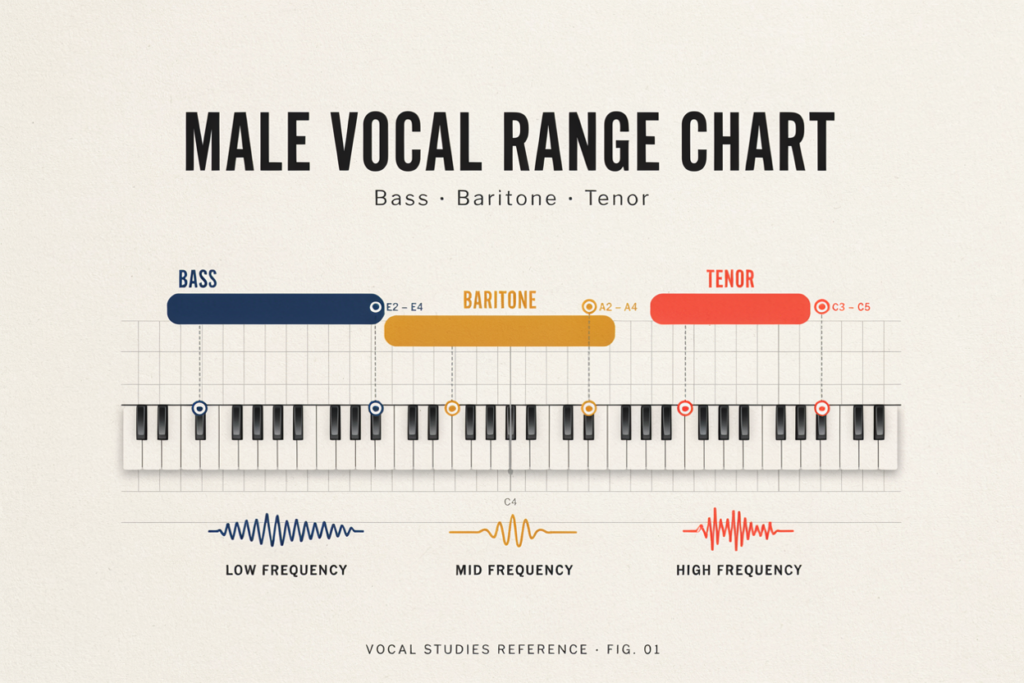
Male voices include countertenor, tenor, baritone, and bass, from highest to lowest. A male vocal range chart places them around E3–E5, C3–C5, A2–A4, and E2–E4. These ranges overlap, so your highest and lowest notes cannot reliably identify your voice type.
The more useful clue is your tessitura—the part of your range where you sing with comfort and control. Timbre, vocal weight, register transitions, and repertoire also affect classification.
Male Vocal Range Chart: What Are the Typical Ranges?
Typical classical male ranges extend from about E2 for a bass to E5 for a countertenor. The table below combines conventional note boundaries with approximate frequencies in 12-tone equal temperament, using A4 = 440 Hz.
| Male voice type | Approximate range | Approximate frequency span | General position | Important caution |
|---|---|---|---|---|
| Countertenor | E3–E5 | 164.8–659.3 Hz | Highest | Often uses a developed upper register; technique varies |
| Tenor | C3–C5 | 130.8–523.3 Hz | High | A singer who reaches C5 is not automatically a tenor |
| Baritone | A2–A4 | 110.0–440.0 Hz | Middle | Boundaries vary considerably by style and repertoire |
| Bass | E2–E4 | 82.4–329.6 Hz | Lowest | A single low E2 does not establish bass tessitura |
These are reference points rather than entry requirements. OperaVision gives these approximate countertenor, tenor, and baritone ranges while emphasizing tessitura in classification. Other sources may shift either boundary by several notes.
If you are comparing a measured result with the table, first learn how a tenor voice is classified rather than treating C3 or C5 as a pass-or-fail boundary.
Countertenor range
A countertenor commonly sings around E3–E5. Many use a coordinated head-dominant or falsetto-based production, although technique differs among singers.
Tenor range
A tenor’s conventional range is about C3–C5. The voice usually has a higher comfortable center than a baritone, but the label also depends on passaggi—the transition areas where registration adjustments become necessary. A detailed tenor note-range guide puts individual notes in context.
Baritone range
The conventional baritone span is roughly A2–A4. Baritones often have a comfortable middle register and greater vocal weight than tenors, though lighter baritones can overlap extensively with them.
Bass range
A typical bass range is E2–E4. Classification requires more than touching low notes: the lower register should remain resonant and usable. The usual bass singing range explains why low-note access and bass tessitura differ.
How Do Male Vocal Ranges Overlap?
Male vocal ranges overlap because voice categories describe how a voice functions, not exclusive sets of notes. A tenor, baritone, and bass may all sing E3, G3, or C4; what differs is the effort, tonal quality, and role those notes occupy within each voice.
Range versus tessitura
Range is the distance between your lowest and highest notes. Tessitura is where you can sustain phrases comfortably. Your performance range is narrower still, containing notes you can use with stable pitch, tone, and diction in music.
| Measurement | What it tells you | What it does not prove |
| Total range | The outer notes you can currently produce | Your voice type or endurance |
| Comfortable tessitura | Where singing feels efficient across phrases | Every role or song that will suit you |
| Performance range | Notes reliable enough for repertoire | Your permanent anatomical limit |
This distinction explains why two people with identical endpoints can belong to different categories. The overlap becomes especially clear when comparing bass and baritone ranges.
Timbre, vocal weight, and passaggio
Timbre is the perceived color of sound; vocal weight is its sense of lightness or fullness. Teachers also listen for passaggi and changes in registration.
Consider two singers who can both produce A2–A4. Singer A is comfortable from C3 to F4, with a lighter tone and free upper transitions. Singer B prefers A2 to D4, has a heavier sound, and loses consistency above E4. Their endpoints match, but Singer A may be a baritone with upper extension while Singer B may lean toward bass-baritone territory.
How Can You Find Your Male Vocal Range?
You can estimate your male vocal range by warming up, matching notes on a reliable instrument, and recording the lowest and highest notes that remain comfortable and controlled. Do not count squeezed lows, shouted highs, or brief sounds that you could not repeat in a phrase.
- Warm up gently for five to ten minutes with lip trills, humming, or light slides.
- Start near a comfortable middle note and descend by semitones on an easy vowel. Stop when tone or pitch becomes unstable.
- Return to the middle and ascend by semitones without raising volume or tightening your throat. Record the highest comfortable modal note separately from falsetto.
- Sing short scales and simple phrases in different keys to locate the zone that remains easiest for several minutes.
- Compare your total range and tessitura with the chart, then repeat the check on another day.
Modal voice is used for ordinary speech and much chest-dominant singing. Falsetto is a lighter upper production; mixing the two without labels makes comparisons misleading. The distinction between head voice and chest voice helps when recording upper notes.
An at-home check is an estimate, not a professional classification. Room noise, octave errors, fatigue, and technique can affect the result.
Are You a Tenor, Baritone, or Bass?
You are more likely to be a tenor if your comfortable center sits higher and upper notes remain efficient; a baritone if the middle register is strongest; or a bass if low notes are consistently full and the comfortable center sits lower. No single note decides the category.
As a practical example, a singer who reaches C3–A4 but prefers D3–F4 may fit baritone better than tenor. Another singer with the same endpoints who sings comfortably from E3–G4 and manages tenor passaggi efficiently may be a developing tenor. The baritone-versus-tenor comparison shows why shared notes do not mean shared vocal function.
Classification is most reliable after a teacher hears scales, sustained vowels, registration changes, and repertoire. Choir placement may differ from a solo label because a director is assigning a part, not a permanent voice type.
Why Do Male Vocal Range Charts Show Different Notes?
Charts disagree because they may describe classical solo roles, choral parts, contemporary songs, trained singers, or absolute physical extremes. A chart is only meaningful when you know which of these it represents.
Classical roles versus choral parts
Opera classification considers tessitura, passaggio, projection, timbre, and the orchestral demands of a role. Choral labels are more functional: a singer may be assigned Tenor 2 or Bass 1 because that part fits the ensemble, even if his solo classification is baritone.
Trained range versus current usable range
Training can improve coordination and consistency, making more of an existing range usable. It does not guarantee that a baritone will become a tenor or that a tenor will become a true bass. For low notes, consult a focused baritone range reference rather than forcing a lower category.
Age and puberty also matter. Adolescent voices may change rapidly, while illness, swelling, dehydration, or fatigue can temporarily reduce range. Pain, persistent hoarseness, or sudden unexplained loss of notes is a reason to stop testing and consult a qualified voice professional or clinician.
Frequently Asked Questions
What is the average vocal range for a male singer?
Many untrained male singers can access roughly one and a half to two octaves, but no universal average identifies voice type. Tessitura matters more than raw octave count.
Is C3–C5 a tenor range?
C3–C5 is a conventional tenor reference range. A singer who can touch both notes may still be a baritone if his comfortable center, timbre, weight, and register transitions fit baritone more closely.
Can a baritone sing tenor notes?
Yes. Baritones and tenors share many notes, and a trained baritone may sing pitches found in tenor repertoire. Whether those notes remain comfortable across sustained phrases and repeated performances is the more useful question.
Is falsetto included when measuring male vocal range?
Falsetto can be included in a total vocal range if it is recorded separately. For traditional tenor, baritone, or bass classification, teachers usually examine the modal range, tessitura, and register behavior rather than combining every sound into one span.
What is the rarest male voice type?
Countertenor and very low bass categories are often described as uncommon, but dependable population percentages are not available across styles and cultures. Rarity claims also change depending on whether the term describes anatomy, technique, choral assignment, or professional classical classification.
How many octaves should a male singer be able to sing?
There is no required octave count. Two controlled octaves can be musically useful, while a wider range is not automatically better if its outer notes are strained or inconsistent. When checking your span, follow a careful voice-range testing process and prioritize healthy, repeatable sound.

Williams is a vocal depth and voice analysis writer at Deep Voice Test. He focuses on deep voice analysis, vocal frequency testing, pitch detection, and voice classification tools for singers, creators, speakers, and voice enthusiasts.