
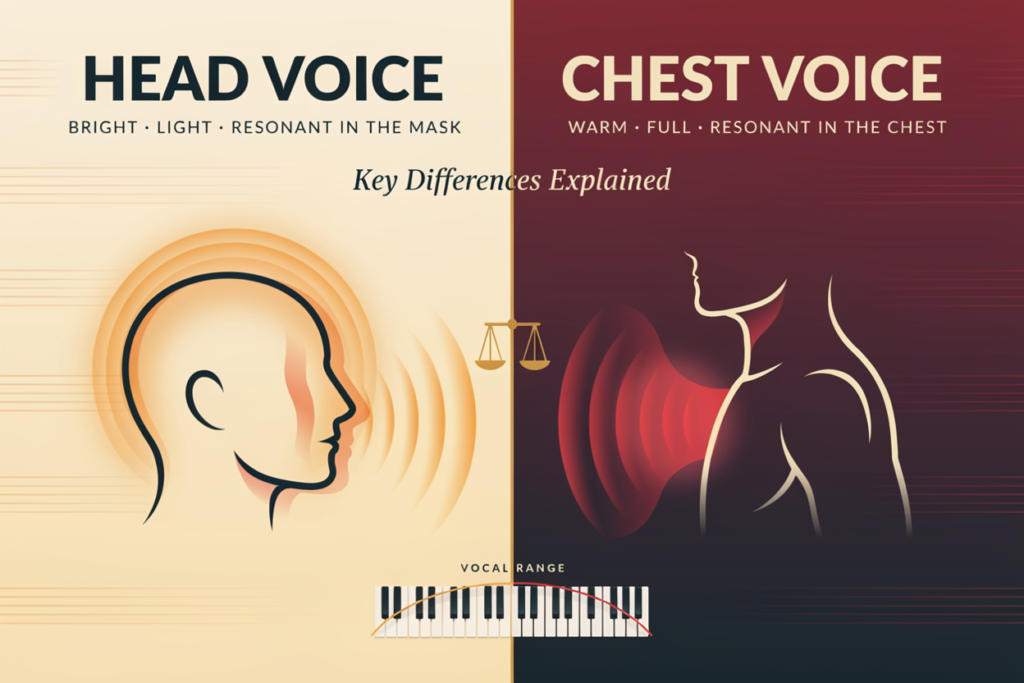
Head voice and chest voice are two contrasting ways of coordinating the singing voice. Chest voice generally sounds fuller and speech-like and is most comfortable at lower pitches, while head voice feels lighter, more flexible, and better suited to higher notes. Both sounds begin at the vocal folds in the larynx; they are not literally produced in your chest or head.
Understanding head voice vs chest voice can help you sing wider without shouting or flipping. Learn how each coordination behaves and how to move between them efficiently.
Head Voice vs Chest Voice: What Is the Difference?
Chest voice uses a relatively heavier vocal-fold coordination associated with speaking, whereas head voice uses a lighter coordination that allows the folds to vibrate efficiently at higher pitches. Singers also distinguish them by tone, intensity, flexibility, and the sensations created by resonance.
The National Association of Teachers of Singing calls chest register mode 1 and describes greater thyroarytenoid-dominant activity. The folds are shorter and thicker than in lighter mode 2. This guide to how the vocal folds shape voice depth explains how fold length, thickness, tension, and airflow interact.
| Feature | Chest voice | Head voice |
|---|---|---|
| Typical pitch area | Lower to middle range | Middle to upper range |
| Perceived sound | Full, direct, speech-like | Lighter, ringing, flexible |
| Vocal-fold behavior | Relatively thicker, heavier coordination | Relatively thinner, more elongated coordination |
| Common sensation | Vibration near the chest or mouth | Vibration near the face or head |
| Dynamic tendency | Strong at conversational and louder levels | Efficient for sustained and agile high notes |
| Common uses | Speech, low melodies, powerful phrases | High melodies, classical upper range, lighter passages |
These are tendencies, not rigid rules. Chest voice can be soft, head voice can be powerful, and pitch boundaries differ by singer, vowel, and volume.
What chest voice sounds and feels like
Chest voice resembles the coordination used when you speak clearly. It often has firm vocal-fold closure and a solid tone. Contemporary singers may carry a chest-dominant quality upward, but the vowel, airflow, and vocal weight must adjust; dragging an unchanged speaking coordination higher commonly produces tightness.
What head voice sounds and feels like
Head voice sounds lighter and makes higher pitches easier. Some singers feel buzzing around the face or head, but sensations vary and are not anatomical proof. Balanced closure and efficient voice resonance exercises can produce a clear upper register without excess breath or pressure.
Are Head Voice and Chest Voice Produced in Different Places?
No. Both chest voice and head voice originate when air from the lungs sets the vocal folds into vibration inside the larynx. The vocal tract above the folds then filters that sound, while vibrations transmitted through tissue and bone create sensations in the chest, mouth, face, or skull.
Why singers feel vibrations in the chest or face
Lower sounds may create noticeable vibration in the chest, while brighter sounds may feel concentrated around the face. Use sensation as feedback, but judge technique by a stable tone, free breathing, and the absence of pain.
Register coordination versus resonance
Register describes vocal-fold vibration patterns. Resonance describes how the vocal tract shapes the sound. They interact but are not interchangeable; a singer can change a vowel or resonance strategy while remaining in the same register.
This distinction also matters when learning how to sing with a deeper tone. Darkening resonance does not automatically turn head voice into chest voice, just as lowering the pitch does not guarantee a healthy, full coordination.
How Can You Tell Whether You’re Singing in Head Voice or Chest Voice?
Chest voice usually connects easily to speech, while head voice makes upper pitches easier. Because sensations alone are unreliable, compare these tests at a comfortable volume.
Try a speech-to-song test
Say “hey” clearly, sustain it on a nearby pitch, then move through three or five notes without getting louder. The connected quality demonstrates chest voice. Stop ascending when it feels pressed.
Try a descending “woo”
Begin on an easy high note with a gentle “woo” and slide downward. A light, clear sound that descends freely usually introduces head-voice coordination. Notice where it becomes fuller.
Use a siren to hear the shift
Glide from low to high on “ng,” a lip trill, or “woo.” A jump, volume change, or loss of closure can reveal a register break. A male range reference or female range reference provides context, but no chart predicts your exact passaggio.
What Is the Difference Between Head Voice and Falsetto?
Head voice and falsetto are sometimes used interchangeably, but many teachers distinguish them by tone and vocal-fold closure. In that teaching model, head voice is clearer and more connected, while falsetto is breathier and less able to build intensity. Other voice models group both under mode 2, so the label depends on the pedagogical system.
The audible result matters more than the label. A light upper note that is steady, clear, responsive, and comfortable can be developed. Avoid squeezing to make a breathy tone stronger.
What Is Mixed Voice?
Mixed voice combines chest-like strength with head-like ease; it is not a third sound-producing location. The folds gradually reduce weight while resonance adjustments preserve clarity through the passaggio.
Chest-dominant and head-dominant mix
A chest-dominant mix retains speech-like density; a head-dominant mix feels lighter. Both are flexible balances rather than fixed switches.
Why mix helps across the passaggio
A crack often occurs when coordination changes suddenly. Mixing encourages smaller changes across several notes. These breathing strategies for a steadier voice can help you avoid blasting extra air at the transition.
How Do You Transition From Chest Voice to Head Voice Smoothly?
A smooth transition requires less vocal weight as pitch rises, steady airflow, and subtle vowel adjustments. Practice quietly before adding volume.
- Begin with two minutes of gentle humming, lip trills, or comfortable slides. Release the jaw and keep the tongue relaxed.
- Choose a moderate pitch and volume. Sing a five-note scale on “mum” or “noo” without trying to sound large.
- Slide through the transition on a lip trill or through a straw. A semi-occluded exercise narrows the exit of the vocal tract and can help the folds vibrate with less collision.
- As you ascend, let the tone become slightly lighter. Do not preserve the exact weight and vowel shape used on the lowest note.
- Repeat the pattern on a narrow vowel such as “oo,” then transfer it to the lyric. Add brightness or intensity only while the throat remains comfortable.
Record the same short scale weekly. Progress should sound even and feel easier, not merely louder. Seek qualified help if coordination remains difficult.
Should You Sing High Notes in Chest Voice or Head Voice?
Most high notes need reduced chest weight, but the balance depends on style, pitch, and vowel. Classical singers commonly favor head-dominant coordination, while pop and musical-theatre singers may use a stronger mix. Forcing unchanged chest voice upward is not healthy belting.
A tenor and a bass may adjust the same note differently because their tessituras and transitions differ. A typical tenor’s usable range illustrates why pitch alone does not dictate registration.
What Mistakes Make the Vocal Break Worse?
Excess chest weight, more air at the break, spread vowels, and extra volume can make the transition harsher. Deliberately breathy head voice may remain disconnected and difficult to strengthen.
Pain, burning, voice loss, or persistent hoarseness is not productive. Stop and rest. If symptoms continue, follow vocal-health guidance for deep and low voices and see a laryngologist or voice-specialized speech-language pathologist.
Frequently Asked Questions
Is head voice higher than chest voice?
Head voice is generally used higher because lighter coordination supports rising pitch efficiently. The ranges overlap, and no single note makes every singer change registers.
Is head voice the same as falsetto?
Not in every teaching system. Some teachers separate connected head voice from breathier falsetto; others group both within mode 2. Ask what quality either term describes.
Can you sing high notes in chest voice safely?
Some singers carry a chest-dominant quality high, but coordination must adjust as pitch rises. Neck tension, shouting, or throat pain signals an unsustainable approach.
Why does my voice crack between chest and head voice?
A crack often happens when vocal weight, airflow, or resonance changes abruptly. Gentle slides, lip trills, and lower volume encourage a gradual transition.
Does everyone have both chest voice and head voice?
Most people can access heavier and lighter vocal-fold patterns, although one may feel unfamiliar. Training improves coordination, but sound and range vary individually.
How long does it take to develop a smooth mixed voice?
There is no fixed timeline. Improvement may appear within weeks, while reliable coordination in songs can take months. Short, regular practice beats occasional strenuous sessions.

Williams is a vocal depth and voice analysis writer at Deep Voice Test. He focuses on deep voice analysis, vocal frequency testing, pitch detection, and voice classification tools for singers, creators, speakers, and voice enthusiasts.