
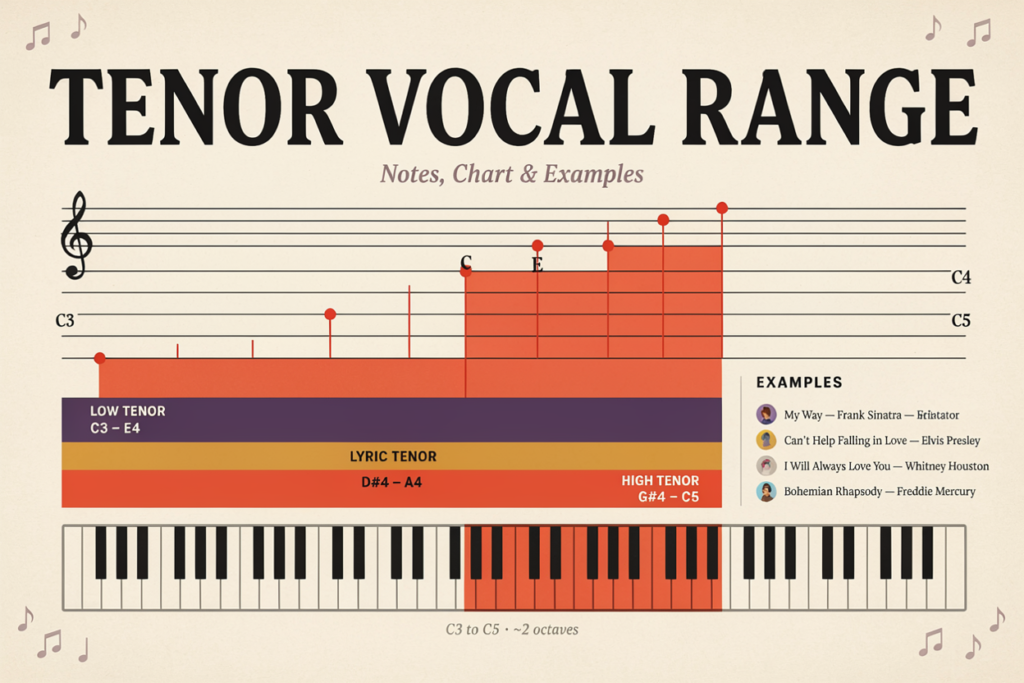
A typical classical tenor vocal range runs from C3 to C5, or roughly 130.8 to 523.3 Hz in A4 = 440 Hz tuning. That two-octave span is a reference, not a strict boundary: a tenor may sing below C3 or above C5, and voice type depends more on comfortable tessitura, tone, register balance, and passaggi than on two extreme notes.
Before comparing yourself with a chart, separate the notes you can touch from the notes you can repeat with a clear, stable tone. A broader chart of standard male voice categories can show where tenor sits, but it can’t classify your voice on its own.
What Is the Typical Tenor Vocal Range?
The commonly cited operatic tenor range is approximately C3–C5. C3 is the C one octave below middle C, while C5 is the C one octave above middle C. In scientific pitch notation, middle C is C4.
| Reference point | Note | Approximate frequency | What it represents |
|---|---|---|---|
| Lower boundary | C3 | 130.8 Hz | A common low endpoint in tenor references |
| Middle C | C4 | 261.6 Hz | A useful keyboard landmark |
| Upper boundary | C5 | 523.3 Hz | The operatic “high C” reference |
These figures describe each note’s fundamental frequency, not speaking pitch or the overtones that shape vocal color. See how human voice frequencies and harmonics relate to musical pitch.
Where C3 and C5 sit on a piano
On a piano, C3 lies below middle C and C5 lies above it. Singing from C3 through C4 to C5 covers two octaves. Tenor melodies often spend more time between those endpoints.
Why C3–C5 is only approximate
Voice categories overlap. A tenor may have a usable B2, while a baritone may reach C5 under certain conditions. Neither note changes the singer’s voice type automatically. The important question is where the voice remains coordinated, resonant, and sustainable across phrases.
Do Tenor Ranges Change Between Classical, Choral, and Popular Music?
Yes. C3–C5 is most useful as a classical reference, while choral and popular-music demands vary by composition, arrangement, microphone use, and singing style. A singer can therefore be called a tenor in one practical setting even when a classical teacher would need more evidence before assigning a voice type.
Operatic tenor range
Operatic singing requires unamplified projection over an orchestra. High notes must carry efficiently, not merely appear in a quiet scale. Classification also considers vocal weight, timbre, passaggi, and repertoire tessitura.
Choral tenor parts
A choral tenor is an ensemble assignment. The written line may be narrower than C3–C5, and the director may divide the section into Tenor 1 and Tenor 2. A high baritone can sometimes sing Tenor 2 comfortably.
Contemporary singing
Microphones allow contemporary singers to use lighter coordination and different tonal colors than opera demands. Mix, head voice, falsetto, distortion, and breathier sounds may all extend the usable palette. When recording your range, label the coordination used; the difference between chest and head voice matters more than simply adding every note to one total.
How Does Tenor Range Compare With Baritone and Countertenor?
Tenor and baritone ranges overlap, but a tenor generally has a higher comfortable tessitura and different register transitions. A countertenor usually sings much of the upper repertoire with a head-dominant or falsetto-based coordination, so countertenor isn’t simply “a tenor who sings higher.”
| Category | Approximate reference range | Typical registration emphasis | Main classification clue |
| Baritone | A2–A4 | Modal voice through much of the range | Lower tessitura and greater middle-low comfort |
| Tenor | C3–C5 | Higher modal range with developed upper coordination | Higher tessitura, passaggi, and sustained upper comfort |
| Countertenor | Often around E3–E5 or higher | Head-dominant or falsetto-based production | Upper-register function and characteristic timbre |
The ranges in this table are broad teaching references, not universal limits. For a closer comparison of overlapping male voices, the tenor and baritone distinction explains why two singers can share several notes but handle the same song very differently.
Tenor versus baritone
A baritone often sounds settled and full lower in the staff, while a tenor typically carries more ease through higher phrases. Timbre can offer clues, but a bright baritone isn’t automatically a tenor, and a dark tenor isn’t automatically a baritone. The singer’s repeatable tessitura and passaggi are stronger evidence than tone color alone.
Tenor versus countertenor
Tenors develop their upper range from modal voice into coordinated mix or head-dominant production. Countertenors commonly use cultivated falsetto or a reinforced head register. Both may sing C5, yet their registration and musical function differ.
Does Reaching C5 Mean You Are a Tenor?
No. Reaching C5 once doesn’t make a singer a tenor. Classification depends on how the note is produced, whether nearby notes remain usable, and whether the voice can sustain a tenor tessitura without pressing, excessive breath, or rapid fatigue.
Total range, modal range, and tessitura
Your total range includes every phonated pitch you can produce. Your modal range covers notes sung in the speaking-like vocal mechanism often called chest voice, though coordination gradually changes as pitch rises. Your tessitura is the zone where you can sing repeatedly with comfort, control, and consistent tone.
Those measurements answer different questions. A broad total range shows pitch access; a stable tessitura is more informative about suitable songs and likely voice type. Compare this with the typical baritone range and comfort zone rather than judging only your highest note.
A worked classification example
Singer A can sing A2–C5, but notes above A4 are airy falsetto and comfortable songs sit around B2–E4. Singer B sustains phrases around F4–A4 and approaches C5 with balanced upper coordination.
Both singers can claim C5 in their total range. Singer A nevertheless behaves more like a baritone, while Singer B shows stronger tenor traits. A teacher would still listen for passaggi, vocal weight, timbre, and endurance before making a firm classification.
How Can You Test Your Tenor Range Safely?
Warm up, sing through a keyboard or reliable pitch reference in semitone steps, and record only notes that are steady and repeatable. Stop if you feel pain, burning, or persistent tightness. An at-home or browser-based check is an estimate, not a clinical assessment or complete voice classification.
- Begin with gentle humming, lip trills, or comfortable five-note scales.
- Start near the middle of your voice and descend by semitone without pushing the larynx down.
- Return to the middle and ascend gradually, keeping volume moderate.
- Record the lowest and highest repeatable notes, plus the register used.
- Repeat on another day and note the range where phrases feel easiest.
Avoid turning the test into a contest. A strained C5 is less useful than a clean A4 you can sing repeatedly. If you want a clearer framework for checking reliability, review the limits of self-measured voice-range results.
Evaluate comfort and endurance
After finding endpoints, sing a short phrase in several keys. Notice where vowels stay clear and breath pressure remains manageable. That repeatable zone is closer to your working tessitura than your widest one-time span.
Know when to get guidance
A qualified voice teacher can hear registration shifts and test suitable repertoire without forcing a label. Seek evaluation from a medical voice professional if singing causes pain, ongoing hoarseness, sudden range loss, or symptoms that persist after rest.
Frequently Asked Questions
Is C3–C5 always considered a tenor range?
C3–C5 is a common classical reference for tenor, but it isn’t a universal rule. Choral parts, contemporary styles, individual anatomy, and training can produce narrower or wider practical ranges.
What is a tenor’s comfortable singing range?
There is no single comfortable range shared by every tenor. The central and upper-middle notes generally matter most, but a singer’s tessitura must be judged through sustained phrases, not isolated keyboard pitches.
Can a baritone sing tenor notes?
Yes. The ranges overlap, and a trained baritone may sing several pitches found in tenor music. A fuller explanation of how tenor classification works shows why pitch access alone doesn’t change tessitura or voice type.
Does falsetto count when measuring tenor range?
Falsetto can count toward total vocal range if it is clearly labeled. It shouldn’t be combined silently with modal notes when using range to estimate voice type, because registration changes how an upper pitch functions.
Is tenor higher than countertenor?
Countertenor is generally treated as the higher male classical category in terms of repertoire. The distinction also involves registration: countertenors commonly use head-dominant or falsetto-based production where tenors use a different upper-voice strategy.
Can a woman have a tenor vocal range?
A woman can sing pitches commonly written for tenor and may sing a tenor part in an ensemble. Classical voice classification considers more than pitch endpoints, so sharing a tenor range doesn’t necessarily mean sharing the same voice type or registration.

Williams is a vocal depth and voice analysis writer at Deep Voice Test. He focuses on deep voice analysis, vocal frequency testing, pitch detection, and voice classification tools for singers, creators, speakers, and voice enthusiasts.