
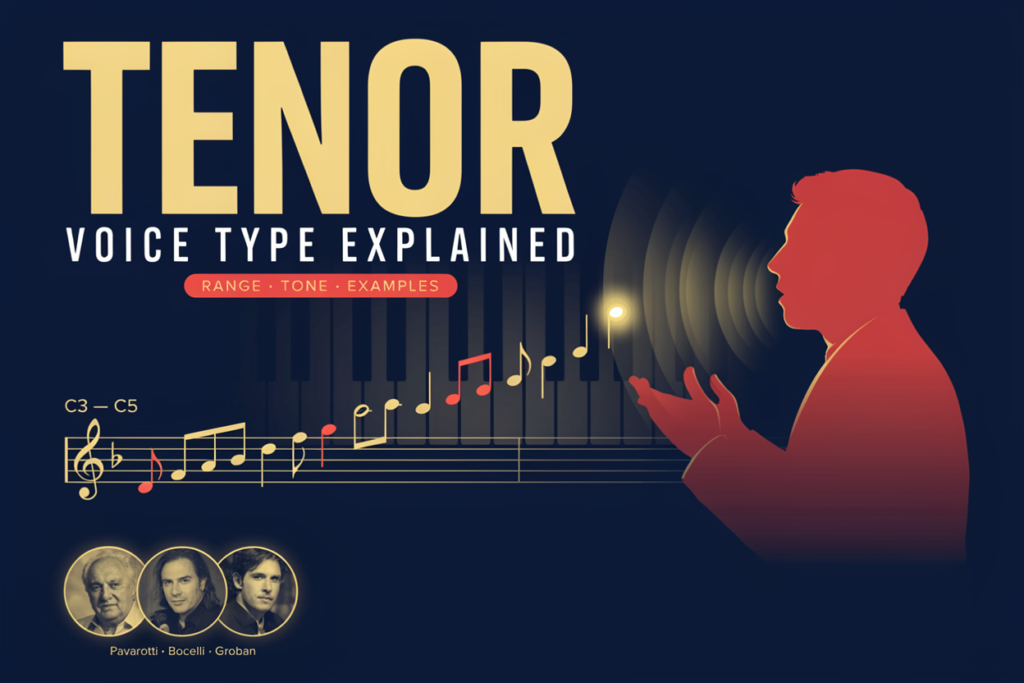
A tenor is the highest standard adult male voice type typically sung in a modal, or chest-dominant, register. Its commonly cited classical range is approximately C3 to C5, but actual classification depends more on tessitura, timbre, vocal weight, passaggi, and registration than on two extreme notes.
That distinction matters because many singers can touch tenor notes without being tenors. A baritone may reach C5 in falsetto, while a true tenor may sing below C3. The useful question isn’t simply “What notes can I hit?” but “Where can I sing repeatedly, freely, and with a characteristic tone?”
What Is a Tenor Voice Type?
A tenor is a high adult male singing voice that generally sits above baritone and bass. In classical music, the term describes an instrument suited to a particular tessitura, tonal character, and repertoire—not merely a singer who can produce high notes.
Where tenor sits among male voice types
The standard classical male categories, from higher to lower, are tenor, baritone, and bass. Their ranges overlap substantially. A tenor’s center of gravity generally sits higher than a baritone’s, and upper notes tend to feel more sustainable in full or mixed coordination.
For a broader view of those overlapping categories, the male voice range comparison shows why boundary notes should be treated as reference points rather than hard divisions.
Why tenor and countertenor are different
A countertenor often sings in a range associated with alto or mezzo-soprano repertoire, commonly using a developed falsetto or head-dominant production. A tenor usually produces most of his working range through modal voice and a coordinated upper register.
Countertenor is therefore not simply “a tenor who sings higher.” The two labels involve different registration strategies, repertoire traditions, and tonal expectations. Understanding the difference between head voice and chest voice helps clarify why the same pitch can be produced in very different ways.
What Is the Typical Tenor Vocal Range?
The typical operatic tenor range is approximately C3 to C5. Under equal temperament with A4 tuned to 440 Hz, those fundamentals are about 130.8 Hz and 523.3 Hz. Choral and contemporary parts may use narrower or differently centered ranges.
| Voice category | Approximate reference range | Boundary frequencies | Typical characteristic |
|---|---|---|---|
| Countertenor | roughly E3–E5 or higher | 164.8–659.3 Hz | High male voice, often head-dominant or falsetto-based |
| Tenor | C3–C5 | 130.8–523.3 Hz | High modal male voice with an accessible upper tessitura |
| Baritone | A2–A4 | 110.0–440.0 Hz | Medium male voice with a lower center of gravity |
These figures are broad teaching references, not diagnostic limits. Frequencies represent the fundamental pitch of each note; a sung tone also contains harmonics extending far above its fundamental. The human voice frequency guide explains that distinction in more detail.
Operatic, choral, and contemporary ranges
Operatic tenor roles may demand sustained singing near the top of the voice, projection over an orchestra, and specific passaggio management. Choral tenor lines often stay within a more practical ensemble range, although the exact notes depend on the composition. Contemporary singers may use microphones, breathier colors, distortion, or frequent falsetto, so classical labels do not map perfectly onto every style.
A dedicated tenor range reference can help you interpret note boundaries, but repertoire comfort remains more revealing than an isolated range test.
Total range versus comfortable tessitura
Total range includes the lowest and highest notes you can produce under acceptable conditions. Tessitura is the region where your voice remains comfortable, resonant, and repeatable across phrases.
Suppose Singer A and Singer B can both produce C3–C5. Singer A becomes tired above G4 and reaches C5 only in light falsetto. Singer B can sustain repeated phrases around A4, transition smoothly through the upper register, and sing C5 with an appropriate modal-mix coordination. Singer B is more likely to have tenor behavior even though their endpoint ranges match.
What Are the Different Types of Tenor?
Tenor subtypes describe differences in vocal weight, agility, color, power, and suitable repertoire. The categories are most useful in classical singing and should normally be assigned with guidance from an experienced teacher or coach.
Leggero and lyric tenor
A leggero tenor has a light, agile sound and is often suited to rapid passages and easy upper extension. A lyric tenor generally has a warm, flexible tone with enough carrying power for expressive melodic roles, without the density expected from heavier voices.
Spinto, dramatic, and Heldentenor
A spinto tenor combines lyric qualities with extra thrust for climactic passages. A dramatic tenor has greater vocal weight and power for heavier orchestration, while a Heldentenor is associated particularly with demanding German dramatic repertoire and a robust, baritone-like color.
These labels do not form a simple ladder from beginner to advanced. A light tenor does not “graduate” into a dramatic tenor through forceful training; the singer’s underlying instrument, development, and repertoire fit all matter.
How Can You Tell If You Are a Tenor?
You may be a tenor if your comfortable singing area sits relatively high, your upper modal or mixed register is accessible, and your tone and passaggi behave more like a tenor’s than a baritone’s. A single self-test can estimate range, but it cannot confirm a professional voice classification.
Find repeatable notes without forcing
Warm up gently, then move downward and upward by semitones using an easy vowel. Record the lowest and highest pitches that remain clear, stable, and repeatable. Stop if you feel throat pressure, pain, or a need to shout.
A browser-based test can misread harmonics, background noise, or unstable phonation, so review the limitations of voice range test accuracy before treating a detected note as definitive.
Evaluate tessitura, timbre, and passaggi
Observe where you can sing phrases for several minutes without fatigue. Timbre means the recognizable color of the voice; vocal weight describes its perceived lightness or density; passaggi are transition zones where registration adjustments become necessary.
Those traits help distinguish two singers with similar endpoints. A tenor often maintains more comfort and brilliance higher in the staff, whereas a baritone typically has greater ease and fullness lower down. The detailed baritone and tenor comparison explores this overlap without reducing it to one high note.
Can a Baritone Sing Tenor Notes?
Yes. A baritone can sing pitches found in tenor repertoire, especially through falsetto, head-dominant production, or a well-trained extension. Singing tenor notes does not automatically make the singer a tenor because voice type describes how the whole instrument functions.
Consider a baritone who can sing B4 once but is most comfortable from G2 to E4. If sustained phrases above F4 quickly cause fatigue, assigning tenor repertoire based on B4 alone would be misleading. By contrast, a tenor might possess notes below C3 yet still have a high tessitura and tenor-like registration.
This is why comparing your experience with a full baritone range overview is more useful than checking whether two endpoint notes fit a chart. If classification affects demanding repertoire, consult a qualified voice teacher who can hear registration, resonance, and endurance over time.
Frequently Asked Questions
Is C3–C5 always a tenor range?
C3–C5 is a widely used reference range for tenor, not a rigid test. Baritones and countertenors may overlap with it, while individual tenors may extend below C3 or above C5.
How can you tell whether you’re a tenor or baritone?
Compare your comfortable tessitura, vocal weight, timbre, passaggi, and upper-register endurance—not just your highest note. A teacher can make a safer assessment after hearing you across scales, phrases, and suitable repertoire.
Is tenor the highest male voice type?
Tenor is the highest standard adult male category primarily associated with modal singing. Countertenor usually sings higher but is treated separately because its repertoire and registration commonly rely on a developed head-dominant or falsetto production.
Can a baritone train to become a tenor?
Training can expand range, improve registration, and reveal that an earlier label was wrong. It usually does not transform a mature baritone instrument into a true tenor, and forcing the voice upward can create fatigue or strain.
Does reaching a high C make you a tenor?
No. High C, or C5 in tenor notation, may be produced in falsetto or reached only briefly. Tenor classification also requires an appropriately high tessitura, sustainable coordination, characteristic timbre, and suitable passaggi.
Can women have tenor voices?
Women can sing tenor lines, especially in choirs, and some have ranges centered in that region. In classical solo classification, female voices are more often described as soprano, mezzo-soprano, or contralto, while “tenor” may describe the ensemble part being sung.

Williams is a vocal depth and voice analysis writer at Deep Voice Test. He focuses on deep voice analysis, vocal frequency testing, pitch detection, and voice classification tools for singers, creators, speakers, and voice enthusiasts.