
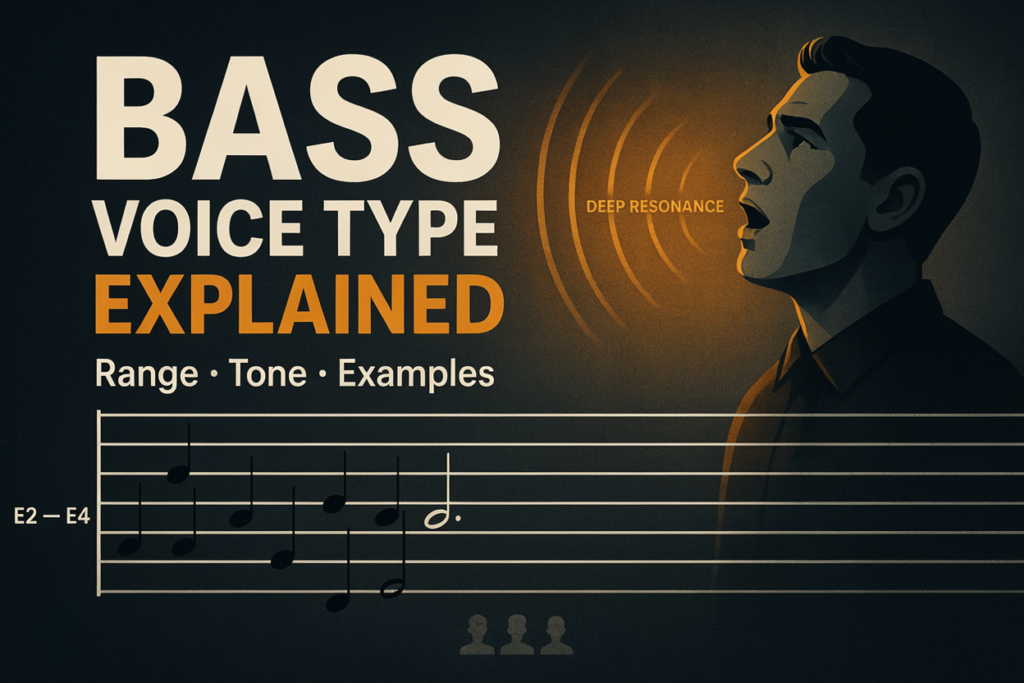
A bass is the lowest standard male voice type in Western classical singing. It is commonly associated with an approximate E2–E4 range, a low tessitura, and a dark, weighty tone, but voice type is determined by more than the lowest and highest notes a singer can reach.
The often-cited E2–E4 span corresponds to roughly 82–330 Hz. Treat those figures as reference points rather than entrance requirements: repertoire, language, training, and the individual instrument all affect a singer’s usable range. The broader male voice range comparison helps place bass alongside tenor and baritone without turning overlapping ranges into rigid borders.
What does a bass voice sound like?
A trained bass usually has strong resonance and vocal weight in the lower register. The tone may be described as dark, round, sonorous, or imposing, but not every bass sounds equally heavy. Some basses sing smooth, lyrical lines, while others specialize in comic agility or exceptionally low dramatic roles.
Vocal depth comes from the interaction of vocal-fold vibration and the resonating spaces above the larynx. The anatomy behind voice depth explains why pitch and tone color are related but not interchangeable.
Is bass the lowest singing voice?
Bass is the lowest standard male classical category. Basso profondo is the term commonly used for especially low bass voices, while oktavists in some choral traditions may sing unusually low notes. These specialties sit within particular musical traditions rather than forming a universal voice type below bass.
What Is the Typical Bass Vocal Range?
The typical reference range for bass is about E2–E4, although trained singers may extend below or above it. A more useful classification question is where the voice can sustain phrases comfortably, clearly, and repeatedly—not which note appears once on a tuner.
| Voice category | Approximate reference range | Typical center of comfort | Common distinction |
|---|---|---|---|
| Tenor | C3–C5 | Higher male tessitura | Brighter upper register |
| Baritone | A2–A4 | Middle male tessitura | Balanced low and upper range |
| Bass-baritone | Roughly F2–F4 | Between bass and baritone | Bass weight with more upper flexibility |
| Bass | E2–E4 | Lowest male tessitura | Strong low-register resonance |
These ranges vary among teaching systems and roles. The dedicated bass range reference gives more context for note names, frequency, and practical testing.
Range versus tessitura
Range means every pitch you can produce, including notes that may be brief or unreliable. Tessitura is the region where your voice remains comfortable, resonant, and controllable across sustained musical phrases. A baritone might touch E2 in the morning yet tire when a song repeatedly sits near F2 or G2; a bass may handle that lower writing with greater stability.
Passaggi also matter. A passaggio is a transition area where vocal coordination shifts between registers. Teachers listen to how those transitions behave alongside timbre, vocal weight, and tessitura when considering classification.
Why doesn’t one low note make you a bass?
One low note may come from temporary conditions, vocal fry, subharmonic production, or an unsupported extension. Classical classification concerns repeatable singing within suitable repertoire. This is why a browser recording or at-home range check can offer an estimate, but it cannot diagnose a classical voice type.
How Is a Bass Different From a Baritone or Bass-Baritone?
A bass generally sits lower and carries more natural weight in low repertoire than a baritone. A bass-baritone occupies the overlap: the voice retains substantial low resonance but is often more comfortable with higher passages than a typical bass.
Bass versus baritone
Baritones usually have a higher tessitura and easier access to upper-middle notes, even when they possess impressive low extensions. Basses tend to sound settled lower and may find sustained high baritone writing tiring. The detailed baritone and bass comparison shows why comfort and repertoire tell you more than two overlapping range charts.
Tone alone can mislead. A dark baritone may sound deeper than a lighter bass in speech, yet the two voices behave differently when singing scales and full phrases. Likewise, a bright bass does not stop being a bass because its tone lacks an exaggerated rumble.
Bass versus bass-baritone
Bass-baritone is not simply another name for bass. It describes voices with bass-like weight and authority that also manage a somewhat higher tessitura or repertoire. The boundary is not mathematically fixed, and the same singer may be described differently as the voice matures or as repertoire changes.
For a note-focused view of the overlap, compare the bass and baritone range patterns rather than assuming the lowest note settles the question.
What Are the Main Types of Bass Voice?
Bass subtypes describe different combinations of range, weight, agility, acting demands, and repertoire. Terminology varies across Italian, German, French, and choral traditions, so these labels are useful descriptions rather than universal measurements.
Basso cantante and basso buffo
Basso cantante, or “singing bass,” typically combines low resonance with a smoother, more lyrical line and useful upper-range flexibility. The sound may be noble and flowing rather than exceptionally cavernous.
Basso buffo is associated with comic roles that demand clear text, timing, character work, and sometimes rapid passages. Agility and diction can matter as much as sheer low-note power.
Dramatic bass and basso profondo
A dramatic bass has the projection and vocal weight needed for intense orchestral writing and authoritative stage roles. The category emphasizes power, stamina, and dramatic presence.
Basso profondo describes an exceptionally low, resonant bass. The voice must remain musically functional in its low tessitura; producing isolated growls or subharmonics does not establish this classification. Listening to established famous low-voice singers can help you hear how these distinctions operate in real repertoire.
How Can You Tell If You Have a Bass Voice?
You may have a bass voice if low phrases remain comfortable and resonant, your usable tessitura sits below that of most baritones, and your register transitions and tone suit bass repertoire. The safest assessment combines a rested warm-up, repeated phrase testing, and evaluation by a qualified singing teacher.
- Warm up gently in your middle range instead of starting with the lowest possible note.
- Descend by semitones on a comfortable vowel and note where tone becomes breathy, pressed, or fry-like.
- Sing short phrases across several keys and identify where the voice remains easy for several minutes.
- Repeat on another day, because fatigue, illness, hydration, and time of day can affect the result.
- Ask a teacher to assess tessitura, passaggi, timbre, and repertoire before adopting a demanding label.
An online or at-home result is only a starting estimate. A careful voice-depth testing method can improve consistency, while the guide to range-test accuracy and limitations explains why microphones, background noise, and vocal technique may alter readings.
Common signs of a bass include reliable low notes with a clear sung tone, comfort in low-lying phrases, and substantial resonance without pushing. Signs that may suggest baritone instead include greater ease in the upper-middle register, fatigue in repeatedly low passages, or low notes that appear only at quiet volume.
Frequently Asked Questions
How do I know if I am a true bass singer?
A true bass usually has a naturally low tessitura, stable low notes, bass-like vocal weight, and register transitions suited to bass repertoire. A trained teacher can evaluate these features more reliably than a range test alone.
Is E2–E4 the complete range of every bass?
No. E2–E4 is a commonly cited reference range, not a limit shared by every bass. Individual singers may extend beyond it, while some repertoire uses a narrower but demanding tessitura.
Can a baritone train to become a bass?
Training can strengthen low notes and improve resonance, but it does not reliably change a singer’s underlying anatomy or natural tessitura into another voice type. A baritone can develop a better lower extension without becoming a true bass.
What is the difference between bass and bass-baritone?
A bass generally has a lower tessitura and greater natural comfort in low repertoire. A bass-baritone combines significant low-register weight with more facility in a somewhat higher range.
Does singing bass in a choir mean I have a bass voice?
Not necessarily. “Bass” in an SATB choir names the lowest section, and that part may include basses, bass-baritones, and baritones. Solo voice classification requires a broader assessment.
Is basso profondo the lowest type of bass?
Basso profondo is commonly regarded as the deepest bass subtype, noted for an unusually low and resonant tessitura. The label refers to a functional singing voice in appropriate repertoire, not merely an extreme lowest note.

Williams is a vocal depth and voice analysis writer at Deep Voice Test. He focuses on deep voice analysis, vocal frequency testing, pitch detection, and voice classification tools for singers, creators, speakers, and voice enthusiasts.