
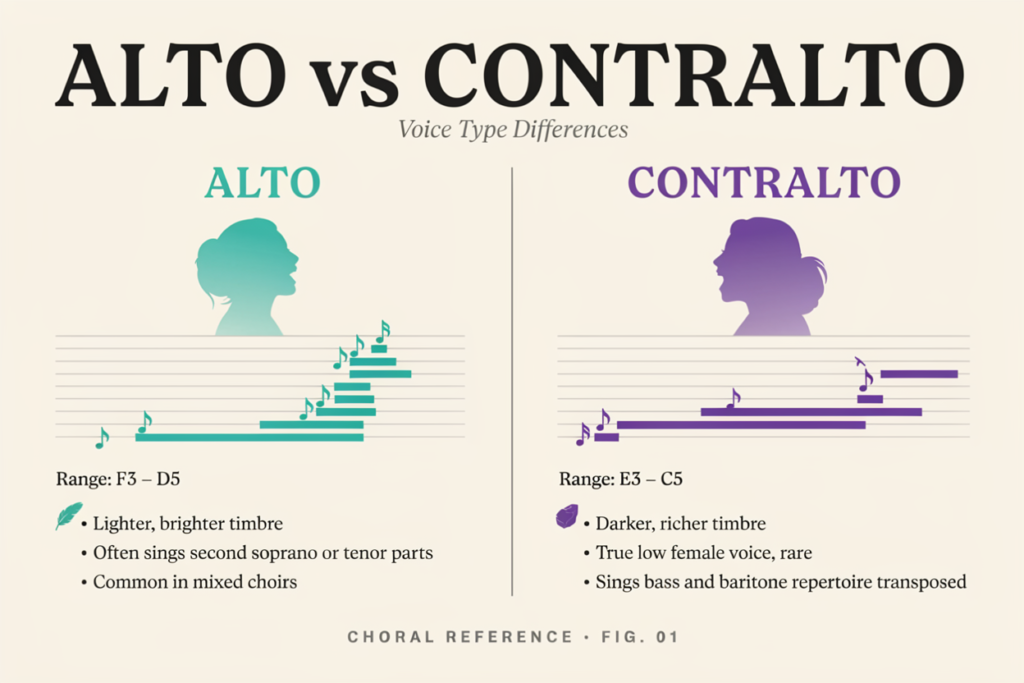
Alto and contralto describe different things. Alto usually refers to the lower female part in a choir, while contralto is the lowest standard female classical solo voice type. A singer can therefore perform alto without being a contralto.
The distinction depends on context, tessitura, timbre, vocal weight, and register transitions. The broader female voice-range reference shows where soprano, mezzo-soprano, and contralto ranges overlap.
Alto vs Contralto: What Is the Difference?
Alto is normally a choral role; contralto is a classical voice classification. The terms sometimes overlap in everyday speech because a true contralto will often sing alto in a choir, but they are not interchangeable.
| Feature | Alto | Contralto |
|---|---|---|
| Primary meaning | A lower part in a choir or vocal ensemble | The lowest standard female classical solo voice type |
| Context | Choral writing, especially SATB arrangements | Solo repertoire and classical vocal classification |
| Range | Changes with the composition and ensemble | Often cited around F3–F5, with individual variation |
| How it is assigned | The part a singer can perform reliably in that group | Tessitura, timbre, passaggi, vocal weight, and usable range |
| Who may sing it | Contraltos, mezzo-sopranos, countertenors, or other suitable singers | Singers whose instruments consistently show contralto traits |
| Does one low note prove it? | No | No |
Alto describes a part in an ensemble
In an SATB choir—soprano, alto, tenor, and bass—alto is the harmony line below soprano and above tenor. The composer determines its written notes, so there is no single universal alto range. One piece may keep the section near the middle of the staff, while another may demand lower notes or brief higher passages.
Choir directors assign singers according to blend, balance, comfort, and repertoire. A mezzo-soprano may sing Alto 1 or Alto 2 because that line suits her dependable range without being a contralto.
Contralto describes a classical solo voice
Contralto is the lowest conventional female classical voice category. A commonly cited approximate range is F3 to F5, but endpoints alone do not define it. The central questions are where the voice remains comfortable, where it carries naturally, and how its registers behave.
A fuller contralto voice classification guide explains why a strong lower register and a naturally low tessitura matter more than touching F3 once. Tessitura means the area in which most notes can be sung repeatedly with comfort, control, and a characteristic tone.
How Do Alto and Contralto Ranges Compare?
An alto part has no fixed universal range, whereas contralto references describe the capabilities and character of an individual voice. The two may occupy many of the same pitches, but a written part and a voice type answer different questions.
Why an alto part has no universal range
Choral ranges are determined by repertoire. Alto 1 often carries the upper portion of the section and Alto 2 the lower portion, but those labels still describe assignments rather than permanent voice types.
Countertenors and some tenors may also cover alto lines, confirming that alto is not a female-only voice classification.
The approximate contralto range and tessitura
F3–F5 is a useful reference for contralto, not a pass-or-fail boundary. Many mezzo-sopranos can sing F3, and a trained contralto may extend above F5. Range also changes with warm-up, health, and register choice.
The way low notes are produced matters. A singer may reach low pitches in chest voice yet feel more efficient higher; another may have fewer total notes but greater ease in the low-middle register. Understanding chest voice and head voice coordination prevents an isolated register extension from being mistaken for a whole voice type.
Can an Alto Singer Be a Mezzo-Soprano?
Yes. Many choir altos are mezzo-sopranos because mezzo voices often have the range, tonal color, and flexibility needed for lower choral harmony. Singing alto identifies what the singer does in that ensemble, not necessarily how a classical teacher would classify the solo voice.
Voice type and choir placement answer different questions
Choir placement asks which part a singer can perform reliably. Voice classification asks where the instrument functions most freely and which solo repertoire suits its weight, color, and transitions.
Those answers can differ. A mezzo-soprano may sing Alto 2 because her lower notes blend well or the score sits comfortably. A contralto might sing Alto 1 when the arrangement calls for it.
A practical classification example
Imagine two singers who can produce F3–F5. Singer A is comfortable from A3 to E5 and tires when repertoire stays low. Singer B has a stable lower register and carries more weight through the low-middle range.
The same measured endpoints do not produce the same classification. Singer A could be a mezzo-soprano who sings alto, while Singer B may show contralto characteristics. A guide to naturally deep female voices adds another useful distinction: speaking pitch or dark tone alone does not determine a singing category.
How Can You Tell If You’re a Contralto?
Look for a consistently low tessitura, secure low and middle notes, characteristic tonal weight, and register transitions that suit contralto repertoire. Do not classify yourself from your lowest note, speaking voice, or choir seat alone.
Check comfortable notes instead of one extreme
After a gentle warm-up, identify the lowest and highest pitches you can sing cleanly without strain. Sing short phrases across the middle of that span and record where the voice remains repeatable, resonant, and dynamically controllable. That comfortable zone matters more than a one-time extreme.
A browser-based pitch check can estimate note names, but microphone quality, background noise, octave errors, and vocal fry can distort the result. The same caution applies to interpreting raw human voice frequencies: frequency identifies pitch, not voice type by itself.
Consider timbre, register balance, and passaggi
Timbre is vocal color; vocal weight describes how light or substantial the instrument feels; passaggi are transition regions between registers. Together, these traits show how a voice functions beyond the notes displayed by a tuner.
Dark timbre is not automatic proof of contralto. Vocal-tract shape, resonance choices, language, style, and imitation can all make a voice sound darker. Safe voice resonance exercises may improve clarity and efficiency, but they should not be used to manufacture an artificially heavy sound for classification.
When to ask a qualified voice teacher
If classification will guide repertoire or auditions, work with a qualified teacher who can hear your voice across multiple sessions. Fatigue, illness, and nerves can make one assessment misleading.
A teacher can assess phrases, dynamics, passaggi, and resonance—not simply request the lowest possible sound. At-home results should remain provisional because range-test accuracy has practical limits.
What Are the Most Common Alto and Contralto Myths?
Common myths treat choir placement, low notes, or dark tone as proof of voice type. Each is only one clue.
Myth: every choir alto is a contralto
Reality: alto sections frequently contain mezzo-sopranos and may include other singers who can perform the line. True contraltos are only one possible group within that section.
Myth: reaching F3 proves you’re a contralto
Reality: F3 falls within the extended capability of many female singers. A contralto classification requires more consistent evidence, including a low tessitura, stable tone, suitable register balance, and characteristic vocal weight.
Myth: a dark voice must be a contralto
Reality: singers of several voice types can have dark, warm, or rich timbres. Resonance strategy and style can also alter perceived depth, which is why examples of women known for lower voices should be treated as listening references rather than templates for self-diagnosis.
Frequently Asked Questions
Is alto lower than contralto?
Not in a strict voice-type hierarchy. Alto is usually a choral part, while contralto is a solo voice classification, so the terms describe different categories rather than two adjacent voice types.
Can a mezzo-soprano sing alto in a choir?
Yes. Mezzo-sopranos commonly sing alto because their comfortable range and tone may suit the part. Their choir placement does not automatically change their solo voice classification.
What is the typical contralto vocal range?
A frequently cited approximate contralto range is F3–F5. Individual voices may extend beyond it, and teachers also assess tessitura, timbre, passaggi, vocal weight, and register stability.
Does singing F3 make someone a contralto?
No. Many mezzo-sopranos and some sopranos can reach F3, especially as an isolated low note. The pitch must be considered alongside comfort, repeatability, tone, and the rest of the voice.
Can men sing the alto part?
Yes. Countertenors and some tenors may sing alto lines using a coordinated upper register. Alto identifies the ensemble part, not the singer’s sex or one fixed physiological voice type.
Is contralto rarer than mezzo-soprano?
Contralto is generally regarded as less common than mezzo-soprano in classical classification. Exact prevalence is difficult to state because terminology, training, choir assignment, and classification practices vary.

Williams is a vocal depth and voice analysis writer at Deep Voice Test. He focuses on deep voice analysis, vocal frequency testing, pitch detection, and voice classification tools for singers, creators, speakers, and voice enthusiasts.