
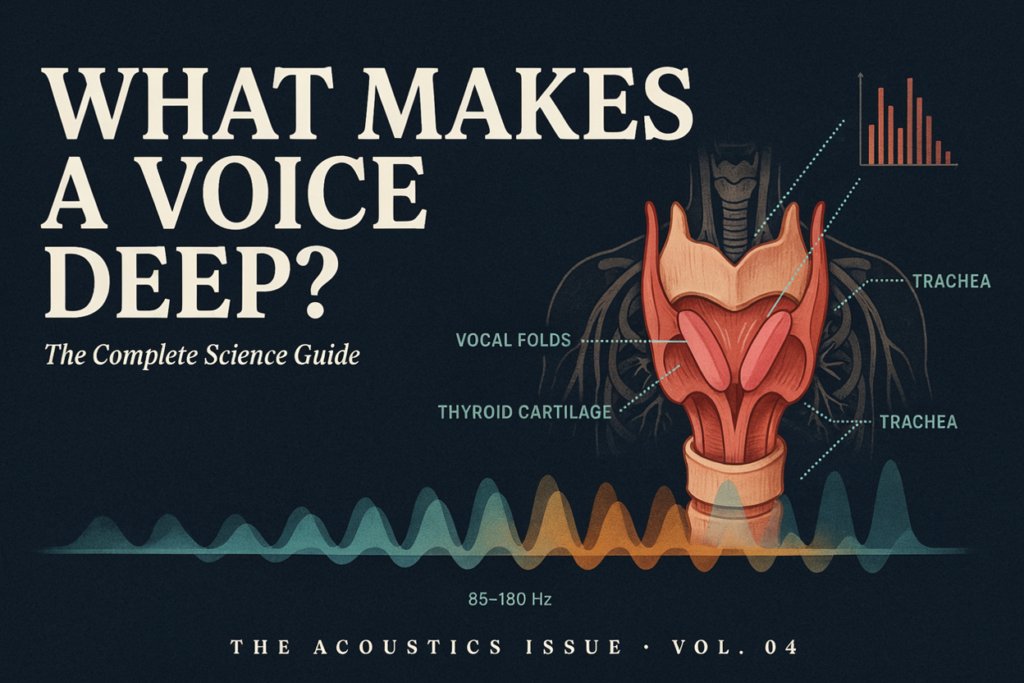
A voice sounds deep because the vocal folds vibrate slowly, producing a low fundamental frequency, or F0. Longer, thicker folds often support slower vibration, while the vocal tract shapes resonance and formants. Anatomy, puberty, hormones, genetics, age, health, and technique all contribute.
Pitch is only part of what you hear. Two people can speak at 100 Hz yet sound different because their resonance differs. This guide to how vocal-fold structure affects voice depth explains the tissue behind the sound.
What Makes a Voice Deep?
A deep voice combines low fundamental frequency with a dark or full sound. Vocal-fold length, mass, stiffness, and tension influence vibration speed; vocal-tract shape influences resonance. Puberty and genetics establish this anatomy, while health and behavior can alter it.
| Factor | Main acoustic effect | Changes measured pitch? | Changes perceived depth? |
|---|---|---|---|
| Effective vocal-fold length | Longer vibrating tissue tends to oscillate more slowly | Yes | Yes |
| Vocal-fold mass | Greater vibrating mass can support a lower F0 | Yes | Yes |
| Tension and stiffness | Greater tension usually raises vibration rate | Yes | Yes |
| Fundamental frequency | Sets the primary rate heard as pitch | Yes | Yes |
| Vocal-tract length and shape | Shifts formants and resonance | Usually no | Yes |
| Speaking style | Changes pitch, pace, loudness, and articulation | Sometimes | Yes |
| Swelling or irritation | Alters fold mass and vibration quality | Sometimes | Yes, often with roughness |
“Deep” does not mean only “low Hz.” A reference for deep-voice frequency can help interpret pitch, but it cannot describe timbre, resonance, clarity, or vocal health.
How Do the Vocal Folds Determine Voice Depth?
The vocal folds determine the sound source. Air from the lungs passes between them, and coordinated opening and closing creates repeating pressure pulses. Fewer vibration cycles per second produce a lower fundamental frequency and therefore a lower perceived pitch.
Vocal-fold length and vibrating mass
Longer folds generally vibrate more slowly than shorter folds under comparable conditions. Thicker folds can also place more tissue into vibration, increasing effective mass and favoring a lower pitch. The National Center for Voice and Speech identifies effective vocal-fold length as a major influence on F0 and reports a substantial average anatomical difference between adult male and female folds.
These are tendencies, not a calculator. Muscle coordination, tissue properties, airflow, and the amount of tissue vibrating also affect the result. Height, neck size, or sex alone cannot predict an individual voice accurately.
Tension, stiffness, and vibration speed
Laryngeal muscles adjust vocal-fold length, tension, thickness, and contact. Increased tension usually raises pitch; reduced tension can lower it within a functional range. Unlike guitar strings, vocal folds are living, layered tissue controlled by several muscles.
How Do Testosterone and Puberty Deepen the Voice?
During androgen-driven puberty, the larynx grows and the vocal folds usually become longer and thicker, particularly in males. This maturation commonly produces a large pitch drop relative to childhood. Testosterone influences the development, but an adult testosterone reading does not reveal exactly how deep someone’s voice should be.
Laryngeal growth during puberty
Puberty changes both the sound source and the resonating tube above it. An MRI and voice study of 532 adolescents found more pronounced vocal-fold and vocal-tract growth in males; vocal-fold length and F0 were especially predictive of perceived vocal maleness. Rapid growth and changing coordination can cause temporary cracks.
Why adult hormone levels are not a voice-depth score
Much of testosterone’s lasting effect occurs while the larynx develops. After maturation, current hormone levels do not map neatly onto speaking F0. Anatomy, genetics, habits, and health remain important. The relationship between testosterone and voice deepening is more complex than “more testosterone equals a deeper voice.”
Is a Deep Voice Genetic?
Voice depth is partly inherited because genes influence the larynx, vocal folds, vocal tract, and hormone-related growth. No single established “deep-voice gene” determines the outcome.
Inherited anatomy and development
Relatives can share features that favor similar voices, but many genes interact with development, age, health, language, and learned speech patterns. A detailed look at genetic influences on vocal depth separates inherited tendencies from oversimplified claims.
Why environment and behavior still matter
Accent, habitual pitch, emotion, occupation, and training affect how a person uses their anatomy. Smoking, dehydration, reflux, illness, and heavy vocal load may alter quality or comfort, although a rough voice is not necessarily a healthy low voice.
Why Does Resonance Make a Voice Sound Deeper?
Resonance makes a voice sound deeper by filtering frequencies after the vocal folds generate sound. The vocal tract does not usually change F0 directly, but it creates formants—resonant bands that influence perceived size, darkness, and vowel quality.
Fundamental frequency versus formants
F0 is the repetition rate of vocal-fold vibration. Harmonics occur at multiples of F0, while formants are resonances created by the throat and mouth. A low F0 can sound light with bright resonance, while a moderately low F0 may sound imposing with lower formants and a darker timbre.
Consider two speakers measured at a median 100 Hz. Speaker A has lower formants and a warm tone; Speaker B uses brighter vowels. Their pitch trackers show the same median, but listeners may describe Speaker A as deeper.
Resonance can be trained, anatomy cannot be copied
Efficient posture, breath coordination, clear vowels, and reduced throat constriction can improve fullness without forcing pitch downward. Sensible exercises for developing vocal resonance focus on easy vibration and clarity, not on manufacturing someone else’s anatomy.
What Else Can Change How Deep Your Voice Sounds?
Voice depth varies because pitch and timbre respond to emotion, loudness, fatigue, language, and register. Calm speech may sit lower than excited speech.
Irritation, illness, dehydration, or swelling may lower pitch while adding huskiness. A naturally deep voice should remain comfortable and reasonably clear; persistent pain, effort, range loss, or hoarseness deserves attention. This overview of deep-voice health and warning signs explains when low pitch and vocal trouble should not be confused.
Age has no one-way effect. Later changes in tissue, muscle, hormones, and breath support can make older voices lower, higher, or thinner.
Can a Voice Test Explain Why Your Voice Is Deep?
A voice test can estimate speaking F0, but it cannot diagnose the anatomical or hormonal reason. Browser and phone results depend on microphone quality, noise, the speech sample, and pitch-tracking accuracy.
For an estimate, record 30–60 seconds of comfortable connected speech rather than one low note. Repeat on several days and compare median F0, not only the minimum. Guidance on testing your natural voice depth helps avoid mistaking vocal fry for habitual pitch.
A sudden drop with hoarseness, pain, breathing difficulty, or persistent change should be assessed by an ear, nose, and throat doctor or speech-language pathologist. A frequency number cannot identify a medical cause.
Can You Safely Make Your Voice Sound Deeper?
You can develop a fuller sound through resonance, breath coordination, articulation, and speaking habits, but you cannot safely force unlimited pitch change. Work near the lowest pitch that remains easy, clear, and sustainable rather than pressing the larynx down.
Useful practice includes relaxed breathing, gentle humming, comfortable descending glides, and clear consonants. Stop for pain, persistent tightness, or worsening hoarseness. A safe guide to speaking with a lower, more natural sound distinguishes efficient technique from strain.
Frequently Asked Questions
Do thicker vocal cords make your voice deeper?
Thicker vocal folds can increase vibrating mass and support a lower fundamental frequency. Thickness is only one factor, however; effective length, tension, stiffness, airflow, and muscle coordination also influence pitch.
Does more testosterone always mean a deeper voice?
No. Testosterone strongly influences laryngeal development during androgen-driven puberty, but adult voice depth cannot be predicted from a current testosterone measurement. Genetics, anatomy, development, health, and vocal behavior all contribute.
Can a woman naturally have a very deep voice?
Yes. Women vary naturally in vocal-fold anatomy, pitch, resonance, and voice type, and some have a contralto-like quality. A deep female voice does not automatically indicate a hormone problem.
Why do two voices at the same frequency sound different?
The same F0 can be filtered by different vocal-tract shapes, producing different formants, harmonics, and timbres. Articulation, breathiness, loudness, and microphone technique can make equal-Hz voices sound lighter, darker, thinner, or fuller.
Can aging make a voice deeper or higher?
Yes. Age-related changes in tissue, muscle, hormones, and breath support can move pitch or alter timbre in either direction. The pattern differs by individual and is not always a steady decline in frequency.
When is a suddenly deeper voice a medical concern?
A sudden or persistent change deserves professional assessment when it includes pain, effort, breathing difficulty, loss of range, or hoarseness lasting more than a short illness. A deeper sound caused by swelling or impaired vibration is different from a naturally low, comfortable voice.

Williams is a vocal depth and voice analysis writer at Deep Voice Test. He focuses on deep voice analysis, vocal frequency testing, pitch detection, and voice classification tools for singers, creators, speakers, and voice enthusiasts.