
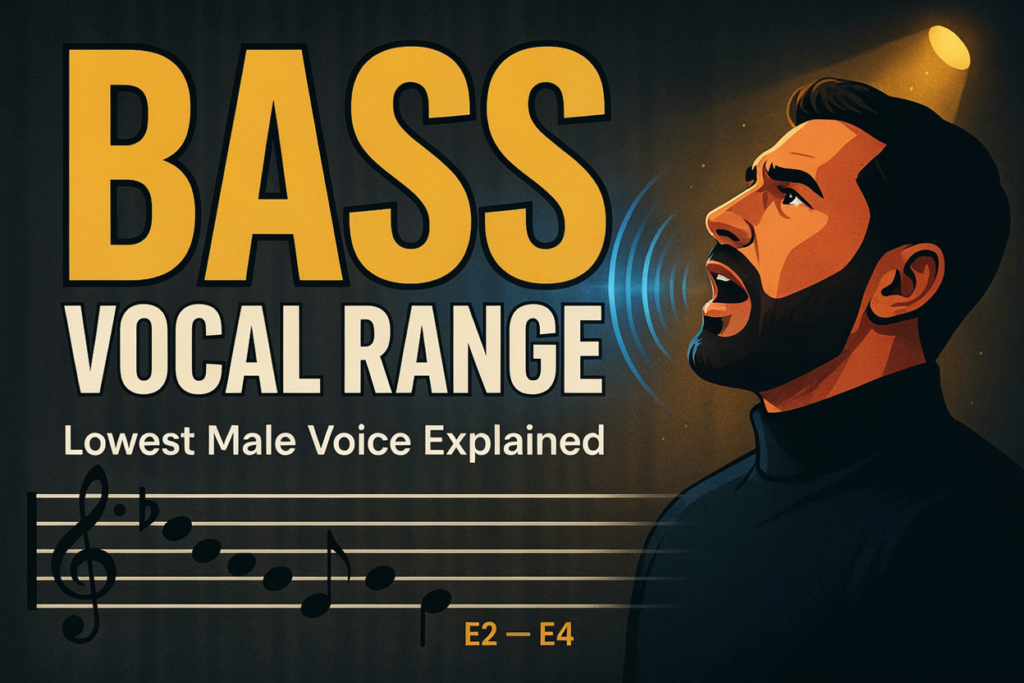
A typical bass vocal range extends from E2 to E4, covering about two octaves. Those notes correspond to fundamental frequencies of approximately 82.4 Hz and 329.6 Hz, respectively. Some bass singers can reach C2 or lower and sing above E4, but exceptional notes do not define the voice type by themselves.
Bass is the lowest standard male singing voice. A genuine bass also has a low tessitura—the range where the voice remains comfortable and resonant. Compare the notes below with a chart of male voice categories.
What Is the Typical Bass Vocal Range?
The commonly cited bass range is E2–E4, although some reference ranges begin at D2 or C2. Choral parts, solo repertoire, and individual training place different demands on the voice.
Bass Range on a Piano
On an 88-key piano, E2 lies below middle C, while E4 lies above middle C. Middle C is C4 under scientific pitch notation. The approximate frequencies of several useful reference notes are:
| Note | Frequency | How it relates to a bass voice |
|---|---|---|
| C2 | 65.4 Hz | A low extension for many basses, not a universal requirement |
| D2 | 73.4 Hz | Included in some published bass ranges |
| E2 | 82.4 Hz | Commonly cited lower boundary |
| C3 | 130.8 Hz | Central working territory for many low voices |
| E4 | 329.6 Hz | Commonly cited upper boundary |
| F4–G4 | 349.2–392.0 Hz | Possible upper extension in certain singers or repertoire |
These figures describe the fundamental frequency, or the rate at which the vocal folds repeat their vibration. A sung note also contains harmonics, which is why it sounds richer than a pure electronic tone. The connection is explained in this guide to vocal-cord anatomy and voice depth.
Full Range vs Comfortable Tessitura
Full range includes the lowest and highest pitches you can produce under test conditions. Tessitura is narrower: it is where you can sing phrases repeatedly with a stable tone, useful volume, accurate pitch, and manageable effort.
An unstable C2 made with vocal fry has less classification value than a clear, repeatable E2. Practical classification considers tessitura, timbre, register transitions, and endurance alongside the outer limits.
How Does Bass Compare With Other Male Voices?
Bass generally sits below baritone and tenor in both range and comfortable tessitura. The ranges overlap, so a single note cannot separate the categories; the strongest clues are where the voice feels settled and where its register transitions occur.
| Voice type | Commonly cited range | General vocal position |
| Bass | E2–E4 | Lowest standard male category |
| Baritone | A2–A4 | Middle male category |
| Tenor | C3–C5 | Highest standard adult male category |
These are reference points rather than biological borders. Repertoire and classification system can shift the endpoints.
Bass vs Baritone
A baritone may sing E2, especially after warming up or early in the day, but often lacks the resonance and consistency a bass brings to that area. Conversely, a bass may reach typical baritone notes without having the brighter timbre or higher tessitura expected of a baritone. The detailed bass and baritone range comparison shows why overlap is normal rather than contradictory.
Bass vs Bass-Baritone
A bass-baritone combines a substantial lower register with more ease in upper territory associated with baritone writing. In classical practice, the label also considers vocal weight, color, and specific roles. A teacher may listen for passaggi—the transition areas where registration changes—rather than asking only for the highest and lowest notes.
How Can You Tell If You Have a Bass Voice?
You may have a bass voice if E2 and nearby low notes are clear and sustainable, your comfortable singing range sits relatively low, and your tone retains depth without manufactured darkness. Classification becomes more reliable when those traits occur together.
Check Your Comfortable Singing Range
Warm up gently, then sing downward and upward by semitones on a neutral vowel. Count only pitches you can hold for several seconds at a normal musical volume without squeezing, breathiness, or vocal fry. Repeat the check on several days because fatigue, illness, hydration, and time of day can change the extremes.
An at-home pitch check is an estimate, not a clinical measurement or professional classification. Compare repeatable notes rather than the most extreme reading. The broader bass voice-type explanation helps interpret range with vocal function.
Listen for Timbre and Low-Note Stability
Timbre is the characteristic color of a sound. Bass voices often sound full or weighty, but color varies between singers. A stronger sign is whether low notes remain pitched, resonant, and controllable rather than becoming quiet fry. Test at moderate volume and avoid pushing the larynx downward.
Notice Register Transitions
Chest voice is the speech-like, fuller coordination used through much of a bass singer’s lower and middle range. As pitch rises, the singer gradually adjusts vocal-fold contact and resonance rather than dragging the same heavy setup upward. This overview of chest voice and head voice explains the functional difference without treating the registers as disconnected voices.
Passaggio can support classification, but technique, vowel, and volume affect where a transition becomes noticeable. Treat it as one piece of evidence, not a verdict.
What Are the Different Types of Bass Voices?
Bass is an umbrella category containing voices with different weights, colors, agility, and usable ranges. Classical labels describe the vocal qualities and repertoire demands of a singer, not merely the lowest pitch on a keyboard.
Basso Cantante and Lyric Bass
Basso cantante means “singing bass” and generally describes a smooth, resonant voice with useful upper-range flexibility. A lyric bass tends to sound less massive than a dramatic bass. Terminology differs between traditions.
Basso Buffo and Dramatic Bass
Basso buffo is associated with comic roles requiring clear text and agility. A dramatic bass has greater weight for heavier repertoire. Range alone cannot confirm either category.
Basso Profondo and Oktavist
Basso profondo refers to an exceptionally deep, weighty bass. An oktavist sings below the standard bass line in certain choral traditions and may descend below C2. These voices are rare. Examples of notable bass singers reveal how varied legitimate basses sound.
How Can Bass Singers Develop Their Range Safely?
Bass singers can develop a more reliable range through efficient breath management, balanced resonance, gradual scale work, and recovery. Safe training strengthens notes already near the edge of the usable range; it does not force the vocal folds to adopt a fundamentally different anatomy.
Strengthen Low Notes Without Forcing Them
Begin in comfortable middle notes and descend in short patterns on “oo” or a light hum. Keep the neck neutral and airflow steady. Stop when the tone turns into fry or requires downward pressure. Use these deep singing exercises and safety cues for more guidance.
Build the Upper Range Without Losing Bass Quality
A bass still needs a coordinated upper register. Practice gentle sirens, lip trills, and medium-volume scales that let resonance adjust as pitch rises. Range practice should not cause pain, persistent hoarseness, or loss of speaking voice. Seek qualified assessment if symptoms continue.
Frequently Asked Questions
Is E2–E4 Always Considered a Bass Range?
E2–E4 is the most commonly cited reference range, but it is not an absolute test. Some sources begin the typical span at D2 or C2, and an individual singer’s tessitura, timbre, passaggi, and stamina may support or contradict the range result.
Can a Baritone Sing Bass Notes?
Yes. Range overlap allows many baritones to produce E2 or other notes associated with bass. The practical difference is whether those pitches are stable and resonant within the singer’s comfortable working range; this fuller baritone-versus-bass guide explains the classification criteria.
What Is the Lowest Note a Typical Bass Can Sing?
E2 is a common lower reference point, while D2 and C2 appear in some broader descriptions. Notes below C2 are extensions found in unusually low voices rather than a normal requirement for bass classification.
Does Vocal Fry Count When Measuring Bass Range?
Vocal fry can produce pitches below the stable sung range, but those pulses usually should not count as usable singing notes. Count a low pitch when it has a recognizable musical tone, steady airflow, controllable volume, and can be repeated without strain.
Can Training Turn a Baritone Into a Bass?
Training can improve coordination, resonance, and access to low notes, and it can reveal that a singer was initially misclassified. Training does not normally change the underlying vocal anatomy enough to convert a true baritone into a true bass.
What Is the Difference Between a Bass and a Basso Profondo?
A bass is the broad lowest male voice category, while basso profondo is an exceptionally low, weighty subtype within it. A basso profondo typically has unusual depth and strength in the bottom register, not merely one isolated low pitch.

Williams is a vocal depth and voice analysis writer at Deep Voice Test. He focuses on deep voice analysis, vocal frequency testing, pitch detection, and voice classification tools for singers, creators, speakers, and voice enthusiasts.