
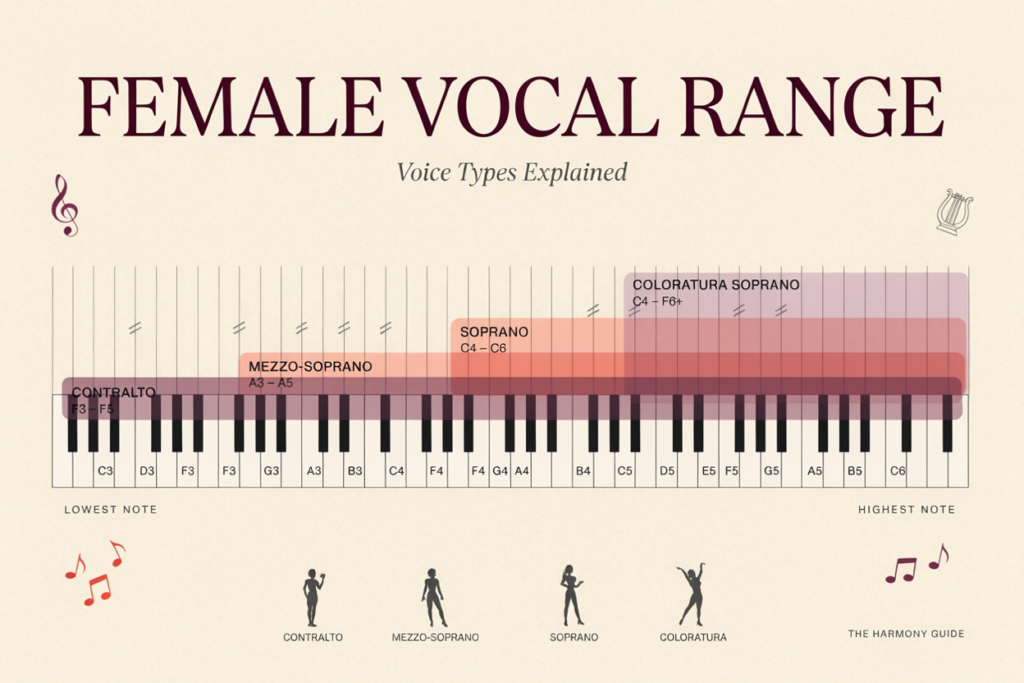
Most female singing voices are commonly grouped as soprano, mezzo-soprano, or contralto. A typical female vocal range chart places soprano around C4–C6, mezzo-soprano around A3–A5, and contralto around F3–E5, but these ranges overlap and should be treated as reference points rather than strict boundaries.
Your lowest and highest notes show total range, not necessarily voice type. Classification also depends on tessitura—the area comfortable for sustained singing—along with vocal color, weight, register transitions, and reliability. This matters when comparing a naturally deep female voice with a trained singer who has extended downward.
Female Vocal Range Chart: What Are the Standard Ranges?
The standard classical female categories are soprano, mezzo-soprano, and contralto. The chart uses approximate ranges with A4 tuned to 440 Hz. Frequencies refer to each pitch’s fundamental, not every frequency in the sound.
| Female voice type | Approximate note range | Approximate frequency range | Typical tessitura tendency | General tonal character |
|---|---|---|---|---|
| Soprano | C4–C6 | 261.6–1046.5 Hz | Upper female range | Bright, clear, or brilliant |
| Mezzo-soprano | A3–A5 | 220.0–880.0 Hz | Middle female range | Warm, full, or rounded |
| Contralto | F3–E5 | 174.6–659.3 Hz | Lower female range | Dark, rich, or weighty |
These descriptions are tendencies, not tests. Two singers may share extreme notes while differing in comfort and register balance. The male vocal categories and ranges provide broader context.
Soprano range
Soprano is the highest standard female classical voice type, commonly shown as C4 to C6. Some sopranos sing below or above that span, but their voices generally feel freer and more resonant in a higher tessitura than mezzo-soprano or contralto voices.
Reaching C6 once does not make someone a soprano. A singer who tires during upper phrases may have a lower functional tessitura.
Mezzo-soprano range
Mezzo-soprano occupies the middle of the standard female classification, with A3 to A5 often used as a practical reference. Because this range overlaps substantially with both soprano and contralto, mezzo classification depends heavily on where the voice has its most stable color and carrying power.
Contralto range
Contralto is the lowest standard female classical solo voice type, commonly approximated as F3 to E5. A true contralto typically has more than access to low notes: the lower and middle range tends to sound naturally substantial and remain comfortable across phrases. The fuller contralto voice classification explains why darkness of tone alone is not enough for the label.
How Do Female Voice Types Compare?
Female voice types differ most meaningfully in comfortable tessitura, timbre, vocal weight, and passaggi—not simply in their highest and lowest pitches. Range measures what notes are possible; voice type describes how the instrument behaves across those notes.
Range and tessitura
Total vocal range includes the lowest and highest notes you can produce with a recognizable pitch. Tessitura is the narrower zone in which your tone stays reliable, resonant, and manageable over repeated phrases.
Consider two singers who both produce A3 through A5. Singer A feels strongest around C4–F5 and can repeat upper phrases without strain. Singer B sounds richest around A3–D5 and finds sustained upper singing tiring. Their measured endpoints match, but their likely classifications may differ because their usable centers are not the same.
Whether a high note should count also depends on how it is produced. Understanding the transition between chest voice and head voice helps distinguish a coordinated extension from a squeezed or unstable pitch.
Timbre, vocal weight, and passaggi
Timbre is the perceived color of a voice, such as bright, dark, clear, or smoky. Vocal weight describes whether the sound tends to feel lighter and more agile or fuller and more substantial. Neither quality can be reduced to frequency alone.
Passaggi are transition regions where the voice adjusts between registers. Their locations can reveal more than one extreme note. Classification also considers training, age, repertoire, and healthy coordination.
Are Alto and Contralto the Same Voice Type?
Alto and contralto are not interchangeable. Alto usually names a lower choral part, while contralto is a solo classification associated with a naturally low tessitura.
Alto as a choral part
In a choir, “alto” describes the line assigned to lower treble voices. That part may be sung by mezzo-sopranos, contraltos, or other singers who are comfortable with the written notes. It identifies a musical function within the ensemble rather than diagnosing each singer’s instrument.
Contralto as a solo classification
Contralto describes the behavior and character of an individual classical voice. A singer assigned to alto in a choir is therefore not automatically a contralto. The detailed alto and contralto comparison is helpful when choir placement and solo classification seem to conflict.
How Can You Find Your Female Vocal Range?
Find your range by recording the lowest and highest pitches you can sing clearly, then identify the smaller span that remains comfortable and repeatable. Warm up first, use a piano or reliable pitch reference, and stop if you feel pain, pinching, or persistent hoarseness.
Find repeatable low and high notes
- Begin near a comfortable speaking pitch and sing a gentle vowel.
- Move downward one semitone at a time until the pitch becomes breathy, unstable, or disappears.
- Return to the middle and move upward gradually without shouting or forcing volume.
- Repeat the boundary notes on another day and count only pitches you can produce clearly more than once.
A browser-based check gives an estimate, not a clinical measurement. Microphone quality, noise, detector settings, and register choice can alter the result; the guide to voice test accuracy explains these limitations.
Identify your comfortable tessitura
After finding the endpoints, sing familiar phrases through the middle. Note where the voice stays clear and where fatigue begins. This repeatable zone is more useful for choosing songs than a one-time maximum.
Compare your result with the chart only after identifying that comfortable center. If your note names are being translated into hertz, remember that sung sound contains a fundamental plus harmonics; the human voice frequency range gives that distinction more context.
Compare without forcing a classification
Use the chart to form a tentative description, not a permanent label. A voice teacher can assess tessitura, passaggi, tone, and coordination. Developing voices may change, so healthy repertoire matters more than claiming a category quickly.
Why Might Your Range Not Match the Chart Exactly?
Your range may not match a chart because boundaries overlap and ability changes with technique, health, fatigue, and register choice. Classical categories also do not map perfectly onto every contemporary singer.
Voice-type ranges overlap
A3–A5 could appear within the working range of a mezzo-soprano, a soprano with developed low notes, or a contralto with an extended upper register. One shared endpoint cannot resolve those possibilities. Your habitual tessitura and transition behavior supply the missing evidence.
Training, registers, and daily condition affect results
Training can expand usable range without changing the voice’s underlying identity. Illness, poor sleep, dehydration, or an aggressive warm-up may temporarily reduce it. Measurements from several healthy days are more useful than a one-time record.
Register choice matters too. A pitch in head voice and the same pitch belted place different demands on the voice. Record how each boundary note was produced.
Classical labels do not fit every genre neatly
These classifications come from classical traditions, where unamplified projection and repertoire matter. Popular styles may use different techniques. Some women known for notably deep voices show why a public description does not always equal formal classification.
Frequently Asked Questions
What is the average vocal range for a female singer?
Many untrained singers can produce roughly one and a half to two octaves, but no single range represents every female voice. Training, health, and counting standards affect the result.
Is A3–A5 a soprano or mezzo-soprano range?
A3–A5 is commonly listed as a mezzo-soprano reference range, but a note span alone cannot confirm the classification. A singer’s comfortable tessitura, timbre, passaggi, and vocal weight must also be considered.
What is the lowest female singing voice?
Contralto is the lowest standard female classical solo voice type. Its commonly cited range is approximately F3 to E5, although individual contraltos may sing beyond either boundary.
Can a woman sing in the tenor range?
Yes. Some women can sing pitches associated with tenor repertoire, especially in lower choral settings or contemporary music. Singing tenor notes describes pitch access or ensemble placement; it does not by itself establish a classical tenor classification.
Does reaching C6 make you a soprano?
No. C6 is a common upper reference point for soprano, but a mezzo-soprano or another trained singer may also reach it. Classification depends more on where the voice remains comfortable, resonant, and repeatable across complete phrases.
Should head-voice notes count toward your vocal range?
Stable head-voice notes can count toward total range. Record total and comfortable ranges separately so one upper note does not exaggerate everyday capacity.

Williams is a vocal depth and voice analysis writer at Deep Voice Test. He focuses on deep voice analysis, vocal frequency testing, pitch detection, and voice classification tools for singers, creators, speakers, and voice enthusiasts.