
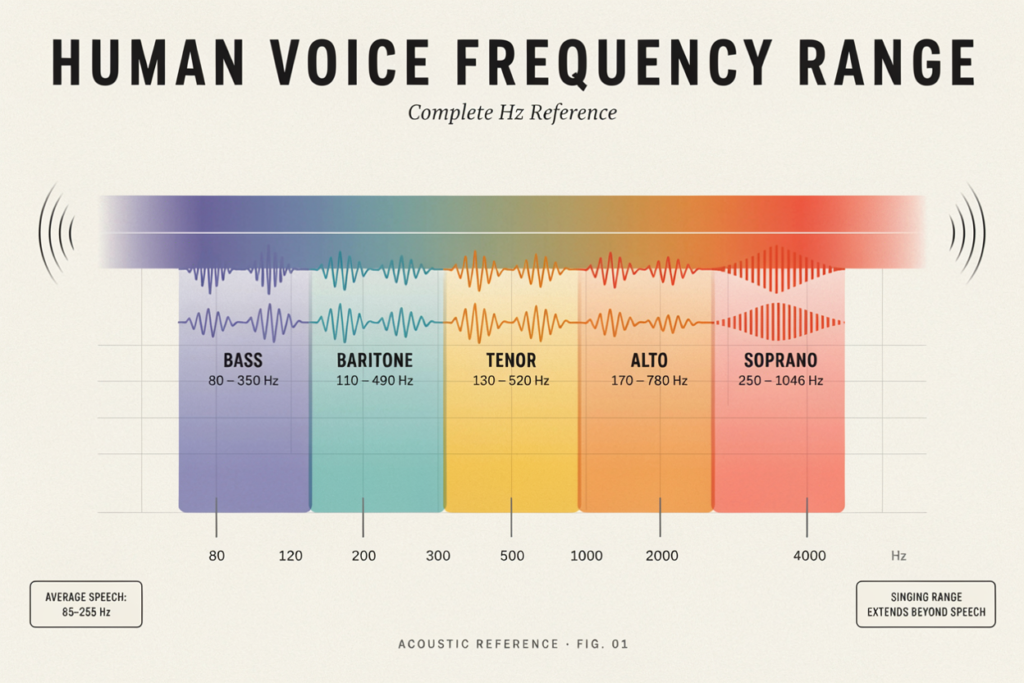
The human voice frequency range has no single pair of limits. Adult speaking pitch often centers around 100–150 Hz for men and 180–230 Hz for women, while common singing references extend from roughly 73 Hz for bass to 1,047 Hz for soprano. Harmonics and consonants carry useful energy several kilohertz higher.
These are references, not boundaries. Results differ between speech, sustained vowels, singing, and the complete acoustic signal.
What Is the Human Voice Frequency Range?
The human voice spans from low vocal-fold vibration rates below 100 Hz to acoustic energy extending beyond 8,000 Hz. A pitch reading measures fundamental frequency, or F0, whereas a microphone captures F0 plus harmonics, resonances, and noise-like consonant energy.
Why there is no single universal range
Different numbers answer different questions. Voice depth usually concerns speaking F0, singers need a musical range, and audio engineers may need the complete spectrum.
| Measurement | What it describes | Useful reference | What it does not mean |
|---|---|---|---|
| Speaking F0 | Average vocal-fold vibration during speech | Often about 100–150 Hz for adult men and 180–230 Hz for adult women | The complete sound spectrum |
| Singing-note range | Lowest to highest usable musical pitch | Roughly 73–1,047 Hz across common bass-to-soprano references | Every human limit |
| Full acoustic spectrum | Fundamental, harmonics, formants, and consonants | Extends several kilohertz above F0 | A person’s average pitch |
| Telephone band | Frequencies transmitted by traditional narrowband telephony | About 300–3,400 Hz | The natural limits of the voice |
For a visual comparison of conversational readings, the voice frequency reference chart explains how common Hz values relate to perceived pitch without treating them as strict labels.
Fundamental frequency versus the full spectrum
If the vocal folds vibrate 120 times per second, F0 is 120 Hz. Harmonics at 240, 360, and 480 Hz are shaped by the throat and mouth into that voice’s recognizable color.
What Is the Normal Speaking Voice Frequency Range?
Adult male speech commonly centers around 100–150 Hz, while adult female speech commonly centers around 180–230 Hz. These broad reference ranges overlap, and a person may move well above or below an average while emphasizing words, asking questions, showing emotion, or using vocal fry.
Typical adult speaking frequencies
A 2020 review reported approximately 100–150 Hz for adult male speaking F0 and 180–230 Hz for adult female speaking F0. Another study found averages of 78–182 Hz among men and 126–307 Hz among women, illustrating the overlap.
If your goal is to interpret a lower result, compare it with a more focused guide to typical male speaking pitch rather than assuming every value below a population average is abnormal.
Children, puberty, and aging
Children generally have higher F0 because their vocal folds are shorter and smaller. Puberty changes laryngeal anatomy, while aging can affect tissue flexibility, muscle condition, hormones, and respiratory support.
The direction and size of these shifts vary between people. The age-based voice depth guide provides context for life-stage patterns, but age never predicts one exact frequency.
What Frequencies Can the Singing Voice Produce?
Common classical voice categories cover approximately D2 at 73.4 Hz through C6 at 1,046.5 Hz. Exceptional singers can go beyond these reference notes, and voice type depends on comfortable tessitura, vocal color, register transitions, and endurance—not the highest or lowest note produced once.
Approximate ranges by classical voice type
| Voice type | Approximate note range | Approximate frequency range |
| Bass | D2–E4 | 73–330 Hz |
| Baritone | G2–G4 | 98–392 Hz |
| Tenor | C3–B4 | 131–494 Hz |
| Contralto | E3–F5 | 165–698 Hz |
| Mezzo-soprano | G3–A5 | 196–880 Hz |
| Soprano | B3–C6 | 247–1,047 Hz |
These are pedagogical ranges, not pass-or-fail rules. The bass range explained in notes adds context about low-register comfort, while the tenor range overview shows why overlapping notes do not guarantee the same voice type.
Why range and voice type are not identical
Vocal range spans your lowest to highest notes; tessitura is where you sing comfortably and consistently. Touching one tenor note does not make a baritone a tenor.
Why Does a Voice Contain Frequencies Higher Than Its Pitch?
A voice contains frequencies higher than its perceived pitch because vocal-fold vibration generates harmonics, and the vocal tract selectively strengthens frequency regions called formants. Unvoiced consonants such as /s/ and /f/ also create high-frequency, noise-like energy.
Harmonics and formants
For a 120 Hz F0, harmonics occur at 240, 360, 480 Hz, and upward. The vocal tract reshapes that pattern; resonance peaks called formants help listeners distinguish vowels.
Equal pitch does not guarantee equal depth. A longer vocal tract or different resonance can create a darker sound without lowering F0, as this explanation of vocal-fold anatomy and perceived depth shows.
High-frequency information and clarity
Research has found perceptually useful voice information above 8 kHz. Removing it may leave speech understandable while reducing naturalness and detail.
Is the Speech Range Really 300 to 3,400 Hz?
The 300–3,400 Hz range describes traditional narrowband telephone transmission, not the full range of frequencies a human voice creates. It was designed to preserve much of speech intelligibility while limiting bandwidth, so it omits low fundamentals and higher-frequency detail.
Pitch versus transmission bandwidth
A 110 Hz voice remains understandable over a telephone although F0 falls below 300 Hz. Higher harmonics preserve its periodic pattern, allowing the auditory system to infer the missing fundamental.
Wideband audio transmits more of the natural spectrum. The 300–3,400 Hz band therefore cannot define the lowest and highest notes humans produce.
How Can You Measure Your Voice Frequency?
Record several natural conversational samples in a quiet room, keep the microphone position consistent, and compare the median or average F0 across sessions. A browser-based or at-home check is an estimate, not a laboratory measurement, but a controlled setup can produce a useful, repeatable pitch profile.
Use a repeatable recording method
Speak normally for 20–30 seconds and repeat the recording three times. Avoid noise, echo, clipping, and changes in microphone distance.
A sustained vowel checks stable phonation; connected speech better represents everyday depth. The method for testing voice depth consistently explains how to compare them.
Watch for pitch-tracking errors
Vocal fry, breathiness, noise, and weak signals can confuse software. An octave error may report a 100 Hz voice near 200 Hz or 50 Hz. Repeat suspicious doubled or halved results.
What Can Voice Frequency Tell You—and What Can’t It?
Voice frequency can describe average pitch, pitch movement, and repeatable changes over time. Frequency alone cannot determine a singer’s voice type, a speaker’s identity, sex, gender, health, attractiveness, or how resonant and “deep” the voice sounds.
A result around 100 Hz may be perceived as low in many speaking contexts, but interpretation depends on the sample and comparison group. The guide to what counts as a deep voice in hertz adds that needed context.
A sudden, persistent pitch change accompanied by hoarseness, pain, breathiness, swallowing difficulty, or voice loss deserves evaluation by a qualified healthcare professional. Tracking F0 can document a change, but it cannot diagnose the cause.
Frequently Asked Questions
What is the lowest frequency a human voice can produce?
There is no universal lowest limit. Common bass reference ranges begin near D2, about 73 Hz, but some people can phonate below that through modal voice, vocal fry, or specialized singing techniques. An extreme sound is not necessarily a comfortable or usable singing note.
What is the highest frequency a human voice can produce?
Common soprano references extend to C6, about 1,047 Hz, while trained singers using upper registers may exceed it. The highest recorded human sounds are exceptional cases and should not be treated as normal range targets.
Is 100 Hz considered a deep voice?
In adult conversational speech, 100 Hz is generally on the low side and may sound deep. Perception also depends on resonance, timbre, loudness, and intonation, so 100 Hz does not guarantee the same vocal quality in every speaker.
Why is the telephone voice range only 300–3,400 Hz?
Traditional telephony uses a limited band that preserves much of the information needed for speech intelligibility while reducing transmission requirements. It excludes some low pitch energy and high-frequency detail, so it is not the voice’s complete natural range.
Do male and female voice-frequency ranges overlap?
Yes. Research samples show substantial overlap in average speaking F0, and pitch changes with age, anatomy, language, emotion, and speaking style. A frequency measurement should not be used by itself to classify sex or gender.
Is voice frequency the same as vocal range?
No. Voice frequency may refer to one instantaneous pitch or an average speaking F0, while vocal range is the span of notes a person can produce. Singing classification also considers tessitura, timbre, register transitions, and comfort.
Williams is a vocal depth and voice analysis writer at Deep Voice Test. He focuses on deep voice analysis, vocal frequency testing, pitch detection, and voice classification tools for singers, creators, speakers, and voice enthusiasts.