
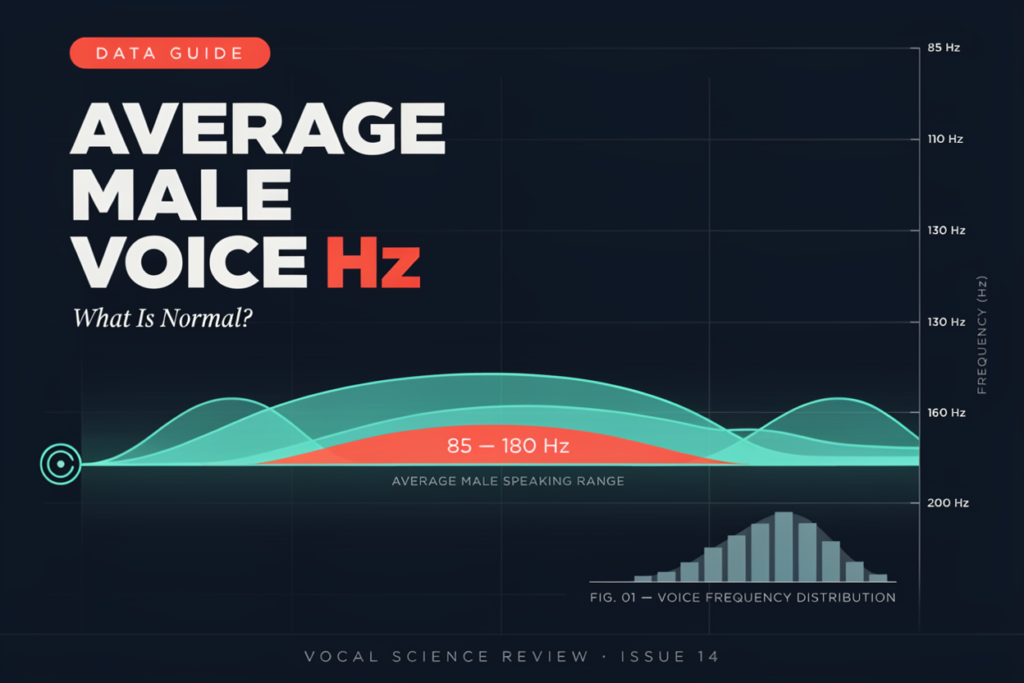
The average adult male speaking voice is roughly 110–125 Hz, measured as fundamental frequency. That figure is a population benchmark, not a pass-or-fail standard: one man may naturally average below 100 Hz, while another may average above 130 Hz, and both can have healthy voices.
Average male voice Hz can refer to habitual pitch, conversational variation, singing range, or the wider frequency spectrum in speech. These are related but different measurements.
What Is the Average Male Voice Frequency in Hz?
Most references place adult male speaking F0 around 110–125 Hz. The National Center for Voice and Speech uses about 125 Hz as a benchmark, while clinical studies report sample means near 112 Hz.
Fundamental frequency, abbreviated F0, is the rate at which the vocal folds repeat their vibration cycle. A frequency of 110 Hz means approximately 110 cycles per second. Listeners usually perceive a lower F0 as a lower pitch, although a voice-frequency chart is only a reference and cannot capture every quality that makes a voice sound deep.
| Reference | Male speaking result | What it represents |
|---|---|---|
| National Center for Voice and Speech | About 125 Hz | General adult-male benchmark |
| 2019 clinical acoustic study | 112.0 Hz | Mean F0 in that study’s normal male sample |
| Population study | 111.8 Hz | Mean speaking frequency in the studied men |
| Earlier reading study | 110.15 Hz | Mean during a controlled reading task |
The figures differ with participants, languages, speaking tasks, and recording methods. An average near 112 Hz and a reference near 125 Hz can both be valid; neither is a universal target.
What Is a Typical Male Speaking-Pitch Range?
A commonly cited male conversational range is approximately 85–155 Hz, but this is a broad reference span rather than a clinical boundary. A person’s voice rises and falls across words and sentences, so average F0 and moment-to-moment pitch range describe different things.
An earlier reading study reported a male mean near 110.15 Hz and an average span of roughly 81.95–158.50 Hz. One low syllable or excited phrase can therefore misrepresent habitual pitch.
| Frequency | Nearest equal-tempered note | Practical interpretation |
| 82.41 Hz | E2 | Low end of a broad male speech reference span |
| 98.00 Hz | G2 | Below common male averages, but not automatically unusual |
| 110.00 Hz | A2 | Close to several reported adult-male means |
| 123.47 Hz | B2 | Near the often-cited 125 Hz benchmark |
| 146.83 Hz | D3 | Upper part of a broad male conversational span |
Musical notes are landmarks, not diagnoses. A connected-speech median of 110 Hz sits near A2, but it does not make someone a bass or baritone. Compare conversational values with the full human voice frequency range rather than treating one number as a label.
What Does Voice Frequency Actually Measure?
When a pitch tracker displays a value such as 118 Hz, it is usually estimating fundamental frequency. It is not measuring every frequency present in the sound, and it does not completely describe how low, rich, bright, or resonant the voice seems.
Fundamental frequency and perceived pitch
F0 tracks how rapidly vocal-fold vibration repeats; pitch is the listener’s perception of that rate. Context and tracking errors can affect the result.
F0, harmonics, formants, and resonance
The vocal folds generate a fundamental plus harmonics. The vocal tract emphasizes frequency regions called formants, shaping vowels and timbre. Resonance and harmonic balance explain why two men averaging 115 Hz can sound different.
The traditional 300–3,400 Hz telephone band preserves speech intelligibility; it is not average vocal pitch. Our guide to what counts as a deep voice in Hz explains why F0 differs from the full audio spectrum.
Is Your Male Voice Deeper Than Average?
A sustained speaking average below roughly 110 Hz is lower than many reported adult-male means, while a result near 110–125 Hz sits around common benchmarks. A reading above 125 Hz may be higher than those benchmarks without being abnormal, unhealthy, or less masculine.
| Median connected-speech F0 | Cautious interpretation |
| Below 100 Hz | Relatively low compared with common adult-male means |
| 100–109 Hz | Somewhat below many published benchmarks |
| 110–125 Hz | Near commonly reported male averages |
| 126–140 Hz | Above common averages but within ordinary individual variation |
| Above 140 Hz | Relatively high for an adult male; context still matters |
These are descriptive bands, not medical thresholds. A comfortable voice can fall outside them. The contrast between a deep voice and a typical voice also depends on resonance, articulation, and vocal weight.
A single low note cannot establish voice depth. Use several samples and their median. Trackers may report half or double the true F0 when noise, vocal fry, or an unstable signal confuses the algorithm.
Why Does Average Male Voice Hz Vary?
Male speaking frequency varies with anatomy and voice use. Longer, thicker vocal folds generally vibrate more slowly, while muscular tension, airflow, and context continuously change pitch.
Puberty commonly lowers male pitch as the larynx and vocal folds grow. Pitch can continue changing, and voice depth across different ages places adult averages in context.
Language, emotion, loudness, fatigue, illness, hydration, and speaking task can shift F0. Reading may differ from relaxed conversation, and excitement often raises pitch. A sustained-vowel study should not be compared directly with spontaneous speech.
Is Speaking Voice Frequency the Same as Vocal Range?
Speaking frequency is not the same as singing range. Speaking F0 describes the pitches used in speech, usually summarized by a mean or median; vocal range covers the lowest and highest notes a person can phonate or sing under specified conditions.
Bass, baritone, and tenor classification depends on tessitura—the comfortable, resonant singing range—plus passaggi, timbre, and usable notes. A 105 Hz speech average does not identify a bass, and 130 Hz does not establish a tenor. The male vocal range reference chart is more appropriate for sung notes.
Two men who speak near A2 may have different tessituras and transition points. Classification requires observing the singing voice in use.
How Should You Measure Your Average Speaking Pitch?
Measure speaking pitch from several clean connected-speech samples in a comfortable voice. Use the median of stable voiced portions, not one vowel or the minimum shown.
- Record 30–60 seconds in a quiet room with the microphone about the same distance from your mouth each time.
- Read a neutral passage, then record a short sample of natural conversation or spontaneous speech.
- Avoid deliberately lowering your larynx, using exaggerated vocal fry, or speaking more loudly than usual.
- Repeat the process on two or three occasions and compare the medians.
- Review obvious octave errors and ignore unvoiced consonants that a tracker cannot analyze reliably.
Follow a structured method for checking your natural voice depth, but treat browser and phone results as estimates. Microphones, noise, algorithms, and the passage introduce variation.
Small changes are expected. Our explanation of voice-depth test accuracy covers tracking errors and why repeated medians beat one unusually low minimum. Persistent hoarseness, pain, sudden pitch change, or range loss warrants clinical assessment.
Frequently Asked Questions
Is 100 Hz a deep male voice?
An average speaking F0 of 100 Hz is below several commonly reported adult-male means of roughly 110–125 Hz, so it would usually be described as relatively low. The measurement should come from connected speech and repeated samples, not one deliberately lowered sound.
Is 120 Hz normal for an adult man?
Yes. A 120 Hz average sits within the commonly cited 110–125 Hz region. Healthy individual variation is wider.
What Hz range is considered a deep male voice?
There is no universal diagnostic cutoff for a deep male voice. A stable speaking average below about 100–110 Hz is relatively low compared with common male benchmarks, but resonance and delivery also affect perceived depth.
Can speaking pitch identify a bass or baritone?
No. Bass, baritone, and tenor are singing classifications based on usable range, tessitura, passaggi, and timbre, not speaking F0 alone. Two men with similar speaking averages can have different singing voice types.
Why does my measured voice frequency keep changing?
Pitch naturally moves during speech and responds to emotion, loudness, fatigue, language, and the sentence being spoken. Noise and pitch-tracking errors can add further jumps, including readings at half or double the actual fundamental.
Is male voice pitch the same as the 300–3,400 Hz speech band?
No. Male voice pitch usually refers to fundamental frequency, often around 110–125 Hz on average, while 300–3,400 Hz describes a traditional telecommunications band used to carry intelligible speech. The band includes parts of harmonics and formant information rather than defining vocal pitch.
Williams is a vocal depth and voice analysis writer at Deep Voice Test. He focuses on deep voice analysis, vocal frequency testing, pitch detection, and voice classification tools for singers, creators, speakers, and voice enthusiasts.