
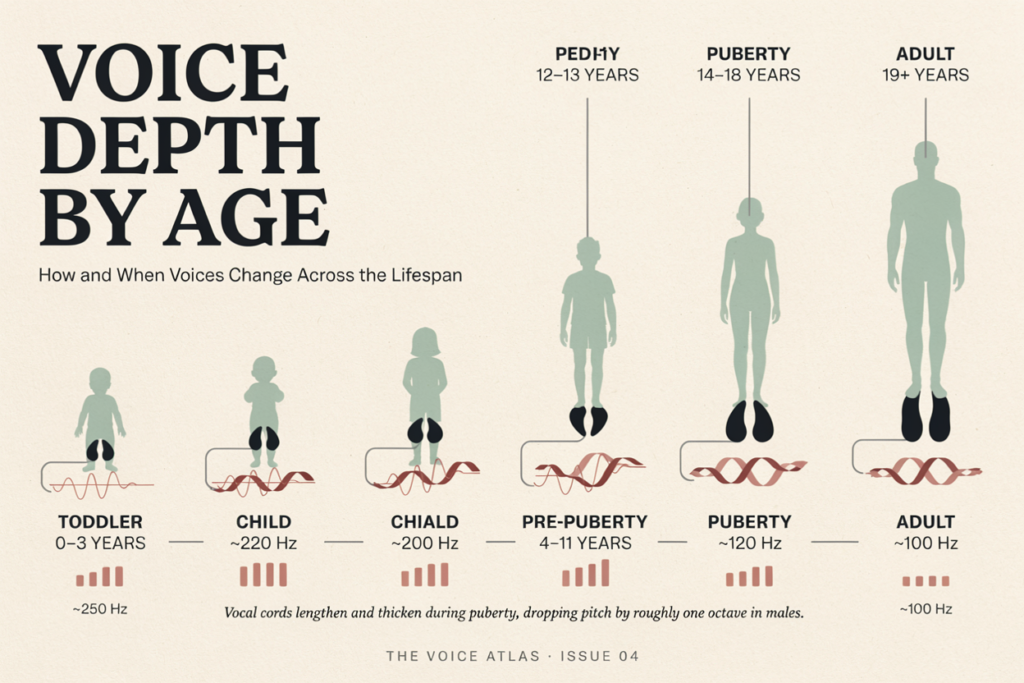
Voice depth changes most dramatically during puberty, usually remains relatively stable through early and middle adulthood, and may change again later in life. However, age alone cannot predict how deep a person’s voice will be. Genetics, hormones, vocal-fold anatomy, body size, health, and speaking habits all play important roles.
A “deep” voice generally has a lower fundamental frequency, measured in hertz (Hz), but depth is not determined by pitch alone. Resonance, vocal weight, tone, and the way sound is shaped in the throat and mouth also influence whether a voice sounds deep or light.
Voice Depth by Age at a Glance
| Life stage | Typical voice pattern | What is happening |
|---|---|---|
| Infancy | Very high pitch | The larynx and vocal folds are small |
| Childhood | High, light voice | Vocal folds gradually lengthen as the body grows |
| Puberty | Noticeable pitch drop | Hormones enlarge the larynx and make the vocal folds longer and thicker |
| Late teens to 20s | Voice settles and matures | Coordination, resonance, and vocal control continue developing |
| 30s to 50s | Usually fairly stable | Health, hormones, occupation, and vocal habits can cause gradual changes |
| 60s and beyond | Changes vary by person and sex | Muscle loss, tissue stiffness, hormonal shifts, and respiratory changes may affect pitch and strength |
These stages describe broad tendencies, not fixed standards. Two healthy people of the same age can have very different voices.
Why Does Voice Depth Change With Age?
Voice begins when air from the lungs passes through the vocal folds in the larynx and causes them to vibrate. In general, longer, thicker vocal folds vibrate more slowly and produce a lower fundamental frequency. Shorter, thinner folds tend to vibrate faster and produce a higher pitch.
Age can alter the larynx, vocal folds, hormones, lung support, muscle coordination, and vocal tract. A change may therefore affect pitch, resonance, volume, steadiness, or endurance—or several of them at once.
Voice Depth in Babies and Children
Babies have small larynges and short vocal folds, so their cries and early vocal sounds are naturally high. As children grow, their vocal folds lengthen and their vocal tract becomes larger. Their average pitch gradually falls, but voices before puberty generally remain higher and lighter than adult voices.
Before adolescence, voice differences between boys and girls are usually much smaller than they become after puberty. Individual variation is still normal. A child’s voice may sound temporarily rough or lower because of shouting, illness, allergies, or irritation, but persistent hoarseness should not be dismissed as ordinary growth.
How Puberty Makes the Voice Deeper
Puberty produces the most recognizable age-related change in voice depth. Hormonal changes cause the larynx to grow and the vocal folds to become longer and thicker. The vocal tract also enlarges, changing resonance.
The effect is usually more pronounced in testosterone-driven puberty. A clinical review published by the National Association of Teachers of Singing reports that the male speaking voice may fall by roughly an octave, while the female voice typically drops by only a few semitones. The same review gives approximate post-change speaking averages of 120–130 Hz for males and 220–225 Hz for females, but these are population averages rather than targets for individuals.
During this transition, a teenager may experience voice cracks, an unstable speaking pitch, temporary roughness, range changes, or reduced control at the extremes of the singing range.
Voice change does not happen on an identical schedule for everyone. It may begin earlier or later depending on genetics and pubertal development, and the voice can continue settling after the most obvious pitch drop has ended.
Does Your Voice Keep Getting Deeper in Your 20s?
For many people, the dramatic anatomical change is largely complete by the late teens, but the voice may continue to sound more mature in the early 20s. Better muscular coordination, a larger adult vocal tract, learned speaking habits, and improved breath control can make the tone sound fuller or more stable without causing a major drop in fundamental frequency.
Voice Changes From the 30s Through the 50s
Adult voice depth is often relatively stable during these decades. Still, subtle changes can occur because of hormones, pregnancy, menopause, medications, smoking, reflux, respiratory health, occupational voice use, or long-term technique.
Menopause can contribute to a lower speaking pitch or a different vocal quality in some women. Hormonal treatment and other medical factors may also influence the voice, although the effect varies considerably. In adults of any sex, a suddenly deeper or persistently hoarse voice should not automatically be attributed to age.
Does the Voice Get Deeper in Old Age?
Not always. Later-life voice change is more complicated than a steady descent in pitch.
In many older men, vocal-fold muscle loss and thinning can make the voice weaker, breathier, or even somewhat higher. In many older women, hormonal changes and tissue changes can lower the speaking pitch. Both may experience reduced projection, vocal fatigue, tremor, dryness, or less stable control.
Age-related weakening or atrophy of the voice mechanism is often called presbyphonia. It does not affect everyone equally, and a change in an older adult’s voice may also come from a treatable condition rather than normal aging.
Factors That Affect How Deep Your Voice Is
Age is only one contributor. Voice depth also depends on:
These include genetics; testosterone, estrogen, and thyroid hormones; laryngeal anatomy; colds, allergies, reflux, and dehydration; and habits such as smoking or frequent shouting. People also change pitch naturally with emotion, language, fatigue, and social context.
How to Measure Voice Depth by Frequency
Voice-analysis software can estimate fundamental frequency in Hz. Record 20–30 seconds of relaxed speech in a quiet room, keep the microphone distance consistent, and compare the median or average frequency across several recordings. Do not rely on one held note or the lowest detected value. Frequency measures pitch—not resonance, timbre, voice type, or vocal health—and an online result is not a diagnosis.
When Should You See a Voice Specialist?
Seek medical advice if a voice change is sudden, painful, progressively worsening, or accompanied by trouble swallowing or breathing. The National Institute on Deafness and Other Communication Disorders advises seeing a doctor when hoarseness lasts longer than three weeks, especially when it occurs without a cold or flu.
An ear, nose, and throat doctor can examine the larynx. A speech-language pathologist who specializes in voice can assess vocal function and provide appropriate therapy. Avoid forcing the voice lower while symptoms are present, since extra strain may worsen irritation.
How to Keep Your Voice Healthy as You Age
Stay hydrated, avoid smoke, rest during illness, and use amplification instead of shouting. Address reflux, allergies, or respiratory problems with professional guidance. Speak at a comfortable pitch, warm up gradually before demanding use, and seek qualified help when changes affect daily life. Healthy technique cannot prevent every effect of aging, but it can reduce unnecessary strain.
Frequently Asked Questions
At what age does your voice become deepest?
There is no universal age. The largest deepening usually occurs during puberty, after which the voice often settles through the late teens and early 20s. Later changes depend on hormones, health, anatomy, and sex.
Does a man’s voice get deeper after 30?
It may change subtly, but a major natural drop after 30 is not typical. Smoking, illness, hormones, reflux, or speaking habits can make a voice sound lower and should not automatically be mistaken for normal maturation.
Do women’s voices get deeper with age?
They can, particularly around and after menopause, but the amount varies. Changes in resonance and vocal quality may be more noticeable than a large pitch drop.
Can exercises permanently deepen your voice?
Training can improve resonance, breath support, and access to comfortable lower pitches. It cannot safely recreate the anatomical changes of puberty. Exercises that cause pain, persistent hoarseness, or throat pressure should be stopped.

Williams is a vocal depth and voice analysis writer at Deep Voice Test. He focuses on deep voice analysis, vocal frequency testing, pitch detection, and voice classification tools for singers, creators, speakers, and voice enthusiasts.