
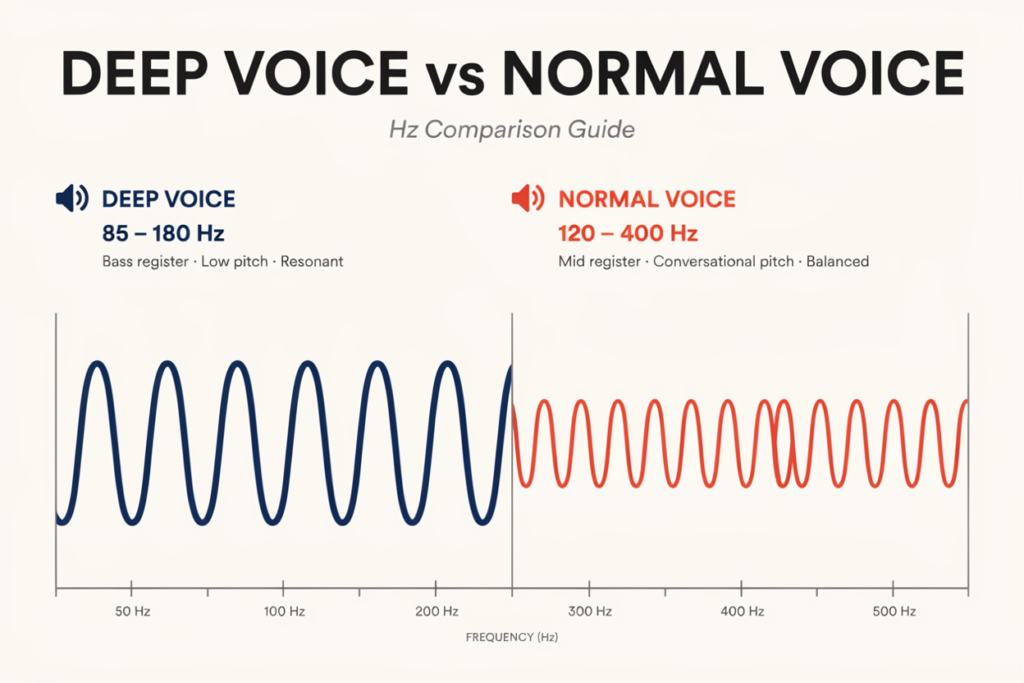
A deep voice has a lower habitual fundamental frequency than a comparable group. A “normal voice” is not a scientific voice type or healthier alternative; here, it means a voice near the relevant average.
Fundamental frequency, or F0, is the rate of vocal-fold vibration. Faster vibration produces a higher pitch, while slower vibration produces a lower one. Research-based estimates of the average male speaking frequency are more useful than a universal cutoff.
Deep voice versus average voice at a glance
| Feature | Deep voice | Average or typical voice |
|---|---|---|
| Habitual F0 | Lower than the relevant group average | Near the relevant group average |
| Perceived sound | Often described as low, dark, weighty, or rich | Often described as mid-pitched or neutral |
| Vocal-fold behavior | Usually slower repeated vibration during voiced speech | Usually a moderate vibration rate for the group |
| Resonance | May reinforce a darker or larger sound, but varies by person | May sound bright, dark, large, or light despite average pitch |
| Vocal health | Can be completely healthy | Can also be healthy or disordered |
| Singing classification | Does not automatically indicate bass or contralto | Does not determine a singing voice type |
Is there an exact Hz cutoff for a deep voice?
There is no universal frequency at which a voice suddenly changes from normal to deep. Published averages vary with age, sex-related anatomy, language, speaking task, microphone setup, and statistical method. A useful explanation of what counts as a deep voice in Hz therefore treats frequency bands as references rather than diagnostic boundaries.
A person might average 105 Hz in relaxed conversation but rise to 130 Hz while presenting or speaking excitedly. Voice depth describes a habitual pattern, not the lowest tracker reading.
How Do Deep and Average Voices Compare in Hz?
Deep voices generally have lower median speaking F0 values, but population averages are not pass-or-fail thresholds. Studies have reported adult male means near 112 Hz and adult female means ranging from roughly 161 to 196 Hz, depending on the sample and method.
Typical adult male and female frequencies
One general-population study reported mean speaking frequencies of about 111.8 Hz for men and 161.3 Hz for women. Another microphone-based study found approximately 112.0 Hz for men and 195.8 Hz for women. A reading-based study observed broader ranges of about 107–140 Hz for men and 170–240 Hz for women.
These figures overlap and should not be used to label an individual voice from a single recording. The broader voice Hz reference chart can help put a result in context, but the relevant comparison group and recording method still matter.
Why the measurement method changes the result
A sustained vowel is steady and easy for software to track, but it does not reproduce the pitch movement of connected speech. Reading aloud can also sound more formal and controlled than spontaneous conversation.
Consider a speaker whose five short samples have median values of 101, 106, 110, 104, and 109 Hz. The combined pattern centers near 106 Hz. A momentary 72 Hz detection at the end of a sentence may be vocal fry or a tracking error; reporting 72 Hz as the person’s voice frequency would misrepresent how the person normally speaks.
Why Does a Deep Voice Sound Different?
A deep voice usually sounds different because of lower F0, but pitch is only part of the result. Vocal-fold anatomy, vocal-tract resonance, formant frequencies, articulation, loudness, and speaking style all shape perceived depth.
Vocal-fold length, mass, and vibration
Longer or more massive vocal folds tend to vibrate more slowly, although tension, airflow, and muscular adjustments continually change their rate. Puberty-related laryngeal growth is one reason average speaking pitch often changes with age and sex-related development. Individual anatomy is also why two people cannot safely force identical results.
Resonance and formants
Formants are frequency bands strengthened by the shape and length of the vocal tract. Research on voice perception shows that F0 and formants provide separate information, which is why two people speaking the same note can sound strikingly different.
A speaker with average F0 may still sound dark because of lower formants, strong low-frequency energy, or a relaxed, full timbre. Conversely, someone with a low measured F0 may sound less imposing if the voice is breathy, lightly resonant, or delivered with narrow pitch variation. That distinction is central to understanding what makes a voice sound deep.
Does a Deep Speaking Voice Mean You Are a Bass?
A deep speaking voice does not automatically make someone a bass singer. Singing classification depends on usable range, tessitura—the area where the voice remains comfortable and resonant—plus timbre, registration, vocal weight, and how the voice functions across pitches.
Speaking pitch versus vocal range
Speaking F0 describes the pitch pattern used in speech. Vocal range describes the span from a singer’s lowest usable note to the highest usable note, while tessitura focuses on the pitches that can be sustained comfortably.
A low-speaking tenor may still sing most comfortably in tenor repertoire, and a baritone may occasionally produce a bass-like low note without having a bass tessitura. Comparing bass and baritone vocal ranges is more useful than classifying a singer from conversational Hz.
Deep female voices and contralto classification
Women can naturally have voices below the average female speaking pitch without having a disorder. In singing, contralto is the lowest principal female voice type, but a deep speaking voice by itself does not prove someone is a contralto. A full classification requires comfortable sung range, register transitions, tone, and tessitura.
Is a Deep Voice Better Than a Normal Voice?
Neither a deep voice nor an average-pitched voice is inherently better. Lower pitch can influence first impressions, but clear articulation, appropriate volume, pitch variation, pacing, and vocal comfort usually matter more for effective communication.
Perception is not personality
Listeners may associate lower male voices with size, maturity, dominance, or strength. Those perceptions do not reliably measure confidence, honesty, competence, intelligence, or character. Listeners also respond to several vocal features at once.
This is why claims about voice depth and personality need careful interpretation. A person can sound authoritative with an average pitch through deliberate pacing and precise diction, while an extremely low monotone may be harder to understand.
Healthy variation matters
An expressive voice moves through a range of pitches. Habitually suppressing that movement to sound deeper can make speech less natural, and forcing the larynx downward or pressing the vocal folds may produce fatigue or discomfort. Comfortable resonance is a safer goal than chasing a particular number.
How Can You Tell Whether Your Voice Is Deep?
Record several relaxed speech samples and compare their median F0 with suitable age- and sex-group references. Use normal conversation or a standard reading passage, keep the microphone distance consistent, and ignore isolated minimum readings.
A browser-based voice-depth test and its accuracy limits can provide an estimate, not a clinical measurement. Pitch trackers may mistake background noise, vocal fry, breathiness, or octave-related harmonics for the fundamental frequency.
For a better home check, record three to five 20–30-second samples on different days. Speak comfortably, then compare the medians. A stable pattern matters more than one unusually low syllable.
Persistent hoarseness, pain, vocal fatigue, loss of range, or a sudden unexplained pitch change is different from a naturally low voice. Those symptoms warrant guidance from an ear, nose, and throat doctor or a speech-language pathologist; the distinction between natural depth and potential deep-voice health concerns should never depend on Hz alone.
Frequently Asked Questions
What Hz is considered a deep voice?
There is no universal cutoff. A voice is better described as deep when its habitual speaking F0 is meaningfully below the average for a comparable age, sex, language, and measurement task.
Is a deep voice healthier than a normal voice?
No. Naturally deep and average-pitched voices can both be healthy; health is judged by comfort, clarity, stamina, tissue function, and the absence of persistent symptoms rather than pitch alone.
Can a woman naturally have a deep voice?
Yes. Female speaking pitch varies widely because of anatomy, age, hormones, language, and individual vocal habits. A naturally low female voice is not automatically abnormal or evidence of a contralto singing classification.
Why does my voice sound deep when its measured pitch is average?
Lower formants, strong resonance, timbre, articulation, and delivery can make a statistically average F0 sound darker or larger. Frequency software measures pitch more readily than it captures the complete perceptual character of a voice.
Can forcing a lower speaking pitch damage your voice?
Habitual pressing, excessive tension, or speaking below a comfortable pitch can cause strain and fatigue. Stop if lowering your voice causes pain, hoarseness, or reduced endurance, and seek professional assessment if symptoms persist.

Williams is a vocal depth and voice analysis writer at Deep Voice Test. He focuses on deep voice analysis, vocal frequency testing, pitch detection, and voice classification tools for singers, creators, speakers, and voice enthusiasts.