
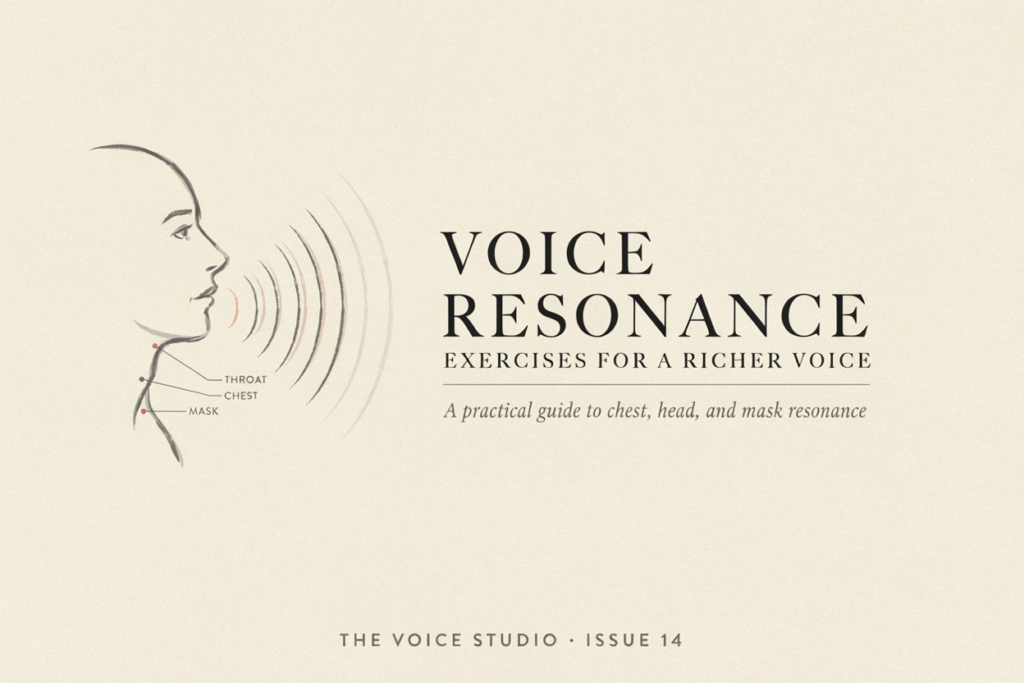
Voice resonance exercises use easy sounds such as humming, lip trills, straw phonation, and nasal consonants to coordinate the vocal folds with the vocal tract. When practiced without strain, they can make speaking or singing feel easier and sound clearer, fuller, and better projected.
Resonance is not the same as pitch. Pitch is mainly related to how quickly the vocal folds vibrate, while resonance describes how the throat, mouth, tongue, lips, and other parts of the vocal tract filter that sound. If you want the anatomical background first, this guide to how the vocal folds and vocal tract shape voice depth explains the distinction.
What Are Voice Resonance Exercises?
Voice resonance exercises train an efficient, clear tone without throat squeezing or excessive air. Many use a narrowed opening that creates gentle resistance above the vocal folds.
These practices are often called semi-occluded vocal tract exercises. “Semi-occluded” means partially closed: humming closes the lips, while straw phonation sends sound through a narrow tube. Resonant Voice Therapy similarly moves from easy humming and nasal sounds into conversation.
You may notice buzzing around the lips, nose, or front of the face. Teachers sometimes call this “forward placement,” but it is best treated as sensory feedback, not an anatomical destination for the voice. The air column in the vocal tract shapes the sound; you do not need to force vibration into your face.
How Do You Practice Voice Resonance Exercises?
A useful resonance routine moves from releasing unnecessary tension to easy semi-occluded sounds, then into vowels, words, and ordinary speech or singing. The entire sequence can take about 8–10 minutes, but comfort matters more than completing every step.
1. Release Jaw, Tongue, and Neck Tension
Keep your head balanced, let your jaw hang loosely, and rest the tongue tip near the lower front teeth. Take two or three quiet breaths without lifting the shoulders. If breathing feels unstable, practice low-effort breathing for a steadier voice before adding sound.
2. Begin With Gentle Humming
Hum “mm” at a comfortable speaking pitch for three to five seconds. Repeat five times at conversational volume, pausing for an easy breath. A mild lip or facial buzz is common, but do not press harder to increase it.
3. Use Lip Trills
Let the lips flutter on a relaxed “brrr.” Start on one easy note, then glide up and down through a small, comfortable pitch range. Use only enough air to keep the lips moving. If the trill stops unless you blow forcefully, support the cheeks lightly with your fingers or return to humming.
4. Practice Straw Phonation
Sustain a soft “oo” through a narrow straw, then make gentle pitch glides without reaching for extreme notes. Straw phonation should feel easier than open-mouth singing, not louder.
5. Move From Nasal Sounds Into Vowels
Connect “m,” “n,” or “ng” to an open vowel: “mee,” “moh,” “nee,” or “ng-ah.” Try five comfortable repetitions of each pattern. Preserve the easy onset as the mouth opens; do not hold the nose closed or exaggerate a nasal tone.
6. Use Resonant Words and Sentences
Practice phrases rich in “m” and “n,” such as “many mornings.” Then speak a normal sentence with the same easy quality. The goal is not a nasal sound, but efficient vibration after the consonant cue disappears.
7. Transfer the Coordination Into Speech or Singing
Read two or three lines aloud or sing a short phrase at a comfortable pitch. Compare the effort before and after the routine. Singers should also understand the coordination differences between head voice and chest voice, because register changes can alter both sensation and tone even when resonance remains efficient.
Which Exercise Should You Use for Each Vocal Goal?
Choose the exercise that reduces effort and produces a repeatable improvement, then transfer it into real speech or singing.
| Exercise | Main goal | Useful feedback | Common mistake |
|---|---|---|---|
| Gentle humming | Easy onset and clear tone | Light lip or facial buzz | Pressing for louder vibration |
| Lip trill | Balanced airflow and fold vibration | Steady, easy flutter | Blowing too much air |
| Straw phonation | Reduced effort and smooth pitch glides | Consistent sound through the straw | Using a pitch range that is too wide |
| “M,” “N,” or “NG” into vowels | Carrying resonance into open sounds | Tone remains clear as the mouth opens | Making every vowel nasal |
| Resonant phrases | Transfer into communication | Speech feels clear at moderate volume | Returning to throat pressure for projection |
For a warmer speaking quality, resonance work can be combined with the safe coordination ideas in these exercises for developing a fuller voice. Avoid treating warmth as a command to force the larynx downward.
How Often Should You Practice Resonance Exercises?
Practice for 5–10 comfortable minutes once or twice daily. Short sessions make improving efficiency or growing fatigue easier to notice.
A Short Daily Practice Plan
Use two minutes each of tension release, humming or lip trills, and straw glides, followed by two minutes of words or song phrases. On demanding days, reduce the duration rather than increasing effort.
How to Measure Progress
Judge progress by ease, clarity, consistency, and recovery. Record the same sentence at a similar microphone distance weekly. Browser and phone measurements are estimates affected by the microphone, room noise, and speaking style; see how at-home voice-depth checks work for a careful method.
Can Resonance Exercises Make Your Voice Deeper?
Resonance exercises may make a voice sound warmer, fuller, or less thin, but they do not necessarily lower fundamental frequency or create a permanent anatomical change. A listener may perceive more depth because the vocal tract emphasizes different harmonics even when the speaking pitch changes very little.
Resonance Versus Fundamental Frequency
Fundamental frequency is the rate at which the vocal folds repeat each vibration cycle. Resonance shapes the harmonics above it. Two people can therefore share a similar pitch yet differ in warmth or brightness; a human voice frequency overview adds context.
Why Forcing a Low Pitch Backfires
Deliberately dragging the voice below its comfortable range can create vocal fry, instability, or throat tension. If your aim is lower-sounding speech, work on easy resonance, pacing, articulation, and a pitch that remains comfortable. The safer principles in speaking with a naturally fuller, lower sound focus on coordination rather than pressure.
What Mistakes Make Resonance Practice Less Effective?
The most common errors are chasing facial vibration, pressing for volume, forcing an artificially low pitch, and repeating an exercise after the voice becomes tired. Effective practice should make sound easier to produce, not merely create a dramatic sensation.
More airflow does not guarantee more resonance. Excess breath can destabilize phonation, while squeezing trades comfort for temporary loudness. Avoid copying another person’s tone exactly because vocal tracts and coordination differ.
When Should You Stop and Seek Professional Help?
Stop an exercise if it causes pain, burning, increasing tightness, loss of range, or worsening hoarseness. Persistent or unexplained voice changes deserve assessment by an ear, nose, and throat physician or a speech-language pathologist with voice expertise.
Breathing difficulty, swallowing difficulty, coughing blood, a neck mass, or a sudden major voice change requires prompt medical attention. Self-guided exercises are not a substitute for diagnosis. For general prevention habits, review these voice-health practices for avoiding strain.
Frequently Asked Questions
How long does it take to improve vocal resonance?
Some people notice easier sound during the first session, but making that coordination habitual can take weeks of regular practice. The timeline depends on vocal health, technique, daily voice demands, and whether an underlying disorder is present.
Can humming make your voice more resonant?
Gentle humming can encourage efficient phonation and provides clear sensory feedback at the lips and face. The benefit comes from easier coordination, not from forcing the buzzing sensation to become stronger.
Do resonance exercises make your voice permanently deeper?
Resonance practice can change tone quality and perceived fullness, but it does not reliably or permanently lower fundamental frequency. Lasting pitch changes are influenced by anatomy, hormones, age, health, and learned vocal habits.
Where should you feel vocal resonance?
You may feel light vibration around the lips, nose, mouth, or chest, depending on the sound and pitch. There is no single required location; prioritize an easy throat and a clear, stable tone rather than chasing a specific sensation.
Can you practice voice resonance exercises every day?
Yes, brief daily practice is usually reasonable when the voice feels healthy and the exercises remain comfortable. Reduce or stop practice if hoarseness, pain, or fatigue increases.
Why does my throat hurt during resonance exercises?
Throat pain can signal excessive pressure, an unsuitable pitch, too much volume, poor coordination, or an underlying vocal issue. Stop rather than pushing through pain, and seek professional evaluation if the symptom persists or recurs.

Williams is a vocal depth and voice analysis writer at Deep Voice Test. He focuses on deep voice analysis, vocal frequency testing, pitch detection, and voice classification tools for singers, creators, speakers, and voice enthusiasts.