
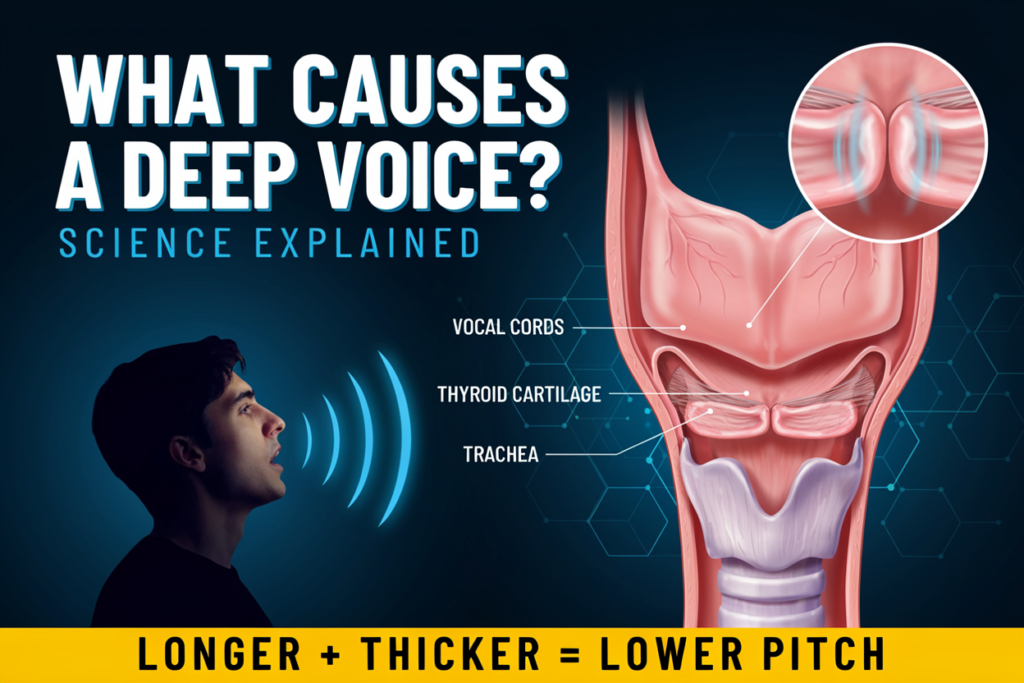
A deep voice is mainly caused by long, thick vocal folds that vibrate slowly, creating a low fundamental frequency. Genetics, hormones, anatomy, age, health, resonance, and speaking habits influence the result.
What Causes a Deep Voice Physically?
The primary physical cause of a deep voice is slow vocal-fold vibration. Fundamental frequency, often shortened to F0, measures how many vibration cycles occur each second in hertz (Hz). Fewer cycles per second produce a lower pitch.
Vocal-Fold Length, Thickness, and Mass
Longer, thicker vocal folds usually carry more mass and vibrate more slowly than shorter, thinner folds.
The vocal folds sit inside the larynx, or voice box. Air from the lungs passes between them, and controlled muscular tension helps set their vibration. Their layered tissue, hydration, elasticity, and closure pattern affect tone as well as pitch. Our guide to how vocal-fold structure influences depth explains this mechanism in more detail.
Larynx Size and Vocal-Tract Length
A larger larynx can accommodate longer vocal folds, but visible neck anatomy does not reveal exact pitch. The Adam’s apple is the front of the thyroid cartilage; a prominent one may accompany laryngeal growth, but it does not act as a reliable voice-depth gauge.
The vocal tract—the airspace above the larynx through the throat and mouth—also matters. A longer tract tends to produce lower formants, the resonant frequency bands that shape vocal color. Formants do not equal fundamental frequency, but lower formants can make a voice sound darker.
How Do Hormones and Genetics Affect Voice Depth?
Hormones and genetics affect voice depth mainly by guiding how the larynx, vocal folds, and vocal tract develop. Testosterone-driven puberty often causes substantial laryngeal growth, while inherited traits influence anatomy and the way each person responds to development.
Testosterone-Driven Puberty
During testosterone-driven puberty, the larynx grows and the vocal folds become longer and thicker. Pitch may be unstable while the tissues and coordination adjust, then usually settles lower. A review of sex hormones and voice physiology describes androgen-related laryngeal growth as a central mechanism.
The effect varies greatly. Puberty timing, hormone sensitivity, anatomy, and genetics all contribute, so testosterone level alone cannot predict a person’s finished pitch. The separate guide on how testosterone changes the voice also explains why additional testosterone is not a dependable pitch-lowering method for a healthy adult whose larynx has already matured.
Inherited Anatomy, Not One “Deep-Voice Gene”
Voice depth can run in families because traits such as laryngeal dimensions, vocal-fold length, vocal-tract length, and patterns of physical maturation have genetic components. There is no single known gene that fixes a person at one pitch.
Relatives can therefore sound alike without having identical voices. Hormonal development, health, language, accent, learned delivery, and daily voice use add variation. For a closer look at heredity without oversimplifying it, see the explanation of which voice traits can be inherited.
What Else Makes a Voice Sound Deep?
Resonance, vocal weight, intonation, articulation, and speaking habits can make a voice sound deeper even when its fundamental frequency changes little. Pitch is measurable vibration rate; perceived depth is the listener’s combined impression of pitch, tone, and delivery.
| Factor | What it changes | Anatomical, trainable, or temporary? | Likely effect |
|---|---|---|---|
| Vocal-fold length and mass | Fundamental frequency | Mainly anatomical | Longer, heavier folds tend to lower pitch |
| Vocal-tract length | Formant frequencies | Mainly anatomical | Can create a larger, darker tone |
| Resonance strategy | Where sound energy is emphasized | Trainable | Can make the voice sound fuller |
| Intonation | Pitch movement across phrases | Trainable | Less upward movement may be perceived as grounded |
| Breath and tension | Stability, efficiency, and tone | Trainable | Balanced coordination can reduce thin or strained sound |
| Swelling or irritation | Fold mass and vibration | Temporary or medical | May lower pitch but often adds hoarseness |
Pitch Versus Resonance
Two speakers could average the same F0 yet differ in perceived depth because their formants, vocal weight, articulation, and intonation differ. This is why a simple Hz reading describes pitch but not the whole voice. A reference chart for voice frequencies can provide context, but its ranges are descriptive rather than diagnostic boundaries.
Resonance exercises may help you find a fuller, less constricted sound. They cannot lengthen mature vocal folds or reproduce puberty-driven anatomical change. Safe practice feels comfortable and does not rely on forcing the larynx downward; these exercises for balanced vocal resonance focus on coordination instead of strain.
Breath, Posture, and Speaking Technique
Breath pressure that is too weak can produce an unstable sound, while excessive pressure can invite throat tension. Efficient speech uses steady airflow and easy vocal-fold closure. Neutral posture can also give the ribs, neck, and jaw room to work without unnecessary bracing.
Speaking more slowly, using clear consonants, and reducing habitual upward inflection may create a calmer or more grounded impression. Lowering every sentence mechanically or pressing for the lowest possible pitch often sounds artificial and can fatigue the voice. Training should improve ease, consistency, and resonance rather than chase one low number.
Can Age, Health, or Lifestyle Make Your Voice Deeper?
Age, health, and lifestyle can change pitch or tone, but a lower sound is not always a healthy deep voice. Normal maturation may create lasting anatomical depth; infection, irritation, swelling, or a voice disorder may create a sudden low, rough sound that needs attention.
Normal Changes Across the Lifespan
Children generally have shorter, thinner vocal folds than adults. Puberty produces the most obvious structural shift, but voices continue changing later through hormonal changes, tissue stiffness, muscle loss, and respiratory changes. Aging does not move every voice in the same direction: some become higher, others lower, and many become less stable or less powerful. The overview of voice depth at different ages gives this variation more context.
Body size alone is not destiny. External size cannot reveal vocal-fold thickness, tension, or fine laryngeal proportions. A small person can naturally have a low voice, and a large person can have a high one.
Temporary Hoarseness Is Not Healthy Depth
Colds, allergies, reflux, dehydration, shouting, smoking, and vocal overuse can irritate or swell the folds. Swollen folds may vibrate more slowly, but the accompanying roughness, effort, or loss of range is dysfunction rather than a useful deepening method. Smoking is especially unsafe and should never be treated as voice training.
Seek medical assessment from an ear, nose, and throat physician or qualified voice clinic for an unexplained change that persists, particularly with pain, breathing or swallowing difficulty, coughing blood, a neck lump, or severe voice loss. The guide to distinguishing depth from unhealthy symptoms covers additional warning signs.
Measuring Whether a Voice Is Deep
A pitch tracker can estimate average F0, but one short sample is not a diagnosis. Noise, vocal fry, emotion, and the words spoken can shift the result. Record several natural sentences and compare the average instead of treating the lowest moment as your true speaking pitch.
Sex- and age-based Hz ranges overlap, so there is no universal cutoff that makes every voice “deep.” A more useful assessment combines habitual pitch, resonance, comfort, stability, and how the voice behaves across speech. For a repeatable process, follow the steps for checking your natural voice depth.
Frequently Asked Questions
Does a bigger Adam’s apple cause a deeper voice?
A prominent Adam’s apple can accompany a larger larynx, but it does not directly determine pitch. Vocal-fold length, thickness, tension, and the rest of the vocal tract matter more than the cartilage’s visible outline.
Is voice depth inherited from your mother or father?
Voice traits can be inherited from both sides of a family. Many genes and developmental factors influence laryngeal anatomy, hormone response, vocal-tract shape, and body growth, so voice depth does not follow a simple mother-versus-father rule.
Does higher testosterone always produce a deeper voice?
No. Testosterone-driven development often deepens the voice during puberty or medically supervised masculinizing therapy, but blood level alone does not predict the outcome. Extra testosterone may not lower an already mature adult voice and carries medical risks when used without an appropriate prescription.
Can a small person naturally have a deep voice?
Yes. Height and overall body size do not precisely predict vocal-fold dimensions or habitual pitch. A smaller person can have relatively long or thick vocal folds, a resonant vocal tract, or speaking habits that create a naturally deep sound.
Why has my voice suddenly become deeper or hoarse?
A sudden change may come from infection, swelling, reflux, allergy, overuse, medication effects, or another voice condition. Rest and hydration may help minor short-lived irritation, but persistent or concerning symptoms warrant professional evaluation.
Can voice exercises permanently deepen your voice?
Exercises can improve resonance, efficiency, breath coordination, and speaking habits, which may make the voice sound fuller. They do not permanently lengthen mature vocal folds, and forcing an unnaturally low pitch can cause strain.

Williams is a vocal depth and voice analysis writer at Deep Voice Test. He focuses on deep voice analysis, vocal frequency testing, pitch detection, and voice classification tools for singers, creators, speakers, and voice enthusiasts.