
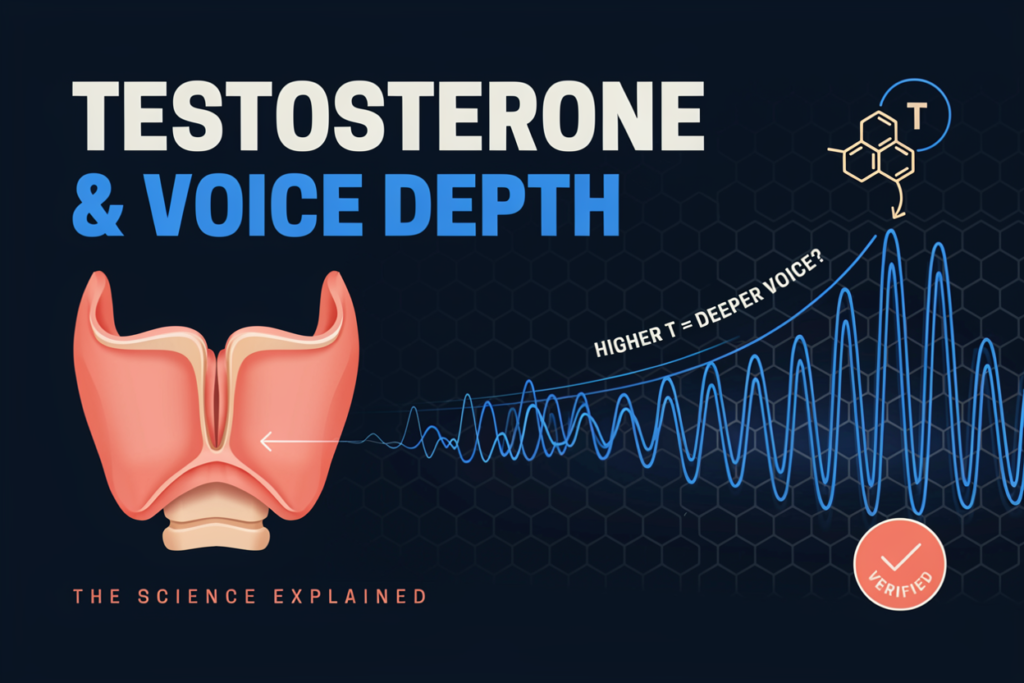
Testosterone can deepen the voice by enlarging the larynx and making the vocal folds longer and thicker. The effect is strongest during androgen-driven puberty or medically supervised masculinizing hormone therapy, varies from person to person, and can be permanent. Taking more testosterone after the voice has matured does not guarantee a lower voice.
How Does Testosterone Affect Voice Depth?
Testosterone acts on androgen-sensitive tissues in the larynx, the structure that contains the vocal folds. During androgen-driven development, the larynx grows and the vocal folds gain length, thickness, and vibrating mass. Heavier folds generally vibrate more slowly, lowering fundamental frequency, or F0—the acoustic rate measured in hertz that listeners mainly perceive as pitch.
A medical review of sex hormones and voice physiology describes androgen receptors in laryngeal tissue and substantial vocal-fold growth during puberty. Cleveland Clinic says puberty-related changes to vocal-fold size are generally irreversible.
Pitch is only one part of a deep sound
Lower F0 can make a voice sound deeper, but vocal-tract resonance, vocal weight, articulation, pacing, and speaking habits also matter. Two people producing the same 120 Hz fundamental can sound different.
The underlying mechanics are easier to understand through vocal-fold anatomy and voice depth. That distinction also explains why changing resonance can alter the character of a voice without changing its pitch dramatically.
When Does Testosterone Deepen the Voice?
Testosterone most predictably lowers pitch when vocal folds have not already undergone substantial androgen-driven growth. That usually means puberty or masculinizing hormone therapy. The timing, extent, and final sound remain individual.
Voice changes during puberty
During androgen-driven puberty, laryngeal growth can produce cracking, instability, and temporary difficulty controlling pitch. The voice usually settles as coordination adapts. Genetics, hormone exposure, and original laryngeal dimensions affect the outcome, so puberty does not give everyone the same adult frequency.
Hormones are therefore one part of what causes a voice to sound deep, not a complete explanation. Inherited anatomy can influence how the larynx responds and how large the resonating vocal tract becomes.
Voice changes during masculinizing hormone therapy
Masculinizing testosterone therapy can initiate comparable changes after adolescence. UCSF’s Gender Affirming Health Program says early effects may include scratchiness, hoarseness, voice breaks, or instability before a lower pitch stabilizes. There is no universal schedule.
In one prospective study of seven trans men, all participants reached the mean fundamental-frequency range reported for cisgender men within six months, while four continued to show lowering afterward. A separate longitudinal study reported group mean F0 values of roughly 155 Hz after six months and 132 Hz after twelve months. These averages show a trend, not a promised personal result; individual voices and satisfaction varied.
| Context | Likely vocal response | Is the change permanent? | Main caution |
|---|---|---|---|
| Androgen-driven puberty | Substantial laryngeal growth and lower F0 are common | Structural effects generally persist | Timing and final pitch vary |
| Masculinizing testosterone therapy | Pitch often lowers over months, sometimes with instability first | Some structural changes may persist after stopping | Dose and monitoring require a qualified clinician |
| Testosterone replacement in an adult man | A dramatic additional drop is not predictable after completed puberty | Depends on whether any change occurs | TRT treats a medical condition, not a voice preference |
| Anabolic-steroid misuse | Voice change is unpredictable; other serious effects are possible | Androgen-related vocal changes may be lasting | Unsupervised use carries substantial health risks |
Are Testosterone-Related Voice Changes Permanent?
Structural testosterone-related changes can be permanent because stopping the hormone does not reliably shorten or thin vocal folds that have already grown. Pitch may continue to settle as coordination improves, but the earlier voice should not be assumed to return.
A clinician can explain systemic effects, monitor laboratory values, and discuss which changes may not reverse. Testosterone should never be adjusted solely because of an online pitch measurement.
Temporary hoarseness during a changing period is different from persistent vocal trouble. Pain, loss of voice, ongoing roughness, or hoarseness lasting more than a few weeks warrants assessment by an ear, nose, and throat clinician or a voice-specialized speech-language pathologist. The broader relationship between symptoms and vocal function is covered in this guide to maintaining a healthy deep voice.
Does More Testosterone Always Mean a Deeper Voice?
No. Current testosterone level and adult voice depth do not follow a simple dose-to-pitch relationship. The adult voice reflects past pubertal exposure, genetics, laryngeal dimensions, age, health, learned technique, and resonance—not merely the hormone concentration in a blood test today.
Deep voice does not prove high testosterone
A naturally low voice cannot diagnose high testosterone, and a higher voice cannot diagnose low testosterone. Hormone disorders require symptoms, clinical history, examination, and properly timed laboratory testing. A pitch detector measures sound; it does not measure endocrine function.
Adult TRT is not a voice-deepening shortcut
Once an adult larynx has completed substantial androgen-driven growth, extra testosterone may not create another puberty-like transformation. Testosterone replacement therapy is intended for an appropriately diagnosed medical condition and should be prescribed and monitored by a clinician. Using testosterone or anabolic steroids purely to chase a lower pitch exposes the whole body to risk for an uncertain vocal result.
This is also why genetics and deep-voice inheritance must be considered alongside hormones. People with similar hormone levels can develop different voices because their anatomy and developmental histories differ.
What Else Determines How Deep a Voice Sounds?
Voice depth emerges from several interacting factors. Testosterone can influence the instrument, especially during development, while speech behavior determines how that instrument is used.
| Factor | What it can change | What it cannot establish alone |
| Genetics and anatomy | Vocal-fold dimensions and vocal-tract size | Current hormone level |
| Age and development | Tissue structure, control, and sometimes pitch stability | A fixed pitch for every person of the same age |
| Resonance | Dark, warm, bright, or large vocal quality | The fundamental frequency by itself |
| Speaking technique | Habitual pitch, pacing, clarity, and vocal weight | Permanent anatomical growth |
| Illness or irritation | Temporary swelling, roughness, or pitch change | A healthy or desirable deeper voice |
| Recording conditions | Measured pitch accuracy and perceived bass response | The speaker’s true anatomy |
Normal age-related patterns appear in how voice depth changes across life. Smoking, reflux, infection, dehydration, and overuse can make a voice rougher or temporarily lower, but that is not healthy testosterone-driven development.
Can You Safely Make Your Voice Sound Deeper Without Testosterone?
You can often create a fuller or more grounded sound through efficient resonance, breath coordination, pacing, and a comfortable habitual pitch. Training does not enlarge the larynx like puberty, but it can change how listeners perceive the voice.
Avoid forcing the larynx downward, squeezing the throat, or sustaining the lowest possible note. A useful speaking voice should remain clear and repeatable without pain, increasing effort, or lingering hoarseness. Gentle resonance work and coordinated breathing are safer starting points than pushing pitch below its sustainable range.
For practical options, use evidence-aware methods for making a voice sound deeper and treat browser-based Hz readings as estimates rather than medical measurements. Anyone considering testosterone for gender affirmation or a diagnosed endocrine condition should discuss goals with the appropriate clinician; someone seeking vocal change can also benefit from a voice-specialized speech-language pathologist.
Frequently Asked Questions
Does a deep voice mean you have high testosterone?
No. Adult voice depth reflects anatomy, pubertal development, genetics, age, resonance, and speaking habits. A voice recording cannot determine a person’s current testosterone level.
Will testosterone deepen an adult man’s voice?
Testosterone replacement does not reliably produce a dramatic additional drop after androgen-driven puberty has already changed the larynx. TRT should be used for a clinically established indication, not as a voice-deepening treatment.
How quickly can a voice change after starting testosterone?
Some people notice scratchiness, instability, or pitch change within weeks, while larger changes often develop over several months. Published group averages cannot predict one person’s timeline or final pitch.
Does the voice return to its original pitch after stopping testosterone?
Not necessarily. Vocal-fold growth caused by testosterone can persist, so stopping treatment may not restore the previous pitch. Decisions about changing therapy should be made with the prescribing clinician.
Can low testosterone cause a high-pitched voice?
Insufficient androgen exposure before or during puberty can affect laryngeal development, but an adult’s higher pitch alone does not diagnose low testosterone. Proper endocrine evaluation requires clinical context and laboratory testing.
Is it safe to take testosterone solely to deepen your voice?
No medical treatment is risk-free, and testosterone affects far more than the voice. Taking it without an appropriate indication and clinical supervision can cause systemic harm while offering no guaranteed vocal result.

Williams is a vocal depth and voice analysis writer at Deep Voice Test. He focuses on deep voice analysis, vocal frequency testing, pitch detection, and voice classification tools for singers, creators, speakers, and voice enthusiasts.