
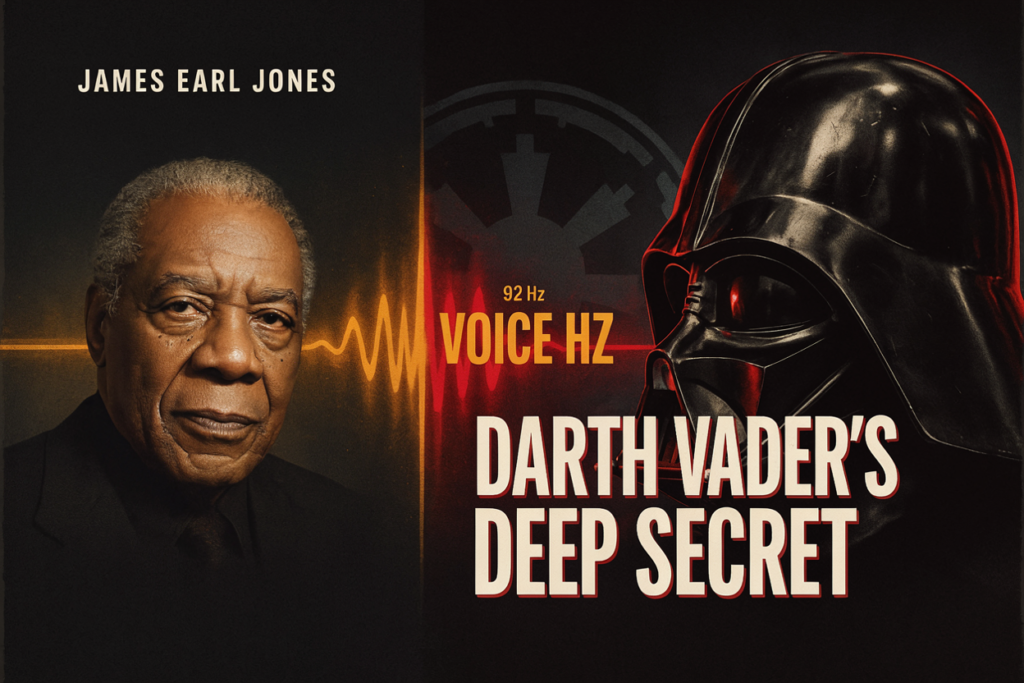
James Earl Jones’s voice is commonly estimated at about 85 Hz, close to the musical note F2. That figure is useful as a rough reference, but it shouldn’t be treated as a fixed or clinically verified measurement: his pitch changed naturally across words, roles, emotions, and stages of life.
His vocal depth also came from resonance, formants, articulation, pacing, and performance technique. These qualities helped create the authority heard in Darth Vader, Mufasa, and his stage work. For context, compare the estimate with the average pitch of an adult male voice.
What Was James Earl Jones’s Voice Frequency?
James Earl Jones’s speaking pitch is reported as approximately 85 Hz. It falls between E2 at 82.41 Hz and F2 at 87.31 Hz.
Why 85 Hz is an estimate
A speaking voice doesn’t remain on one frequency. Fundamental frequency, often shortened to F0, is the rate at which the vocal folds repeat their vibration cycle. During connected speech, F0 rises and falls to create emphasis, emotion, phrasing, and natural intonation.
The 85 Hz figure isn’t accompanied by a transparent acoustic report explaining the recording, analysis method, or whether it represents a mean, median, or single moment. It is best described as a reported estimate.
That distinction matters when interpreting a voice frequency chart. A chart locates 85 Hz but cannot reduce a performance to one number.
What musical note is 85 Hz?
An 85 Hz tone sits about 46 cents above E2 and 54 cents below F2, where 100 cents equals one equal-tempered semitone. It is marginally closer to E2, although commonly rounded to approximately F2.
This conversion doesn’t mean Jones permanently “spoke in” one note. Speech glides continuously between frequencies.
Was James Earl Jones a Bass or Baritone?
James Earl Jones is often described as having a bass or bass-baritone speaking voice, while some profiles use baritone more broadly. Neither label can be proved from the 85 Hz estimate alone because a classical voice type is determined by usable singing range, tessitura, register transitions, vocal weight, and timbre.
Speaking pitch is not singing range
Speaking at approximately 85 Hz doesn’t establish the highest and lowest notes a person can sing. A vocal range spans multiple notes, while speaking F0 describes how rapidly the vocal folds vibrate at particular moments in speech.
Tessitura—the area where a voice remains comfortable and resonant—is especially important in singing classification. The distinctions in a bass and baritone range comparison show why one low spoken value cannot settle the question.
| Measurement or label | What it describes | What 85 Hz can tell us |
|---|---|---|
| Fundamental frequency | Vocal-fold vibration rate at a moment or across a sample | Jones’s reported speaking pitch was low |
| Musical note | A frequency mapped to a tuning system | 85 Hz lies between E2 and F2 |
| Singing range | Lowest to highest usable sung notes | Nothing without a singing assessment |
| Tessitura | Comfortable, sustainable singing area | Nothing from a single frequency |
| Bass or baritone | A classification based on several vocal traits | Not enough evidence by itself |
Why the labels still vary
In everyday descriptions, “bass” may simply mean exceptionally deep. Classical bass and baritone labels have narrower meanings. Jones wasn’t classified through a published operatic assessment, so differing labels are unsurprising.
For a more precise understanding of the lower category, see how bass voice type is classified using range, tessitura, vocal weight, and tone rather than speech pitch alone.
Why Did James Earl Jones’s Voice Sound So Deep?
James Earl Jones sounded unusually deep because low vocal-fold vibration worked with strong resonance, precise diction, deliberate pacing, and controlled emphasis. Listeners perceive a complete acoustic pattern, not only the lowest frequency.
Fundamental frequency and resonance
Fundamental frequency supplies the perceived pitch foundation. Resonance changes which harmonics are strengthened as sound passes through the throat and mouth. Formants—the vocal tract’s resonant frequency bands—strongly influence vowel identity, vocal size, and timbre.
Two speakers producing the same F0 can therefore sound different. Vocal-fold length and mass influence pitch, while the vocal tract affects resonance. This overview of vocal-cord anatomy and voice depth explains how the systems contribute different parts of the sound.
Diction, cadence, and vocal control
Jones used clear consonants, sustained vowels, measured pauses, and carefully shaped changes in intensity. A slow cadence can make a voice feel weightier, but pace alone doesn’t lower its fundamental frequency. His authority came from coordinating acoustic depth with exceptionally controlled delivery.
Jones spoke publicly about overcoming a severe childhood stutter with help from poetry and oral recitation. That history doesn’t explain his low pitch, but it provides context for the deliberate command of language central to his performances.
Did Darth Vader Sound Lower Than James Earl Jones’s Natural Voice?
Darth Vader’s voice was a character performance and produced film sound, not a clean measurement of Jones’s everyday speech. Jones altered timing, emphasis, intensity, and tone, while the soundtrack placed his performance within Vader’s mechanical sound design.
No reliable public analysis establishes a fixed “Darth Vader Hz” for direct comparison with 85 Hz. Measuring a finished film line may capture changing pitch, processing, music, effects, and Vader’s breathing apparatus—not Jones’s unprocessed F0.
The distinction is familiar in deep-voice acting techniques: a performer creates vocal size through resonance, phrasing, articulation, and character choices without simply forcing every sound downward.
How Did His Voice Compare With Other Deep Voices?
James Earl Jones’s reported 85 Hz sits below many commonly cited averages for adult male speech, but celebrity comparisons remain approximate unless every speaker is analyzed from comparable recordings with the same method. Differences of a few hertz shouldn’t be treated as a ranking of whose voice was “deepest.”
| Voice reference | Reported or typical figure | How to interpret it |
| James Earl Jones | About 85 Hz | Widely repeated estimate; method not transparent |
| E2 | 82.41 Hz | Fixed equal-tempered musical-note frequency |
| F2 | 87.31 Hz | Fixed equal-tempered musical-note frequency |
| Adult male speech | Often centered roughly around 100–150 Hz | Population-level reference, not a rule for individuals |
Morgan Freeman is also assigned exact numbers online, but recording context and method matter. A review of Morgan Freeman’s reported frequency should distinguish an estimate from a permanent property.
Perceived depth can differ when two F0 values are close. Darker formants, more low-frequency energy, slower cadence, or greater vocal weight may make one voice seem deeper.
Can You Measure Whether Your Voice Is as Deep?
You can estimate average speaking frequency with a pitch analyzer, but one sustained vowel isn’t a fair comparison. Record comfortable connected speech and review both the median and average so brief creaks or tracking errors don’t dominate.
Use a quiet room, keep microphone position consistent, and speak naturally. Browser measurements are estimates, not clinical assessments, and very low creaky phonation can cause octave errors. The guide to testing voice depth reliably explains how to reduce these errors.
Don’t chase 85 Hz as a target. Forcing the voice lower can create tension or hoarseness. Healthy resonance and comfortable pitch matter more than matching a celebrity estimate.
Frequently Asked Questions
Was James Earl Jones’s voice really 85 Hz?
Approximately 85 Hz is the most widely reported figure for James Earl Jones’s speaking voice, but no transparent standardized analysis accompanies the claim. Treat it as a useful estimate, not a fixed measurement that applied to every sentence or role.
What musical note corresponds to an 85 Hz voice?
An 85 Hz frequency falls between E2 at 82.41 Hz and F2 at 87.31 Hz. It is often described as approximately F2, though it lies slightly closer to E2 when pitch distance is measured in cents.
Was James Earl Jones a bass or a baritone?
He is variously described as a bass, bass-baritone, or baritone. A definitive singing classification would require evidence about his usable range, tessitura, register transitions, and vocal weight, so a spoken estimate of 85 Hz cannot decide the label.
Was Darth Vader’s voice electronically deepened?
The finished Darth Vader soundtrack combined Jones’s character performance with film production and the character’s mechanical sound design. There is no well-documented fixed Vader frequency that proves how much lower the final voice was than Jones’s natural speech.
Why did James Earl Jones sound deeper than many other men?
His low speaking pitch contributed, but resonance, formant structure, vocal weight, precise diction, and deliberate cadence also shaped the effect. Those traits can make a voice seem larger and more authoritative than frequency alone predicts.
Can someone naturally develop a voice like James Earl Jones?
Training can improve breath coordination, resonance, diction, pacing, and vocal control, but anatomy places limits on comfortable pitch. A person should develop the richest healthy version of their own voice rather than forcing it toward 85 Hz.
Williams is a vocal depth and voice analysis writer at Deep Voice Test. He focuses on deep voice analysis, vocal frequency testing, pitch detection, and voice classification tools for singers, creators, speakers, and voice enthusiasts.