
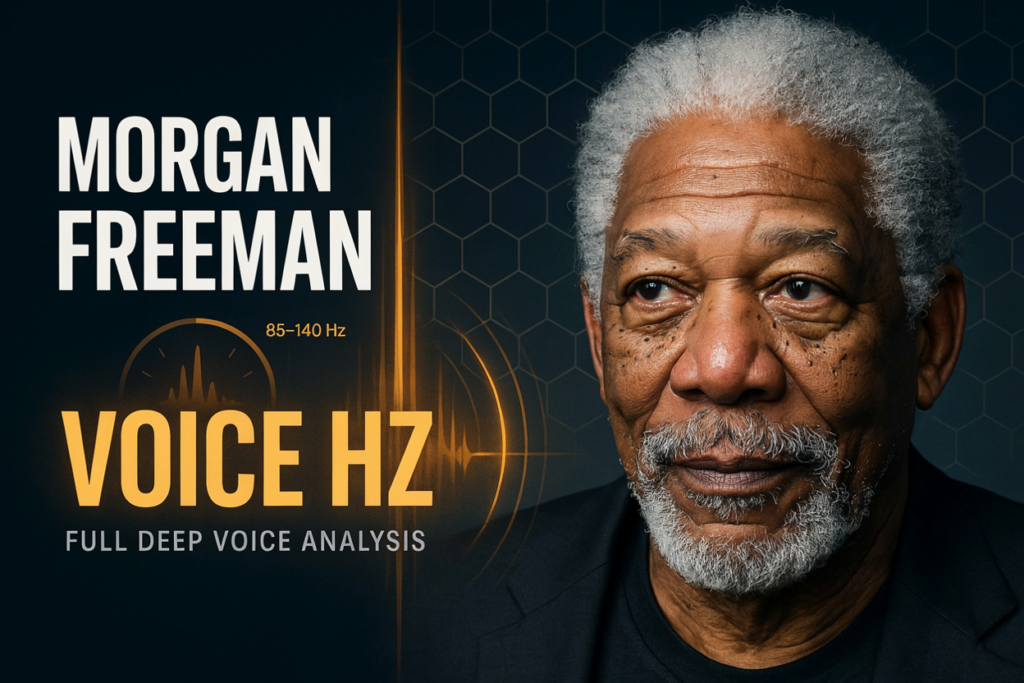
Morgan Freeman does not have one verified, fixed voice frequency. A cautious estimate places much of his relaxed speaking pitch around 80–100 Hz, but published figures vary because speech rises and falls. Any exact number without the recording and measurement method is an estimate rather than confirmed fact.
That estimate places Freeman toward the low end of typical adult male speech. His pitch can drop below that band or rise above it for emphasis. For context, the average male speaking frequency changes with age, language, and speaking task.
Why 80–100 Hz is only a cautious estimate
Online claims commonly put Freeman near 70–80 Hz or around 95–96 Hz. Those figures may represent a minimum, a short-clip average, or an octave-tracking error, so they cannot be compared fairly.
No authoritative acoustic profile appears to publish a reproducible median fundamental frequency for Freeman across several clean recordings. The honest answer is therefore a band with clear uncertainty, not a decimal-level measurement.
Why a speaking voice has no single permanent frequency
Fundamental frequency, usually written as F0, is the rate at which the vocal folds repeat their vibration. A rate of 90 cycles per second is 90 Hz. During speech, F0 forms a moving pitch contour as a person asks questions, stresses words, pauses, or changes emotion.
This is why a voice-frequency chart offers orientation but cannot assign a permanent number to an individual.
How Deep Is Morgan Freeman’s Voice Compared With an Average Man?
Morgan Freeman’s relaxed speaking voice likely sits lower than that of many adult men, but it overlaps the normal male range. Published voice studies often place typical male speech averages near roughly 100–120 Hz, while individual speakers and individual phrases can fall below or above those values.
| Measurement | What it represents | Reasonable interpretation |
|---|---|---|
| Lowest detected pitch | One brief low point | Not the person’s average voice |
| Median F0 | Middle pitch across voiced speech | Best single summary for a sample |
| Mean F0 | Arithmetic average of tracked pitch | Can be shifted by extreme readings |
| Pitch range | Lowest to highest reliable F0 | Shows intonation, not vocal type |
| 80–100 Hz estimate | Likely relaxed-speech region | Plausible, but not formally verified |
Typical male speech is a reference, not a cutoff
There is no universal frequency below which a voice becomes deep. Population values depend on age, language, and speaking task. The guide to what counts as a deep voice in Hz explains why frequency bands are references rather than diagnoses.
Freeman’s perceived depth also cannot be reduced to the gap between 90 and 110 Hz. Two people can share the same median F0 and still sound strikingly different because their resonance, articulation, loudness, and timing differ.
Minimum pitch is not average speaking pitch
A low note at a sentence ending may last a fraction of a second. Reporting it as Freeman’s normal frequency exaggerates his overall depth; median F0 across clean speech is more representative.
Why Does Morgan Freeman’s Voice Sound So Deep?
Morgan Freeman sounds deep because low fundamental frequency combines with rich resonance, substantial vocal weight, precise articulation, and unhurried delivery. Pitch starts the impression, but the shape of the vocal tract and the way he organizes a sentence give the voice its warmth and authority.
Fundamental frequency and vocal-fold vibration
Longer or more massive vocal folds generally vibrate more slowly, producing a lower F0. Freeman’s relaxed pitch contour lets phrases settle downward without sounding pressed.
His sound can be compared with other famous low voices, but the measurements should remain separate. For example, an analysis of Arnold Schwarzenegger’s reported voice frequency faces the same problem: movie dialogue, shouting, background music, and different decades of recording are not controlled laboratory samples.
Resonance, harmonics, and vocal weight
Resonance describes how the vocal tract shapes sound. Formants, its resonant frequency bands, affect vowel color and perceived size but are not the same as F0.
Strong low-frequency energy and a full harmonic spectrum can make a voice seem deeper even when its measured pitch is not exceptionally low. This helps explain why Freeman can sound imposing without maintaining an extreme bass-level F0. Similar caution applies when discussing the famous tone behind James Earl Jones’s reported voice measurements.
Pacing, pauses, and precise articulation
Freeman’s controlled pauses and clean consonants keep his dark voice intelligible. He has publicly discussed learning voice and diction, including clear final consonants and relaxed delivery.
Training can improve pacing, breath coordination, and resonance, but it does not safely rebuild an adult larynx into someone else’s. Freeman’s recognizable sound comes from anatomy and practiced communication working together.
Did Morgan Freeman Naturally Have His Famous Voice?
Morgan Freeman’s underlying vocal anatomy is natural, but his polished delivery was developed. Voice training can refine articulation, phrasing, breath use, and habitual tension without proving that a performer deliberately lowered his anatomy-determined pitch.
What voice training can change
An actor can reduce tension, finish consonants, vary pace, and direct resonance efficiently. Those skills make delivery steadier and more consistent.
Relaxation is different from forcing a low pitch
Forcing the larynx downward or pressing the vocal folds may create a temporarily darker sound, but it can also cause fatigue and roughness. Efficient depth feels comfortable and remains clear. Anyone developing a fuller tone should focus on coordination rather than copying a celebrity’s lowest moments.
Is Morgan Freeman a Bass or Baritone?
Morgan Freeman cannot be reliably classified as a bass or baritone singer from speaking clips alone. Singing voice type depends on usable range, tessitura, register transitions, timbre, and vocal weight—not merely on conversational F0.
Speaking pitch does not establish singing voice type
A man with low speech may sing comfortably as a baritone, while another speaker with a similar pitch may have a different tessitura. The bass and baritone range comparison shows substantial note overlap, so even sung extremes would not settle the classification by themselves.
Evidence a formal classification would require
A meaningful classification would require sung scales and repertoire while a qualified teacher assessed comfort, passaggi, and endurance. Public narration does not provide that evidence, so “bass” remains an impression rather than a verified classification.
How Could Morgan Freeman’s Voice Be Measured Accurately?
An accurate estimate would use several clean, authentic, undubbed speech samples and report the median F0, pitch range, recording dates, and analysis settings. The goal would be to describe representative speech, not search for the lowest number a tracker can display.
Select comparable recordings
Use interviews or narration with little music, no imitation, and minimal echo. Analyze clips from a similar period; exclude shouting, whispers, and processed movie audio.
Measure and inspect the pitch track
A reliable workflow would segment voiced speech, apply a suitable adult-male pitch range, inspect the contour for octave jumps, and calculate the median across usable sections. The steps used to test voice depth responsibly also matter for ordinary users: distance from the microphone and background noise can change what the software detects.
Separate findings from interpretation
Report the sample median, minimum, maximum, and usable audio duration without labeling an isolated minimum as Freeman’s normal voice. The errors described in voice-depth test accuracy apply even to celebrity recordings.
Frequently Asked Questions
Is Morgan Freeman’s voice really 80 Hz?
Morgan Freeman may reach or pass through 80 Hz in relaxed speech, but 80 Hz is not a verified permanent value. A cautious 80–100 Hz region is more defensible than one exact number, and even that should be labeled an estimate.
What is Morgan Freeman’s lowest recorded pitch?
There is no authoritative published value for Morgan Freeman’s lowest reliable speaking pitch. A number taken from one clip could reflect vocal fry, noise, music, or a pitch-tracking error rather than a stable note.
Is Morgan Freeman a bass or baritone?
His speaking voice sounds low, but public speech does not establish a singing voice type. Bass or baritone classification would require evidence about sung range, tessitura, passaggi, tone, and endurance.
Why does his voice sound deeper than its measured frequency?
Resonance, formants, harmonics, vocal weight, slow pacing, and controlled articulation all strengthen the impression of depth. Two speakers with similar F0 values can therefore sound very different.
Did Morgan Freeman train himself to speak more deeply?
Freeman has discussed voice-and-diction training that improved relaxation and articulation. That supports the idea that he refined his delivery, but it does not prove that he forced his natural pitch downward.
Can a phone recording measure Morgan Freeman’s voice accurately?
A phone recording can support a rough estimate if the speech is clean and authentic. It cannot by itself establish a definitive celebrity frequency, especially when the clip contains compression, background audio, dubbing, or only a few words.
Williams is a vocal depth and voice analysis writer at Deep Voice Test. He focuses on deep voice analysis, vocal frequency testing, pitch detection, and voice classification tools for singers, creators, speakers, and voice enthusiasts.