
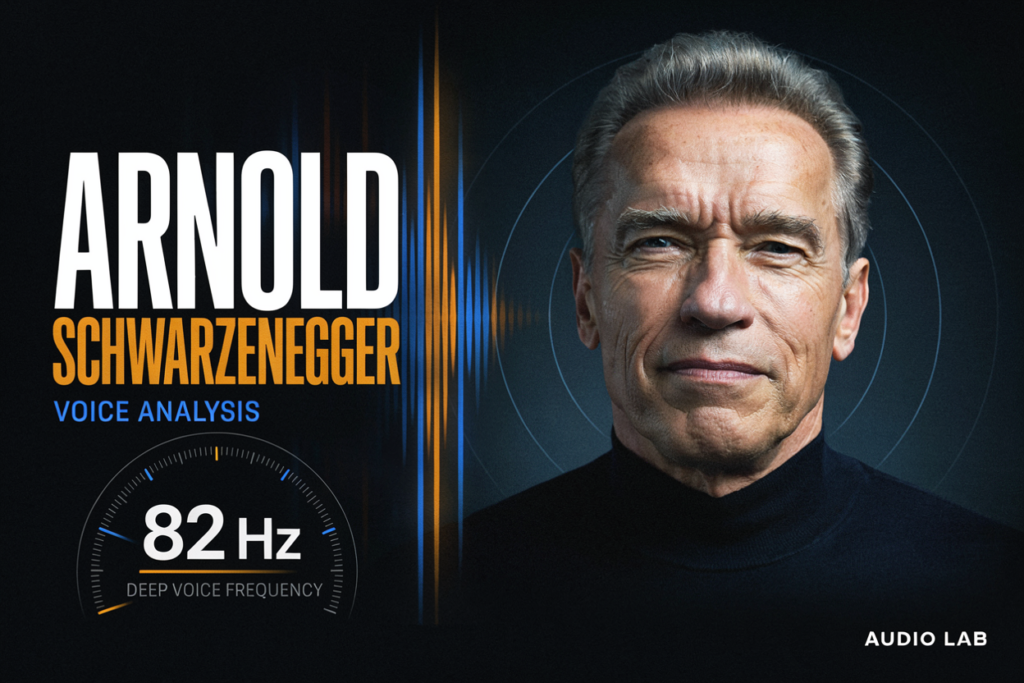
Arnold Schwarzenegger does not have a scientifically verified single voice-frequency figure. Estimates of about 65–75 Hz circulate online, but they should be treated cautiously: the claims rarely identify the recording, isolate normal speech, or explain how the number was calculated.
A speaking voice never stays on one frequency. Its fundamental frequency, or F0, rises and falls with words, emphasis, emotion, and acting choices. One movie-line low is not Arnold’s median speaking pitch.
Published studies have placed average adult male conversational F0 near 108–112 Hz, although individuals vary. A sustained median of 65–75 Hz would therefore be unusually low. An adult male frequency reference provides context without turning population averages into pass-or-fail boundaries.
Why 65–75 Hz is an unverified estimate
The repeated range may describe one low segment or a copied estimate. Without source audio, analysis settings, and a summary statistic, it cannot be reproduced as a measured fact.
A voice cannot be reduced to one number
A recorded sentence produces a pitch contour—a sequence of changing F0 values. Its minimum, maximum, mean, and median answer different questions. Median F0 across clean conversational samples is more representative than a film scene’s lowest frequency.
The meaning of deep voice in hertz depends on whether a number describes a brief low note or ordinary speech’s central tendency.
How Deep Is Arnold Schwarzenegger’s Voice Compared With an Average Man?
Arnold Schwarzenegger’s voice is generally perceived as deeper and heavier than an average adult male voice, but a precise comparison requires matched recordings and the same analysis method. Published male reference values can supply context; they cannot substitute for a controlled measurement of Arnold himself.
| Claim or reference | Approximate value | What it actually tells us | Reliability |
|---|---|---|---|
| Adult male mean F0 in one clinical study | About 112 Hz | A research baseline for normal male voices | Published measurement |
| Male spontaneous speech in an earlier study | About 108 Hz | A comparison point from conversational speech | Published measurement |
| Arnold estimate repeated online | About 65–75 Hz | Possibly a low point or undocumented estimate | Unverified |
| Arnold’s exact habitual F0 | Not established | Would require comparable clean samples | Unknown |
These values do not represent the entire audible voice. A voice-frequency chart shows typical pitch zones, but individual ranges overlap.
Minimum pitch versus average speaking pitch
Minimum F0 is the lowest usable value detected during a sample. Mean F0 averages all detected values, while median F0 is the middle value after observations are ordered and is often less distorted by isolated tracking errors or extreme inflections.
If a quote briefly reaches 68 Hz but spends most voiced time between 85 and 115 Hz, “68 Hz voice” describes its minimum, not its typical pitch. Shouting may also produce irregular vibration that confuses tracking software.
Why recordings cannot be compared casually
Movie dialogue may be processed, mixed with music, dubbed, or performed in character. Interviews differ in acoustics, emotion, and age. A useful comparison must control those variables rather than compare unrelated clips’ lowest numbers.
Why Does Arnold Schwarzenegger’s Voice Sound So Deep?
Arnold Schwarzenegger’s vocal identity comes from a combination of relatively low pitch, strong resonance, vocal weight, projection, speech rhythm, and his Austrian accent. Fundamental frequency contributes to depth, but the acoustic shape and delivery of the sound help make it instantly recognizable.
Fundamental frequency and vocal-fold vibration
F0 reflects how rapidly the vocal folds complete vibration cycles. Longer or more massive folds generally vibrate more slowly, though muscle tension, airflow, vocal register, and speaking behavior continually modify the result. At 70 Hz, for example, the folds would complete about 70 cycles per second during that voiced moment.
Resonance, vocal weight, and projection
Resonance describes how the throat and vocal tract filter sound. Formants—the vocal tract’s resonant frequency bands—affect vowel color and perceived size. Listeners combine them with F0 when judging depth.
Arnold’s projected delivery and weighty tone can sound deeper than pitch alone predicts. Two speakers with similar median F0 values can therefore sound different.
Accent, rhythm, and articulation
His Austrian accent contributes distinctive vowels, consonants, timing, and melody. Deliberate pacing and emphatic stress form a recognizable signature even when his pitch enters an ordinary male range.
The same pitch-versus-resonance distinction helps explain why other famous voices, such as the one discussed in the Morgan Freeman frequency analysis, cannot be meaningfully compared using a single unsupported number.
Is Arnold Schwarzenegger a Bass or Baritone?
Arnold Schwarzenegger cannot be reliably classified as a bass or baritone singer from his speaking voice alone. Singing voice type depends on usable range, tessitura—the area where a singer can perform comfortably—timbre, vocal weight, and register transitions, none of which is established by an actor’s dialogue clips.
Speaking pitch does not establish voice type
A man can speak low without possessing a bass’s comfortable singing range or passaggio pattern. A baritone may also speak lower than expected. Online labels for Arnold are therefore informal, not documented classifications.
Comparing his dialogue with the unusually low voices covered in the Barry White frequency discussion may be interesting, but it does not provide the scale exercises or sustained musical evidence needed for classification.
What evidence would be required
A qualified assessment would need scales, sustained vowels, comfortable repertoire, transition notes, and observations across sessions. It must distinguish touched notes from resonant, repeatable, musically usable ones.
How Could Arnold Schwarzenegger’s Voice Be Measured Accurately?
The best estimate would come from several clean, recent, undubbed conversational recordings analyzed with one consistent pitch-tracking method. The result should report the audio sources, settings, voiced-segment rules, median F0, range, and uncertainty rather than advertise only the lowest detected value.
A reproducible measurement process
- Select multiple interviews containing ordinary speech without music, shouting, imitation, or another speaker.
- Use lossless or high-quality audio when available and isolate comparable 20–30-second segments.
- Analyze each segment with the same software, pitch floor, pitch ceiling, and method.
- Inspect the pitch track and remove obvious octave errors, silence, laughter, and non-speech sounds.
- Report each sample’s median F0 and central range, then explain differences among samples.
Praat’s filtered autocorrelation method measures vocal-fold vibration and intonation. A phone or browser estimate may help exploration, but voice-test accuracy depends on recording and analysis conditions; it is not a laboratory result.
Errors that can produce misleading Hz values
Pitch trackers may mistake creaky or irregular vibration for a frequency one octave too low. Music, noise, and compression also disrupt detection, while deliberately selecting the deepest quote introduces bias.
Has Arnold Schwarzenegger’s Voice Changed With Age?
Arnold Schwarzenegger’s voice may differ across decades, but casual recordings cannot prove that it steadily became deeper. Aging can change vocal-fold tissue, muscular control, respiratory support, loudness, pitch stability, and resonance; performance style and recording technology change at the same time.
Why age comparisons need matched samples
A young action-film performance and a recent relaxed interview differ in more than age. A credible comparison needs similar speech tasks and identical settings. The James Earl Jones voice-frequency review shows why perceived gravitas and measured F0 remain separate claims.
What listeners may perceive
Roughness, slower delivery, breathiness, or reduced pitch variation may sound like added depth even if median F0 does not fall. One clip cannot summarize an entire career.
Frequently Asked Questions
Is Arnold Schwarzenegger’s voice really 65 Hz?
No authoritative acoustic source verifies 65 Hz as Arnold Schwarzenegger’s habitual speaking frequency. It could represent a momentary low value in one recording, but it should not be repeated as his fixed or average pitch without reproducible evidence.
Is Arnold Schwarzenegger a bass or baritone?
There is not enough singing evidence to classify him reliably. Bass and baritone categories depend on tessitura, timbre, range, and register transitions—not speaking pitch alone.
Why can his voice sound deeper than its measured pitch?
Listeners perceive depth from F0 together with resonance, formants, vocal weight, intensity, and delivery. Arnold’s projection, pacing, and accent can therefore reinforce a deep impression even when individual pitch values overlap ordinary male speech.
Does Arnold use his natural voice in movies?
Acting choices change pitch, loudness, rhythm, and effort. Processing and dubbing can also make film clips unsuitable for measuring everyday speech.
Has Arnold Schwarzenegger’s voice become deeper with age?
Recordings may sound different over time, but matched acoustic measurements would be needed to show a consistent pitch decrease. Aging can change vocal quality and stability without necessarily lowering median F0.
Can a phone app measure a celebrity’s voice frequency accurately?
A phone app can produce a rough estimate from clean speech, but it cannot control the original recording, editing, noise, or performance style. For a more defensible result, follow a consistent voice-depth measurement process and report a median across several samples rather than one minimum.
Williams is a vocal depth and voice analysis writer at Deep Voice Test. He focuses on deep voice analysis, vocal frequency testing, pitch detection, and voice classification tools for singers, creators, speakers, and voice enthusiasts.