
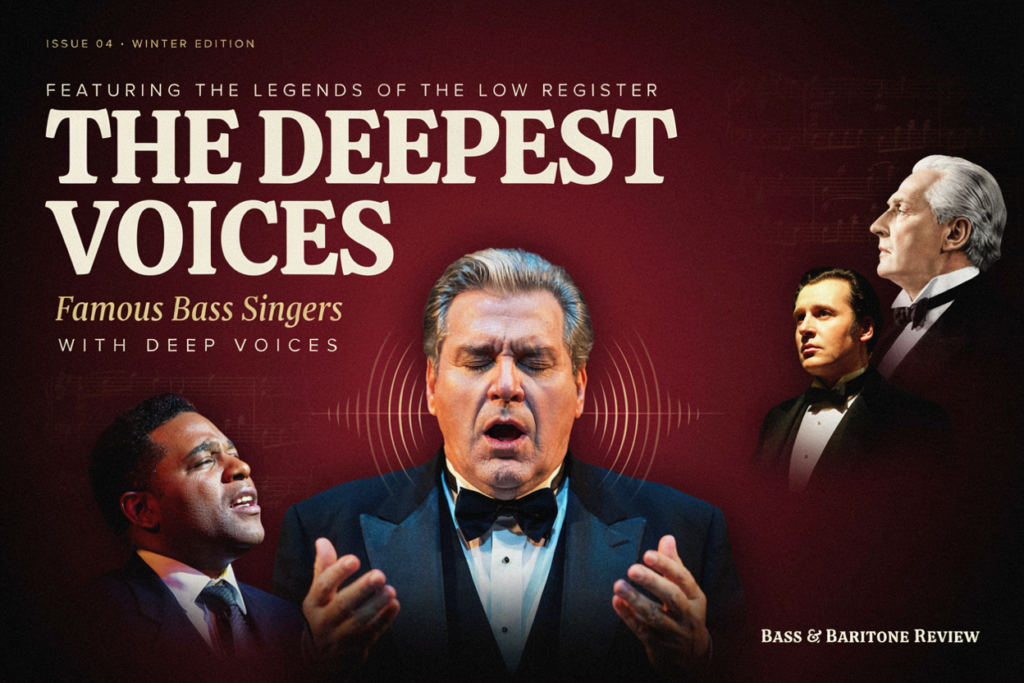
Famous bass singers include Fyodor Chaliapin, Ezio Pinza, Boris Christoff, Cesare Siepi, Nicolai Ghiaurov, Kurt Moll, Martti Talvela, and René Pape. Outside opera, Paul Robeson, Richard Sterban, Avi Kaplan, Tim Foust, and Tim Storms are known for remarkable low-register singing, although popular-music voice labels are less standardized than classical classifications.
A bass is the lowest standard male classical voice type, commonly associated with an approximate E2–E4 range. That range is only a guide. Tessitura—the notes where the voice remains comfortable and resonant—plus timbre, vocal weight, and repertoire matter more than one spectacular low note. Our guide to the characteristics of a true bass voice explains those criteria.
Who Are the Most Famous Bass Singers?
Celebrated operatic basses combine powerful low notes with enough upper-register presence for demanding roles. Non-classical bass singers may specialize in close harmony, amplified lows, or extended techniques, so different classification rules apply.
| Singer | Tradition | Best description | Particularly known for |
|---|---|---|---|
| Fyodor Chaliapin | Opera | Bass | Boris Godunov and dramatic characterization |
| Ezio Pinza | Opera and musical theatre | Bass | Don Giovanni and a smooth, flexible tone |
| Boris Christoff | Opera | Bass | Russian repertoire and Boris Godunov |
| Cesare Siepi | Opera | Bass | Don Giovanni and an elegant legato line |
| Nicolai Ghiaurov | Opera | Bass | Verdi and Russian roles |
| Kurt Moll | Opera | Bass | Sarastro, Baron Ochs, and very low resonance |
| Martti Talvela | Opera | Bass | Commanding scale and dark tone |
| René Pape | Opera | Bass | Modern performances of German and Italian repertoire |
| Paul Robeson | Concert, spirituals, theatre | Bass-baritone | Rich low voice and expressive spirituals |
| Richard Sterban | Country and gospel | Bass vocalist | The Oak Ridge Boys’ bass lines |
| Avi Kaplan | A cappella and folk | Bass vocalist | Ensemble bass and overtone-rich tone |
| Tim Foust | A cappella and country | Bass vocalist | Wide range and prominent low notes |
| Tim Storms | Extended-range vocals | Extreme low-voice specialist | Guinness-recognized low-frequency records |
The usual bass vocal range reference helps with comparison, but it is not an audition checklist. Two singers can reach E2 and still belong to different voice types because their comfortable ranges differ.
Which Operatic Basses Should You Hear First?
Fyodor Chaliapin is an essential starting point because he helped redefine operatic acting as well as bass singing. His portrayal of the title character in Mussorgsky’s Boris Godunov became a historical reference point: the voice could sound regal, frightened, intimate, and overwhelming within one role.
Ezio Pinza and Cesare Siepi demonstrate a more lyrical side of the bass voice. Both became associated with Mozart’s Don Giovanni, a role assigned to a bass or bass-baritone depending on the singer. Their recordings show that clarity, legato, agility, and expression matter as much as darkness.
Boris Christoff and Nicolai Ghiaurov brought distinctive weight to Russian and Italian repertoire. Christoff was renowned for psychologically intense interpretations, especially in Boris Godunov, while Ghiaurov combined a large, polished instrument with authority in roles such as Verdi’s King Philip II.
Kurt Moll offers a clear example of a very low operatic bass. In Sarastro’s arias from Mozart’s The Magic Flute, his sustained low notes remain focused rather than breathy. His Baron Ochs shows how text and timing shape character. Martti Talvela paired an imposing sound with nuance, while René Pape represents a later generation.
Anyone comparing these voices with higher male categories should examine the practical differences between bass and baritone ranges, especially where the two overlap.
Which Bass-Baritones Are Often Included on Bass Lists?
Bass-baritones are often included on bass lists because they can sing substantial low repertoire while retaining more ease or brilliance in the upper range. Samuel Ramey, George London, and José van Dam are major examples, but calling every one of them simply a bass removes useful information about how their voices worked.
Samuel Ramey sang roles from Mozart and Handel to nineteenth-century villains. His agility and upper extension were exceptional, yet opera sources frequently identify him as a bass-baritone. George London’s dark voice suited Wotan, Boris Godunov, and Amfortas. José van Dam likewise crossed conventional category boundaries.
Voice labels vary by role, language, career stage, and source. The distinction is not a hard line at one piano key. A bass-versus-baritone classification guide helps compare tessitura, tone, passaggio—the transition between registers—and repertoire instead of relying on one low note.
Who Are the Famous Bass Singers Outside Opera?
Non-classical music uses the word bass more loosely. It may describe the lowest singer in a harmony group, a performer with an unusually deep tone, or someone who uses subharmonics and other extended techniques. It does not always mean the singer would be classified as an operatic bass.
Paul Robeson possessed one of the twentieth century’s most recognizable low voices. Often described as a bass-baritone, he brought remarkable authority and warmth to spirituals, concert songs, and theatre. Thurl Ravenscroft became famous for an exceptionally resonant commercial and character voice as well as singing, while Richard Sterban’s low entries became a signature element of the Oak Ridge Boys’ sound.
In modern a cappella, Avi Kaplan and Tim Foust show how a bass supports harmony while taking occasional melodic focus. Microphone technique and production make comparison with unamplified opera misleading. A broader list of singers known for deep voices includes artists formally classified as baritones or bass-baritones.
Tim Storms belongs in a separate extreme-vocal category. Guinness World Records recognizes him for a lowest vocal-note record measured at 0.189 Hz, below the normal threshold of human hearing. That measurement is extraordinary, but it is not a conventional sung pitch and should not be used as the standard for an everyday bass voice. The story of the deepest documented male voices explains why record-setting frequencies and useful musical range are different concepts.
Johnny Cash and Barry White are also regularly placed on internet bass lists. Both had unmistakably deep vocal identities, yet many discussions classify them more accurately as low baritones or bass-baritones. Style, speaking pitch, recording choices, and a dark timbre can make a performer sound lower than a written vocal range suggests.
Which Performances Best Demonstrate a Bass Voice?
Compare performances rather than chasing the lowest note. Chaliapin or Christoff in Boris Godunov demonstrates dramatic weight; Moll’s Sarastro shows low resonance; Siepi’s Don Giovanni reveals elegance; and Ghiaurov’s King Philip II shows Verdi grandeur.
Listen for four qualities: whether low notes stay clear, where the singer appears most comfortable, how the upper notes retain body, and whether words remain intelligible. In non-classical recordings, also notice how the bass line functions inside the harmony. Songs built around prominent low voices can provide a useful listening comparison; this collection of music that showcases deep vocals offers additional examples.
If you are comparing your own voice with these singers, record a comfortable scale rather than imitating their darkest sounds. An at-home voice-depth checking method can provide an estimate, but it cannot replace a teacher’s assessment of tessitura, passaggio, tone, and vocal health.
Frequently Asked Questions
Who is considered the greatest operatic bass singer?
There is no objective single greatest bass, but Fyodor Chaliapin is among the most historically influential because of his vocal characterization and celebrated Boris Godunov. Ezio Pinza, Boris Christoff, Cesare Siepi, Nicolai Ghiaurov, and Kurt Moll are also frequent choices, depending on repertoire and judging criteria.
Who has the lowest singing voice in recorded history?
Guinness World Records recognizes Tim Storms for producing a 0.189 Hz vocal frequency. The record reflects an extreme vocal effect below ordinary human hearing, not a conventional musical note or the normal range expected from a bass singer.
Is Johnny Cash a bass or a baritone?
Johnny Cash is most often described as a baritone or bass-baritone rather than a classical bass. His dark timbre, low habitual delivery, and song keys created a distinctly deep sound, illustrating why perceived depth and formal voice type are not identical.
Was Barry White a bass singer?
Barry White is commonly called a bass-baritone or deep baritone, although popular-music classifications vary. His resonant speaking style and low, warm singing tone explain why casual lists frequently call him a bass.
What is the difference between a bass and a bass-baritone?
A bass generally has greater comfort, resonance, and vocal weight in the lowest male repertoire. A bass-baritone combines a substantial low register with more baritone-like facility higher in the voice; range overlaps, so tessitura and repertoire are more informative than one lowest note.
Can one low note prove that a singer is a bass?
No. A singer may briefly reach a low pitch through vocal fry, subharmonics, or exceptional extension without being comfortable across bass repertoire. Reliable classification considers tessitura, timbre, passaggio, projection, and sustainable technique.
Williams is a vocal depth and voice analysis writer at Deep Voice Test. He focuses on deep voice analysis, vocal frequency testing, pitch detection, and voice classification tools for singers, creators, speakers, and voice enthusiasts.