
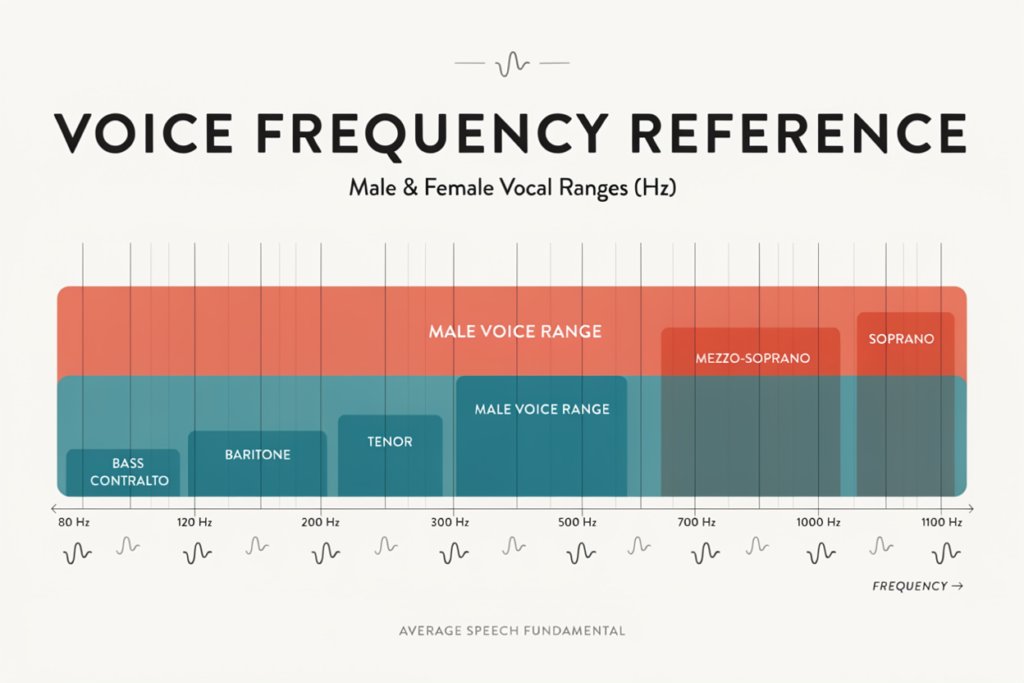
A voice Hz chart shows how quickly the vocal folds vibrate while you speak or sing. The main measurement is fundamental frequency, or F0: 120 Hz means roughly 120 vibration cycles per second. Lower F0 is usually heard as a lower pitch, but Hz alone does not describe resonance, timbre, or vocal weight.
The charts below separate conversational pitch from singing range and the wider sound spectrum. That distinction matters because these measurements are often combined even though they answer different questions. For a broader explanation, see how the human voice frequency range includes both a fundamental and higher-frequency acoustic energy.
What Does a Voice Hz Chart Measure?
A voice Hz chart usually measures fundamental frequency, the lowest repeating rate in a voiced sound. F0 is the strongest acoustic correlate of pitch: as vocal-fold vibration becomes faster, pitch generally sounds higher; as it becomes slower, pitch generally sounds lower.
Fundamental frequency versus the complete voice spectrum
The voice is not a single frequency. When the vocal folds vibrate at 100 Hz, they also generate harmonics at multiples such as 200, 300, and 400 Hz. The throat, mouth, and nasal passages then emphasize or reduce groups of harmonics, creating resonances called formants.
This source-filter relationship explains why two people producing the same F0 can sound very different. The vocal folds provide the source, while the vocal tract filters it. Vocal-fold structure and vibration are explained further in this guide to how vocal anatomy affects voice depth.
How Hz corresponds to musical notes
Each musical note has a frequency, but equal-tempered tuning uses fixed reference values that a live voice may approach rather than hold exactly. A4 is conventionally tuned to 440 Hz. Moving one octave down halves the frequency, so A3 is 220 Hz and A2 is 110 Hz.
| Note | Frequency, approximately |
|---|---|
| E2 | 82.4 Hz |
| G2 | 98.0 Hz |
| A2 | 110.0 Hz |
| C3 | 130.8 Hz |
| A3 | 220.0 Hz |
| C4, middle C | 261.6 Hz |
| A4 | 440.0 Hz |
| C5 | 523.3 Hz |
| C6 | 1046.5 Hz |
What Is the Typical Speaking Voice Frequency?
Adult conversational voices often center near 125 Hz for men and 200 Hz for women, while children commonly speak around 250–400 Hz, according to reference material from the National Center for Voice and Speech. These values are broad population reference points, not pass-or-fail boundaries, and substantial overlap is normal.
| Speaker group | Broad conversational reference | Approximate center | How to interpret it |
| Adult men | About 85–180 Hz | About 125 Hz | Many healthy voices fall outside this span |
| Adult women | About 165–255 Hz | About 200 Hz | Overlap with other groups is expected |
| Children | About 250–400 Hz | Varies by age | Pitch generally changes with growth and puberty |
The broad ranges in this table are orientation values rather than diagnostic norms. A large cross-cultural study reported group-average F0 values of about 78–182 Hz for men and 126–307 Hz for women, showing how language, population, task, and recording conditions can shift an average.
Why age and speaking style change the result
The larynx and vocal folds grow during childhood and puberty, often producing a substantial F0 decrease, especially with androgen-driven laryngeal growth. Aging can also change tissue elasticity, muscle bulk, breath support, and habitual pitch. The resulting pattern is not identical for everyone; the overview of voice depth across different ages adds the relevant life-stage context.
Speaking task matters too. Reading aloud, projecting, and talking casually can produce different averages. Emotion, vocal fry, fatigue, and microphone placement may alter a short sample.
What Are the Hz Ranges for Singing Voice Types?
Common classical singing categories span approximately 82 Hz at E2 through 1,047 Hz at C6. A singer’s category is not determined by the lowest and highest detected frequencies alone; teachers also consider tessitura, the comfortable working area, along with passaggi, timbre, vocal weight, and sustainable technique.
| Voice type | Common approximate note range | Approximate frequency span |
| Bass | E2–E4 | 82–330 Hz |
| Baritone | G2–G4 | 98–392 Hz |
| Tenor | C3–C5 | 131–523 Hz |
| Contralto | F3–F5 | 175–698 Hz |
| Mezzo-soprano | A3–A5 | 220–880 Hz |
| Soprano | C4–C6 | 262–1,047 Hz |
These are teaching conventions, not anatomical borders. Some singers extend beyond them, and adjacent categories overlap. The male singing range comparison and female singing range comparison explain tessitura and classification.
How Should You Interpret Your Voice Frequency Result?
Interpret a voice-frequency result by identifying what was measured: an average speaking F0, a momentary pitch, or a sustained sung note. One number cannot establish a complete vocal range or voice type.
| Reading | Nearest musical area | Possible interpretation |
| 100 Hz | Near G2 | Low for many speaking voices; also a singable pitch |
| 150 Hz | Near D3 | Within the large overlap among conversational voices |
| 200 Hz | Near G3 | Close to a commonly cited adult-woman speaking average |
| 260 Hz | Near middle C, C4 | Could be speech, a sung note, or one instant in an intonation contour |
A 100 Hz average may sound deep in many contexts, but a single 100 Hz frame could simply be the bottom of a sentence. For a more focused interpretation, compare the measurement with the discussion of what counts as a deep voice in Hz.
Why pitch detectors can misread a voice
Background noise, breathiness, vocal fry, and weak fundamentals can confuse an algorithm. An octave error occurs when a detector identifies a harmonic as the fundamental and reports double the expected value, or tracks a subharmonic and reports half. Short measurements are also vulnerable to normal pitch movement.
For a more dependable home estimate, record 20–30 seconds of relaxed speech in a quiet room, keep the microphone distance stable, and repeat the test on several days. Measure sung notes separately after a gentle warm-up. Browser-based checks remain estimates rather than clinical measurements; the guide to testing voice depth consistently explains a repeatable setup.
Why Can Two Voices at the Same Hz Sound Different?
Two voices at the same fundamental frequency can sound different because their harmonic balance, formants, vocal-tract shape, articulation, breathiness, and intensity differ. Pitch answers “how fast is the source vibrating?” while perceived depth also reflects how that source is filtered.
| Claim | Reality |
| A lower Hz number always sounds deeper | Usually lower in pitch, but resonance can make equal-F0 voices sound brighter or darker |
| One reading reveals voice type | Classification requires a usable range, tessitura, passaggi, and timbre |
| 300–3,400 Hz is the pitch range of speech | It is a traditional telephone bandwidth, not the usual F0 range |
| A pitch app provides a clinical result | Consumer and browser measurements are useful estimates with possible tracking errors |
Measurement quality therefore matters as much as the number. Reviewing the main sources of error in voice-frequency test accuracy can help distinguish a stable average from noise or octave mistakes.
Frequently Asked Questions
Is 100 Hz considered a deep voice?
An average speaking F0 of 100 Hz would generally be perceived as low in many adult contexts. Perceived depth still depends on resonance, vocal quality, and whether 100 Hz is a stable average or just a momentary low point.
What musical note is 100 Hz closest to?
100 Hz falls slightly above G2, which is approximately 98 Hz in equal temperament with A4 tuned to 440 Hz. It is well below middle C, which is approximately 261.6 Hz.
Can a voice fall between typical male and female Hz ranges?
Yes. Speaking-frequency distributions overlap substantially, and an individual average does not have to fit a binary reference band. Hormones, anatomy, age, language, learned habits, and speaking context all contribute.
Is speaking frequency the same as vocal range?
No. Speaking frequency is usually an average or distribution measured during speech, while vocal range runs from the lowest to the highest notes a person can produce. A singing classification also depends on which notes are comfortable and sustainable.
Why does a pitch detector show half or double the expected Hz?
The detector may have made an octave error by tracking a harmonic or subharmonic instead of the true fundamental. Noise, vocal fry, breathiness, and an unstable signal make this more likely.
Can Hz alone determine whether someone is a bass or baritone?
No. Bass and baritone ranges overlap, and one measured frequency reveals neither tessitura nor passaggi. Reliable classification considers comfortable range, vocal weight, timbre, and technique across multiple notes.
Williams is a vocal depth and voice analysis writer at Deep Voice Test. He focuses on deep voice analysis, vocal frequency testing, pitch detection, and voice classification tools for singers, creators, speakers, and voice enthusiasts.