
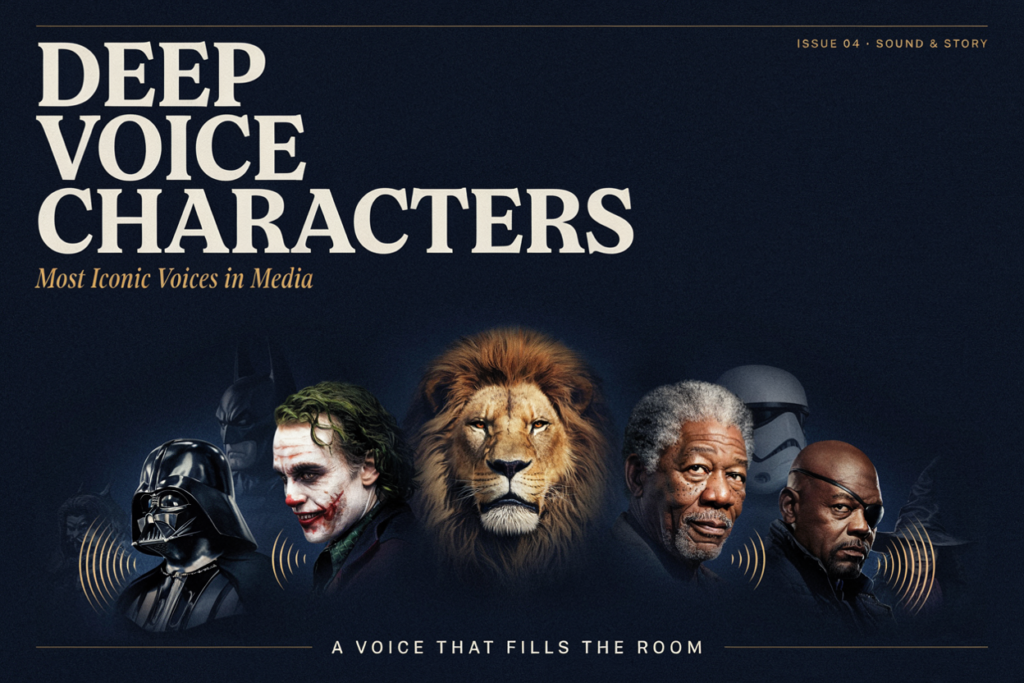
Famous deep voice characters include Darth Vader and Mufasa, voiced by James Earl Jones; Batman, associated with Kevin Conroy; Kratos, performed by T. C. Carson and Christopher Judge; and Optimus Prime, associated with Peter Cullen. These voices combine resonance, vocal weight, pacing, articulation, emotional control, and sometimes studio processing.
The result can suggest menace, leadership, wisdom, or restraint. Mufasa and Darth Vader can both sound deep without sounding alike. Understanding what makes a voice sound deep requires listening beyond pitch.
Which Characters Have the Most Iconic Deep Voices?
The best-known examples span film, animation, and games. Darth Vader is a defining processed villain voice, Mufasa represents warm authority, Batman uses darkness as an identity, and Kratos combines weight with restraint.
| Character | Franchise or work | Principal English-language performer | Vocal impression | Main story function |
|---|---|---|---|---|
| Darth Vader | Star Wars | James Earl Jones | Resonant, controlled, electronically processed | Power and menace |
| Mufasa | The Lion King | James Earl Jones | Warm, expansive, measured | Parental authority and wisdom |
| Batman | DC animation and games | Kevin Conroy | Dark, focused, restrained | Intimidation and hidden identity |
| Kratos | God of War | T. C. Carson; later Christopher Judge | Heavy, rough-edged, deliberate | Strength, anger, and weariness |
| Optimus Prime | Transformers | Peter Cullen in many major versions | Noble, steady, sonorous | Leadership and reassurance |
| Spawn | Todd McFarlane’s Spawn | Keith David in the animated series | Gravelly, resonant, intense | Supernatural menace and conflict |
| Goliath | Gargoyles | Keith David | Full, dignified, commanding | Protective leadership |
| Thanos | Marvel Cinematic Universe | Josh Brolin | Low, restrained, conversational | Calm threat |
| Scar | The Lion King | Jeremy Irons in the 1994 film | Smooth, theatrical | Cunning |
Darth Vader and Mufasa
James Earl Jones voiced Darth Vader for more than four decades, while breathing, filtering, and sound design made the finished voice feel mechanical. Jones also voiced Mufasa in Disney’s 1994 and 2019 versions of The Lion King. Vader sounds enclosed and threatening; Mufasa sounds open and warm.
Jones is often discussed in attempts to assign celebrities a single frequency. A more useful analysis of James Earl Jones’s voice considers pitch variation, resonance, and performance context instead of treating one Hz reading as his permanent vocal identity.
Batman and Kratos
Kevin Conroy began recording Batman in 1991 and became closely identified with the role across animation and the Arkham games. He contrasted public-facing Bruce Wayne with a darker Batman delivery, separating the person from the symbol.
T. C. Carson performed Kratos in the earlier God of War era, while Christopher Judge took over for the 2018 game and its sequel. Judge’s slower delivery supports an older, world-weary character. The role retains depth while changing texture, rhythm, and emotion.
What Makes a Character’s Voice Sound Deep?
A character voice sounds deep through a combination of low fundamental frequency, strong low-frequency resonance, vocal weight, controlled timing, and production choices. Fundamental frequency is the rate at which the vocal folds repeat their vibration; it strongly influences perceived pitch, but it does not describe the entire sound.
Pitch, Resonance, and Vocal Weight
Resonance shapes which frequencies are amplified after sound leaves the vocal folds. The vocal tract, mouth position, and articulation can make the same note feel fuller, darker, brighter, or thinner. Formants, the resonance bands created by the vocal tract, also contribute to the impression of size and depth.
Vocal weight describes how substantial a voice seems; it is not simply volume. A quiet, resonant line may feel more commanding than a tense shout. The anatomy behind voice depth explains how vocal-fold behavior and vocal-tract shaping work together.
Pacing, Articulation, and Silence
Deep characters often speak with deliberate timing. Clear consonants, complete phrase endings, and purposeful pauses imply that the character expects others to listen. Optimus Prime’s steadiness, Vader’s measured commands, and Thanos’s conversational restraint create different personalities even though all can register as vocally imposing.
This overlaps with the way listeners interpret voice depth and personality, but the interpretation remains a storytelling convention. A low voice can signal authority to an audience; it does not prove that a real speaker is competent, dangerous, honest, or dominant.
Processing, Layering, and the Final Mix
Equalization, compression, filtering, pitch shifting, layering, and sound effects can change a performance’s scale. Darth Vader is the clearest example: Jones’s delivery is essential, yet breathing and electronic treatment complete the character.
Not every deep character voice is digitally lowered. Many rely on natural range and acting choices. Movie-clip measurements can mislead because music, effects, and multiple speakers interfere with pitch tracking. A voice frequency chart can explain Hz, but cannot assign a fixed frequency to a character.
Why Are Deep Voices Used for Heroes and Villains?
Deep voices are used for both heroes and villains because audiences often associate lower pitch and substantial resonance with size, authority, maturity, and dominance. Writers and directors can then bend that expectation toward safety, wisdom, menace, grief, or comedy.
| Vocal treatment | Likely audience impression | Character use |
| Low, warm, and smoothly paced | Safety, age, wisdom | Parent, mentor, noble leader |
| Low, clipped, and quiet | Control, danger, restraint | Strategist or villain |
| Low, rough, and forceful | Physical power, anger, hardship | Warrior or antihero |
| Low with heavy processing | Inhuman size or machinery | Monster, robot, supernatural threat |
| Low with playful timing | Contrast and surprise | Comic giant or exaggerated authority figure |
These are cues, not rules. Scar’s threat comes from theatrical precision rather than extreme depth, while a higher voice can dominate through speed, volume, or language. Research on deep voices and perceived confidence concerns listener judgments, not actual ability.
How Do Voice Actors Create Deep Character Voices Safely?
Voice actors create sustainable depth by working near a comfortable pitch, adding resonance and deliberate delivery, and maintaining consistency without squeezing the throat. A convincing result should survive repeated takes; a one-off growl that causes pain is not a usable character voice.
Start With an Acting Choice
Define the character’s age, physicality, emotional state, status, and objective before choosing a sound. “Ancient but patient” produces different timing and texture from “young, enormous, and barely controlled.” This approach prevents every low character from becoming the same generic rumble.
Actors can explore chest-dominant resonance, precise consonants, longer pauses, or controlled breathiness without pushing to their lowest possible note. The principles in deep voice acting technique are most effective when pitch serves the role rather than becoming the whole performance.
Build a Repeatable Voice
Record several test lines at different emotional intensities, then compare pitch comfort, clarity, breath use, and consistency. Note the posture, mouth shape, pacing, and resonance sensation that produced the chosen sound. The goal is not to imitate another actor’s anatomy but to create settings your own voice can reproduce.
A short warm-up, hydration, breaks, and efficient breath coordination help during long sessions. If the voice becomes painful, hoarse, scratchy, or unusually weak, stop. Guidance on speaking with more natural depth should never be interpreted as permission to hold the larynx down or force vocal fry into every line.
Frequently Asked Questions
Who is the most famous deep-voiced fictional character?
Darth Vader is arguably the best-known deep-voiced fictional character. James Earl Jones supplied the performance, while breathing and electronic sound design completed the voice heard in Star Wars.
Did James Earl Jones voice both Darth Vader and Mufasa?
Yes. James Earl Jones voiced Darth Vader across decades of Star Wars productions and performed Mufasa in both the 1994 animated and 2019 photorealistic versions of The Lion King.
Why does Batman use a deeper voice than Bruce Wayne?
Batman’s darker voice helps intimidate criminals and separate the masked identity from Bruce Wayne. Kevin Conroy made this vocal contrast a defining feature of his interpretation, although other Batman performers have approached the distinction differently.
Is Kratos naturally voiced that deeply?
Kratos’s depth comes from the natural instruments and acting choices of his performers, not from one universal “Kratos frequency.” T. C. Carson and Christopher Judge created distinct versions, with differences in vocal texture, pace, and emotional weight.
Are deep character voices digitally altered?
Some are, but many are not substantially pitch-shifted. Darth Vader uses conspicuous processing and sound design, whereas characters such as Mufasa or Goliath depend more heavily on the actor’s performance and conventional studio mixing.
Can a voice actor perform a deep character voice safely?
Yes, if the voice stays within a comfortable range and relies on resonance, articulation, and acting rather than throat pressure. Pain, persistent hoarseness, loss of range, or increasing effort are signs to stop and recover rather than push through another take.
Williams is a vocal depth and voice analysis writer at Deep Voice Test. He focuses on deep voice analysis, vocal frequency testing, pitch detection, and voice classification tools for singers, creators, speakers, and voice enthusiasts.