
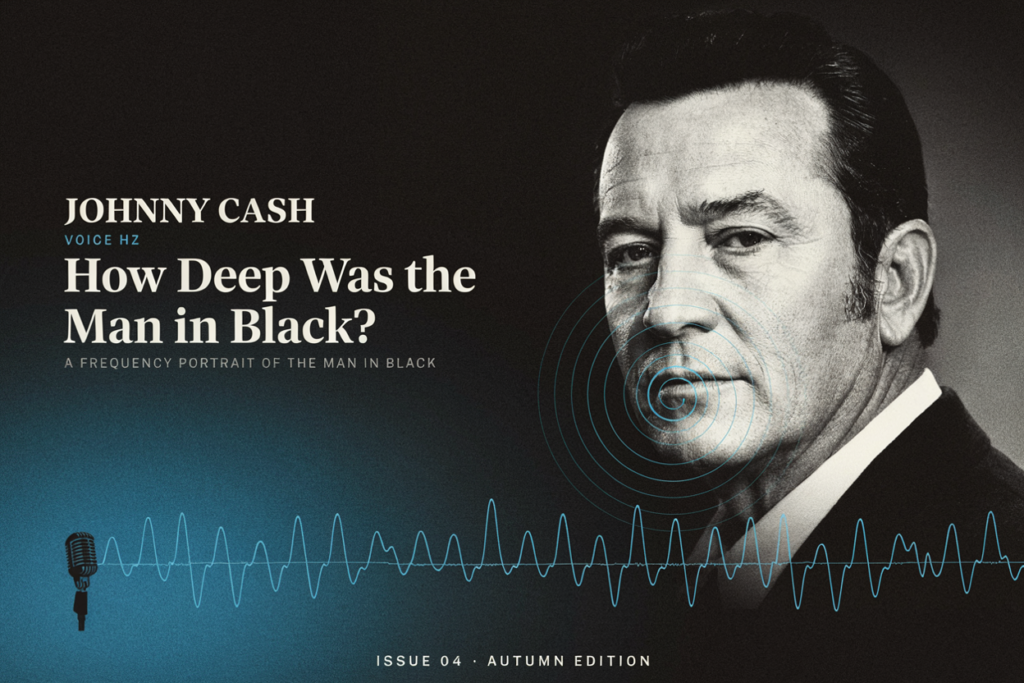
Johnny Cash did not have one fixed voice frequency. His pitch changed from note to note and phrase to phrase, but one acoustic analysis places the final line of “Hurt” at approximately 85 Hz, close to the musical note F2 at 87.31 Hz. That figure describes a particular low passage, not Cash’s average across every song or his entire career.
Cash is commonly described as a bass-baritone because he combined a weighty low register with a usable baritone range. A voice frequency reference chart shows where F2 and other notes sit in hertz. Cash’s depth, however, came from more than pitch.
What Was Johnny Cash’s Voice Frequency?
The most defensible short answer is about 85 Hz in one documented passage from “Hurt.” UC San Diego course material uses that value while examining the fundamental frequency of the final line. Fundamental frequency, or F0, is the rate at which the vocal folds repeat their vibration cycle and is the main acoustic correlate of perceived pitch.
What the 85 Hz measurement represents
An 85 Hz fundamental means the vocal-fold vibration repeated about 85 times per second. F2 is 87.31 Hz, so the passage lies near that note. Sung pitch naturally moves rather than remaining locked to one frequency.
The figure also fits common descriptions of what counts as a deep voice in hertz, but it should retain its label: one passage measurement. It is not a clinically measured habitual speaking pitch, a lifetime singing average, or the frequency of every note in “Hurt.”
Why Cash did not always sing at 85 Hz
A melody requires changing notes. Cash’s pitch also rose and fell with emphasis, emotion, and sentence shape.
The recording also contains harmonics, vocal-tract resonances, instruments, room sound, and production effects. Calling Cash’s whole voice “85 Hz” therefore reduces a complex sound to one limited observation.
How Low Could Johnny Cash Sing?
Recording-based estimates place several well-known Cash performances around D2 or F2 at their low end. These estimates suggest strong access to the low second octave, but they are not equivalent to a controlled studio range test.
| Recording or claim | Reported or relevant low point | Approximate frequency | What the figure means |
|---|---|---|---|
| Final line of “Hurt” | About 85 Hz | About 85 Hz | Acoustic example from one passage |
| “Hurt” estimated song range | F2 | 87.31 Hz | Automated recording-based estimate |
| “Folsom Prison Blues” estimated range | F2 | 87.31 Hz | Estimated lowest detected lead-vocal pitch |
| “I Walk the Line” estimated range | D2 | 73.42 Hz | Estimated low pitch in a recording |
| Overall B1–B5 database claim | B1 to B5 | 61.74–987.77 Hz | Broad detected extremes requiring caution |
Song estimates are not a clinical range test
Singing Carrots estimates “Hurt” at F2–G3, “Folsom Prison Blues” at F2–C4, and “I Walk the Line” at D2–C4. Automatic detection can mistake instruments, backing voices, harmonics, or noise for the lead vocal.
That is why an extraordinary overall B1–B5 claim should not be presented as Cash’s comfortable solo range. A singer’s tessitura—the region where the voice remains comfortable, stable, and musically useful—matters more for classification than isolated extremes. The same distinction applies when reading a general baritone range explanation.
Low notes changed with song and life stage
Keys, arrangements, health, age, and artistic choices changed across Cash’s career. D2 in one track and F2 in another simply describe different performances.
Was Johnny Cash a Baritone, Bass-Baritone, or Bass?
Bass-baritone is the most useful popular description of Johnny Cash’s voice. It reflects a substantial low register with baritone-like flexibility above it. It is not a formal operatic Fach classification because Cash was not assessed through operatic repertoire, passaggi, projection, and tessitura.
| Label | Typical implication | Fit for Johnny Cash |
| Baritone | Middle male voice with a practical range often centered near A2–A4 | Explains much of his functional singing range but understates his low color |
| Bass-baritone | Baritone upper function with stronger bass extension and weight | Best concise description of his recorded vocal identity |
| Bass | Lowest standard male category, commonly cited around E2–E4 | Possible impression from his low notes, but range alone does not establish it |
The bass voice classification guide explains why a stable low tessitura, timbre, and register behavior matter alongside the lowest note. Cash’s ability to produce low pitches does not by itself prove that he was a true classical bass. Conversely, calling him a baritone does not make the audible depth imaginary; bass-baritone captures that middle ground more clearly.
Why Did Johnny Cash’s Voice Sound So Deep?
Johnny Cash sounded deep because low fundamentals were reinforced by dark resonance, vocal weight, chest-register coordination, restrained delivery, and recording choices. Two singers can produce the same F2 yet sound markedly different because pitch is only one ingredient in vocal identity.
Chest-dominant tone and vocal weight
Cash often used a firm, speech-like tone with substantial low-frequency energy and little breathiness. His chest register—the lower coordination commonly associated with a fuller speaking quality—gave notes solidity. Vocal weight made the sound feel dense rather than merely low.
These traits are common among notable singers known for deep voices, but each performer balances them differently. Cash generally avoided the exaggerated swallowed sound that can occur when a singer forces the larynx downward.
Resonance, articulation, and pacing
Resonance shaped Cash’s timbre by filtering the buzz produced at the vocal folds. His deliberate consonants, measured pacing, controlled volume, and limited vibrato made the pitch center feel steady and authoritative. Strategic pauses also gave low phrases room to register with the listener.
Microphone proximity can increase bass, while equalization and compression add warmth and presence. These factors affected how listeners experienced Cash. Comparisons with Barry White’s measured and perceived vocal depth show why celebrity voices cannot be reduced to one number.
Did Johnny Cash’s Voice Become Deeper With Age?
Johnny Cash’s later voice sounded rougher and heavier, but no verified Hz comparison proves a continuous drop with age. Sparse late arrangements exposed breath, texture, and low resonance more clearly than many early productions.
Age can alter vocal-fold tissue, breath capacity, and stability. Health, fatigue, musical key, delivery, and recording technique also change a performance. A lower-sounding late recording may reflect several factors rather than a permanent anatomical shift.
This is especially relevant when comparing Cash with another celebrated spoken voice such as James Earl Jones and his reported voice frequencies. Measurements taken from different clips, rooms, microphones, and speaking tasks do not form a controlled comparison.
Can You Measure Johnny Cash’s Voice From a Recording?
Pitch-tracking software can estimate Johnny Cash’s F0 from a clean vocal passage, but the result must be tied to the exact recording, timestamp, and analysis settings. A defensible average would require multiple representative samples, careful isolation of the lead voice, and manual review of tracking errors.
A useful procedure selects sustained vowels, excludes overlapping instruments or harmony, inspects the detected contour, and reports the median, range, and context. The result still describes only the chosen recordings.
Common errors include octave doubling, octave halving, guitar or piano bleed, creaky voice, and mistaking harmonics for F0. The limitations outlined in a guide to pitch-test accuracy apply especially strongly to mastered music, where the singer is only one layer of the mix.
Frequently Asked Questions
Was Johnny Cash’s voice really 85 Hz?
Approximately 85 Hz was documented for the final line of “Hurt.” It was a passage-specific measurement, not Cash’s fixed or lifetime-average frequency.
What musical note is 85 Hz closest to?
E2 is 82.41 Hz and F2 is 87.31 Hz in standard equal temperament, so 85 Hz falls between them and is slightly closer to F2. Expressive singing can glide between equal-tempered note centers.
What was Johnny Cash’s lowest recorded note?
Some recording databases report notes as low as B1 across Cash’s catalog, while individual well-known songs are often estimated around D2 or F2. The B1 claim should be treated cautiously unless the lead vocal and exact passage are manually verified.
Was Johnny Cash a true bass singer?
Johnny Cash is more commonly and usefully described as a bass-baritone. A low note alone cannot establish a classical bass classification; comfortable tessitura, timbre, passaggi, and sustained performance function also matter.
Why does “Hurt” sound deeper than some earlier recordings?
“Hurt” combines a low key, sparse accompaniment, close vocal presentation, slow pacing, and Cash’s aged vocal texture. Those elements make the low qualities unusually exposed even without proving that his habitual pitch had permanently fallen to one value.
Can pitch-detection software accurately measure Cash’s voice?
Software can estimate clean, isolated notes reasonably well, but full mixes create errors from instruments, harmonies, noise, and octave confusion. Any reported result should identify the clip and be checked against the waveform, spectrogram, and musical context.

Williams is a vocal depth and voice analysis writer at Deep Voice Test. He focuses on deep voice analysis, vocal frequency testing, pitch detection, and voice classification tools for singers, creators, speakers, and voice enthusiasts.