
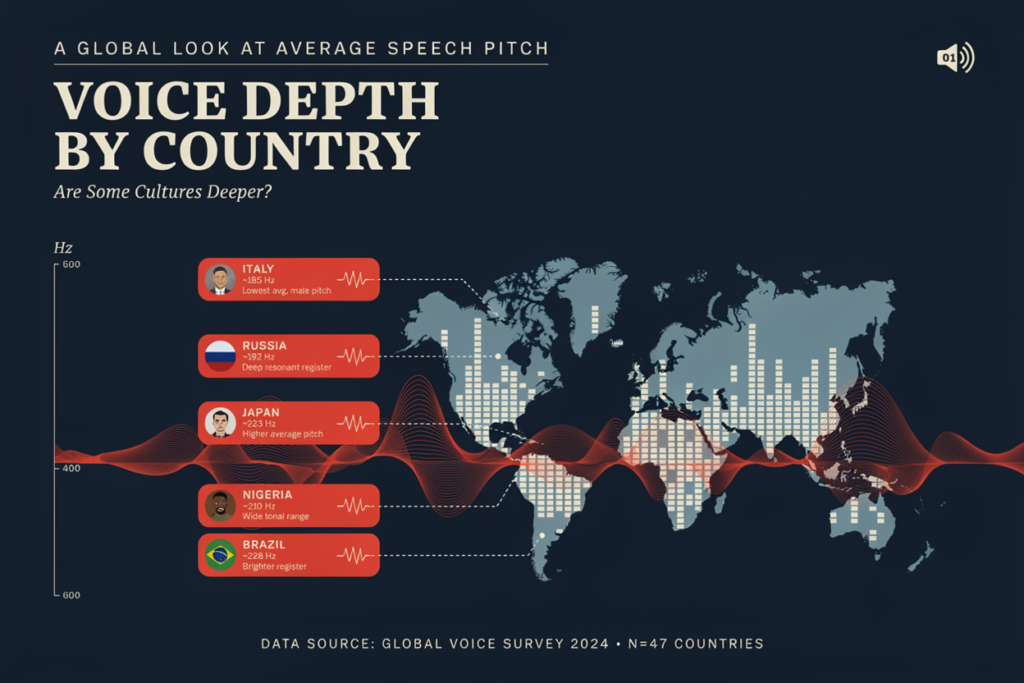
Voice depth can vary among speakers and language communities, but there is no reliable scientific ranking of average voice depth by country. Nationality alone cannot predict whether someone will have a deep voice because pitch also depends on vocal anatomy, age, sex-related development, language, speaking style, and the situation in which the voice is recorded.
Most country-by-country claims online combine studies that used different speakers, equipment, and speech tasks. A useful comparison must examine what cross-language research actually measures and where its conclusions stop.
Does Voice Depth Really Differ by Country?
Researchers have found differences in how some language groups use pitch, but these do not establish national voice types. A sample may use a lower average pitch or narrower range under specific conditions without representing either country’s population.
Voice depth is often estimated through fundamental frequency, or F0: the rate at which the vocal folds repeat their vibration, measured in hertz. A lower F0 usually sounds lower in pitch. However, resonance and formant frequencies—the acoustic patterns created as sound travels through the throat and mouth—also affect whether a voice sounds full, dark, or deep. The broader human voice frequency range therefore includes more information than one average Hz number.
Country, Language, Accent, and Ethnicity Aren’t Equivalent
A country can contain many languages, accents, and speaking traditions, while one language may span several countries. A result described as “German,” “English,” or “Mandarin” may refer only to a language sample.
Bilingual evidence makes the distinction especially clear. When the same speaker changes language and uses a different pitch span, anatomy and nationality have not changed. The speaker has adjusted intonation, rhythm, emphasis, or social style.
Population Averages Don’t Predict an Individual Voice
Individual variation can exceed the difference between group averages. One large study found average F0 values ranging from 78 to 182 Hz among men and 126 to 307 Hz among women, showing why a national label poorly predicts one person’s pitch.
General references place adult male mean speaking pitch around 107–132 Hz and adult female mean pitch around 196–224 Hz. These are broad bands, and average male voice measurements require context such as age and recording task.
What Does Research Show About Pitch Across Languages?
Cross-language studies show that speakers can use pitch differently across languages and communities. They do not provide a worldwide country ranking because their samples, speech material, and acoustic measures are not interchangeable.
| Comparison | Sample or design | Main observation | What it cannot establish |
|---|---|---|---|
| Bulgarian, Polish, German, and British English | 22 speakers per language: 11 men and 11 women | German and English samples used lower pitch maxima, narrower spans, and less variation than Bulgarian and Polish samples | The average biological voice depth of four countries |
| Mandarin and English | Cross-language speech tasks | Some task-dependent pitch differences appeared, while physiological F0 ranges were nearly equivalent | That speakers of one language have inherently deeper vocal anatomy |
| Welsh and English | Welsh-English bilingual speakers | The same speakers used wider F0 spans and higher peaks in Welsh | A difference caused by nationality, ethnicity, or vocal-fold size |
Speech Task Changes the Result
Reading a prepared passage, holding a vowel, answering an interview question, and talking casually do not produce identical pitch measurements. Emotional state, sentence type, microphone distance, and room acoustics can also change the result. A person may use a higher pitch while speaking enthusiastically and a lower, narrower range while reading formally.
For that reason, a chart made by placing an English reading study beside a Japanese conversation study would be misleading. Even a technically correct voice Hz chart needs clear labels for demographic group, vocal task, and whether it reports a mean, median, or total range.
Pitch Usage Is Not the Same as Vocal Capacity
Habitual pitch describes where someone usually speaks; physiological range describes the frequencies that person can produce. Language may shift habitual pitch without changing the vocal folds, so a bilingual speaker can sound lower in one language while retaining the same physical capacity.
This distinction also explains why a recording can sound “deep” even when its measured F0 is not unusually low. Slower delivery, strong low-frequency resonance, limited pitch movement, and darker vowels can influence perception. The guide to what Hz counts as a deep voice explains why frequency should be treated as one clue rather than a complete verdict.
Why Might Voices Sound Deeper in Some Places?
Learned intonation, accent features, media exposure, or sample selection can make some communities sound deeper to unfamiliar listeners without implying deeper anatomy.
Language and Cultural Speaking Styles
Languages organize questions, emphasis, and emotion differently. Cultural expectations may influence loudness, formality, pitch movement, and expressions of authority or politeness. These learned patterns are not national rules.
Anatomy, Age, and Hormonal Development
Physical contributors include vocal-fold length and mass, laryngeal development, and vocal-tract shape. Pubertal hormonal changes help explain average adult pitch differences across sex-related groups. The full explanation of what causes a deep voice includes anatomy, hormones, health, and habits—not nationality alone.
Age composition can distort country comparisons too. A sample dominated by young adults should not be compared directly with one containing many older speakers. Age-related changes vary, as outlined in the reference on voice depth across the lifespan.
Recording and Selection Effects
Broadcast voices are not random population samples. Presenters, actors, and creators may be selected or trained for their roles, while equalization, close microphones, and room acoustics can add low-frequency weight. Judging a country from media voices is like judging average height from a basketball team.
Can Countries Be Ranked by Average Voice Depth?
Countries cannot currently be ranked credibly by average voice depth. Existing studies do not cover representative samples from every country under the same conditions, and a collection of unrelated averages cannot be turned into a scientifically defensible leaderboard.
What a Valid Global Comparison Would Require
A meaningful international project would need:
- Large, representative samples with matched age and sex-related demographics
- Identical microphones, rooms, calibration, and recording distances
- The same reading text plus comparable spontaneous-speech tasks
- Consistent reporting of median F0, pitch span, resonance, and variation
- Language-aware analysis that separates phonetic patterns from anatomy
- Statistical uncertainty and within-country variation, not only one average
Even that design would describe groups, not determine individual abilities. Genetics can influence anatomy, but inherited voice depth should not be converted into national stereotypes.
Why Online Country Charts Can Mislead
Warning signs include no sample size, no demographic breakdown, no speech task, and one exact number assigned to millions of people. Rankings that treat pitch, accent, resonance, and attractiveness as one measurement are also unreliable.
How Can You Compare Your Voice Without Using Nationality?
Compare your voice with repeated recordings made under consistent conditions and with an appropriate demographic reference—not with a country label. Median F0 from ordinary speech is generally more useful than the single lowest frequency detected.
Record 30–60 seconds of comfortable speech in a quiet room. Keep the microphone position constant, repeat on several days, and exclude noise and vocal fry, which can create low pulses that do not represent stable speaking pitch.
A browser or phone result is an estimate. The guide to testing voice depth consistently helps assess pitch, resonance, and stability without turning one reading into a diagnosis. Seek qualified care for sudden change, persistent hoarseness, or pain.
Frequently Asked Questions
Which Country Has the Deepest Average Voice?
No country can be identified reliably as having the deepest average voice. There is no representative worldwide dataset recorded with matched speakers and identical methods, so current national rankings are unsupported.
Do Different Languages Change a Bilingual Speaker’s Pitch?
Yes, a bilingual speaker may use a different habitual pitch, pitch span, or intonation pattern in each language. That change reflects language use and social context; it does not mean the speaker’s vocal anatomy changes when switching languages.
Is Voice Depth Determined by Ethnicity or Nationality?
Nationality does not determine an individual’s voice depth. Vocal anatomy, hormonal development, age, health, habits, language, and individual variation are more relevant, and ethnicity should not be used as a shortcut for those factors.
Why Do Some Accents Sound Deeper Than Others?
An accent may use narrower pitch movement, different vowel qualities, slower timing, or stronger low-frequency resonance. These features can create a deeper impression even when speakers have similar average fundamental frequencies.
Are Online Country Voice-Pitch Charts Reliable?
Treat them cautiously unless they disclose representative samples, speaker demographics, recording conditions, speech tasks, and uncertainty. A chart assembled from unrelated studies cannot support fair country-to-country rankings.
Can Two Countries Be Compared Using Average Voice Frequency Alone?
Average F0 alone is insufficient because it omits pitch variation, resonance, demographics, language, and speaking context. A responsible comparison would report the full distribution and use the same methodology for both populations.
Williams is a vocal depth and voice analysis writer at Deep Voice Test. He focuses on deep voice analysis, vocal frequency testing, pitch detection, and voice classification tools for singers, creators, speakers, and voice enthusiasts.