
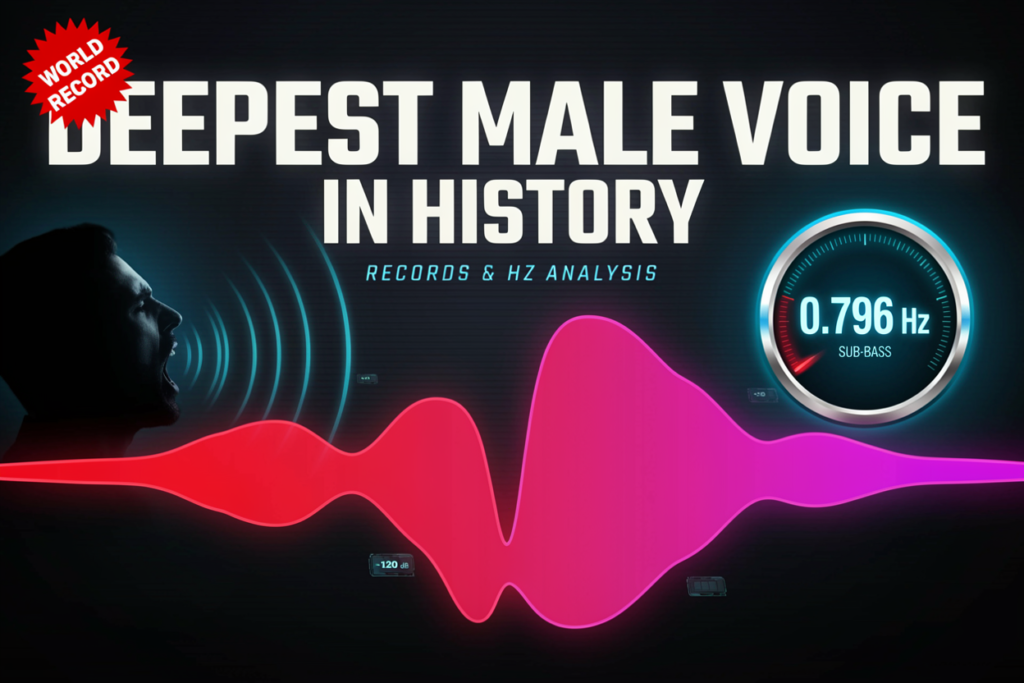
Tim Storms has produced the deepest verified male vocal frequency in history. Guinness World Records reports that he generated G−7 at 0.189 Hz on March 30, 2012. That infrasonic vocalization was not his normal speaking pitch or an ordinary song note.
The record must be separated from musical usefulness. A basso profondo singing an audible low note may sound deeper even when the measured fundamental is far higher. A human voice frequency overview explains why vocal fundamentals and audible harmonics are not the same thing.
Who Had the Deepest Male Voice in History?
Tim Storms is the answer when “deepest” means the lowest instrument-verified vocal fundamental produced by a man. According to Guinness World Records, Storms produced a G−7 fundamental at 0.189 Hz, witnessed by two music professors and an acoustician.
When and where was the record set?
The attempt took place at Citywalk Studios in Branson, Missouri, on March 30, 2012. The record describes one extreme production under test conditions, not an average for Storms’ speech or singing.
How was the 0.189 Hz result verified?
Guinness says the attempt used Brüel & Kjær equipment, including a low-frequency microphone and precision sound analyzer. Phones and music tuners may filter out very low frequencies or track a harmonic instead.
Anyone comparing a home result with this record should treat it as an estimate. The limits described in this guide to voice-depth test accuracy become especially important below the normal musical and speech ranges.
How Low Is Tim Storms’ G−7 Note?
G−7 at 0.189 Hz is far below the usual lower limit of human hearing, commonly described as about 20 Hz. Its vibration period is approximately 5.29 seconds per cycle, calculated as 1 ÷ 0.189. Listeners therefore do not hear a clear 0.189 Hz musical pitch in the way they hear a piano note.
| Reference | Approximate frequency | What the comparison shows |
|---|---|---|
| Tim Storms’ G−7 record | 0.189 Hz | Verified infrasonic vocal fundamental |
| One full cycle at 0.189 Hz | 5.29 seconds | The vibration repeats extremely slowly |
| Common lower hearing boundary | 20 Hz | G−7 is more than six octaves below it |
| Lowest piano key, A0 | 27.50 Hz | A0 is about 145 times higher in frequency |
| C2 | 65.41 Hz | A familiar low bass singing reference |
Why is 0.189 Hz below ordinary hearing?
Frequency measures cycles per second. A 20 Hz tone repeats 20 times each second, while a 0.189 Hz event takes more than five seconds to complete a single cycle. The ears do not interpret such a slow repetition as a stable musical pitch.
A conventional voice Hz chart therefore needs context about audibility and vocal register.
What do listeners hear instead?
An extremely low vocalization can produce audible harmonics, airflow noise, individual pulses, and vocal-tract resonances. Those components make the event audible even when its fundamental is not perceived as a conventional pitch.
Was G−7 a Normal Singing Note?
No. Storms’ G−7 was an extreme vocal production rather than a normal modal note used to carry a melody. The record proves that his vocal system generated a measured periodic event at 0.189 Hz, but it does not show that he could project lyrics at that pitch with ordinary volume, clarity, or stability.
Pulse register versus modal voice
Modal voice is used for most speaking and singing. At an extreme low limit, the vocal folds can enter a pulse-like pattern with slow, distinct closures. That production is not directly comparable with a resonant modal note.
A singer’s bass vocal range is normally discussed with notes that can be sustained and used musically. An isolated extreme extends a record, but it does not define the singer’s comfortable working range.
Lowest note versus usable tessitura
Tessitura is the range where a singer performs comfortably and consistently. It is more useful for assigning repertoire than a one-time extreme.
| Criterion | What it measures | Best use |
| Lowest verified frequency | The smallest measured fundamental | World-record comparison |
| Lowest usable sung note | A stable note with musical tone | Performance capability |
| Tessitura | Comfortable, repeatable range | Repertoire and voice classification |
| Average speaking F0 | Typical vocal-fold rate in speech | Speech-pitch comparison |
| Perceived depth | Pitch plus resonance and timbre | How low or weighty a voice sounds |
Did Tim Storms Also Have the Widest Vocal Range?
Yes. Guinness separately credits Tim Storms with the greatest male vocal range, measured in 2008. The reported span runs from 0.7973 Hz to 807.3 Hz—about ten octaves, although Guinness notes that the concert-pitch interval is technically nine octaves and eleven semitones.
Why are there two different records?
The 2008 record spans verified low and high endpoints; the 2012 record isolates an even lower frequency. The later G−7 should not be substituted into the earlier calculation.
A published range may use unusual registers outside everyday modal singing. Standard bass voice classification also considers color, tessitura, passaggi, projection, and usable notes.
Why doesn’t the record describe every performance?
A world-record value is an achievement under defined conditions, not a permanent setting of the voice.
Which Other Men Were Famous for Exceptionally Deep Voices?
Several singers became famous for musically useful low voices, but verified evidence does not place them below Storms’ record. Historical claims must be compared by measurement type.
| Singer | Tradition | Why the voice is notable | Evidence caution |
| J. D. Sumner | Gospel bass | Powerful projected low singing and earlier low-note fame | Historical claims used different conditions and record categories |
| Mikhail Zlatopolsky | Russian oktavist | Extremely low choral bass singing | Recording estimates are not equivalent to laboratory verification |
| Vladimir Pasyoukov | Russian sacred music | Resonant low notes within ensemble performance | Musical projection matters more than an isolated minimum |
| Vladimir Miller | Oktavist and basso profondo | Strong low register used in repertoire | A usable sung range is different from an infrasonic record |
Russian oktavists reinforce choral harmony below the conventional bass line, while J. D. Sumner helped make gospel bass a featured role. These famous bass singers and their styles show why vocal impact cannot be ranked from one number.
What Actually Makes One Male Voice Sound Deeper Than Another?
Perceived depth comes from fundamental frequency, resonance, harmonic balance, vocal weight, loudness, articulation, and context. A lower fundamental usually contributes to a deeper impression, but two men singing the same note can sound dramatically different.
Resonance and harmonics
The vocal folds create a repeating source; the vocal tract filters it into resonances called formants. Dark timbre and strong lower harmonics can give an audible bass note more authority than an unstable lower pulse.
That is why the singers discussed in this collection of notable deep voices do not all sound alike. Their depth comes from different mixtures of pitch, tone, diction, projection, and recording style.
The measurement criterion changes the winner
Tim Storms wins the verified lowest-frequency criterion. A different question—such as the lowest projected operatic note, deepest average speaking voice, or most resonant choral bass—would require different tests and could produce a different answer. A defensible comparison must use the same speech or singing task, calibrated equipment, consistent recording distance, and clearly defined register.
Frequently Asked Questions
Who currently holds the world record for the deepest male voice?
Tim Storms holds the Guinness World Record for the lowest vocal note produced by a male. His verified result was G−7 at 0.189 Hz, recorded on March 30, 2012.
Can humans hear Tim Storms’ 0.189 Hz fundamental?
The 0.189 Hz fundamental is below the ordinary human hearing range. Listeners can perceive audible harmonics, pulses, resonance, and noise generated alongside it rather than hearing the fundamental as a clear musical pitch.
Is G−7 lower than the lowest note on a piano?
Yes. A standard piano’s lowest note is A0 at 27.50 Hz, while Storms’ G−7 measured 0.189 Hz. The piano note is roughly 145 times higher in frequency.
Did Tim Storms sing G−7 in a normal chest voice?
The record should not be treated as an ordinary chest-voice melody note. It was an extreme, pulse-like vocal production measured with specialized low-frequency equipment.
Who held low-voice records before Tim Storms?
J. D. Sumner was widely associated with earlier record claims for exceptionally low singing. Comparisons require caution because record definitions, equipment, registers, and verification standards have changed over time.
Does the lowest vocal note make someone the best bass singer?
No. Bass singing also depends on usable tessitura, resonance, intonation, diction, stamina, projection, and musical interpretation. Guidance on what counts as a deep voice in Hz can help interpret a frequency, but it cannot grade artistry.
Williams is a vocal depth and voice analysis writer at Deep Voice Test. He focuses on deep voice analysis, vocal frequency testing, pitch detection, and voice classification tools for singers, creators, speakers, and voice enthusiasts.