
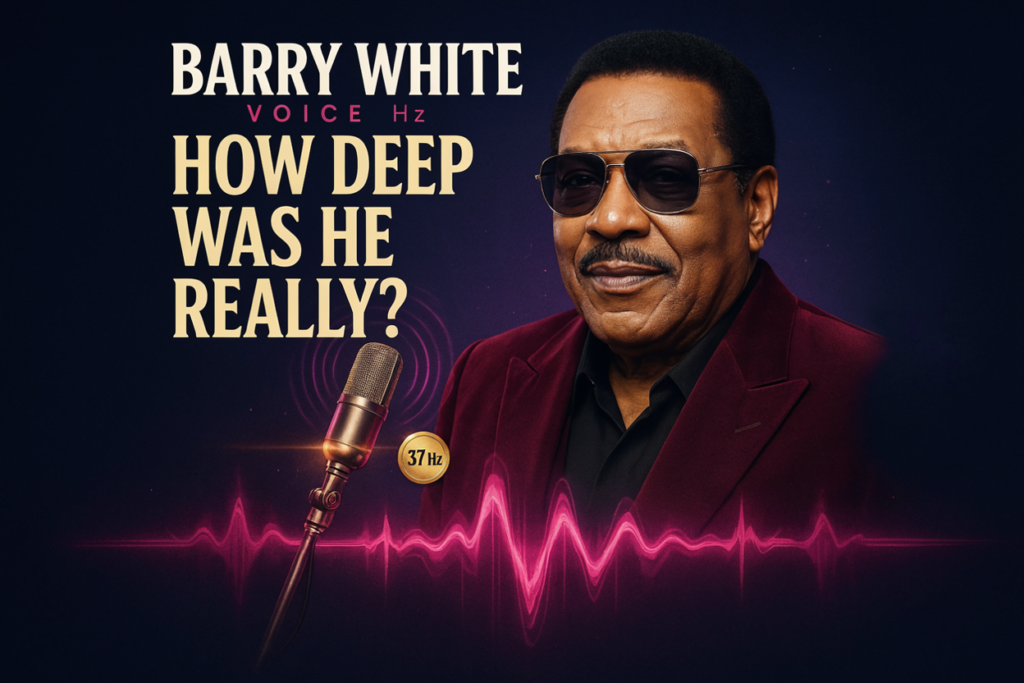
Barry White did not have one fixed voice frequency, and no authoritative acoustic study has published a verified average Hz value for his speaking or singing voice. His famously deep sound came from a combination of low fundamental pitch, bass-baritone timbre, strong lower harmonics, vocal-tract resonance, slow delivery, and close microphone technique—not from one frequency alone.
That distinction matters because a voice changes frequency from syllable to syllable and note to note. Any exact claim is incomplete unless the source identifies the recording, passage, and measurement method.
What Was Barry White’s Voice Frequency in Hz?
No scientifically verified single number is available for Barry White’s habitual voice frequency. His lowest spoken phrases may have entered the lower part of the typical adult male pitch range, but the value would have moved continuously with his words, expression, and recording conditions.
Fundamental frequency, or F0, is the vocal-fold vibration rate. Voice-science references commonly place typical adult male speech averages around 100–125 Hz, although individuals and samples vary. Our guide to the typical frequency of an adult male voice explains why an average is a benchmark rather than a boundary.
Assigning White a lifetime average from produced songs would be unreliable because music recordings contain effects and instrumental energy that complicate analysis.
Barry White Voice Hz: What Can Actually Be Verified?
The most defensible facts are that Barry White was widely described as a bass-baritone and that selected recordings contain identifiable sung pitches. Claims about an exact speaking average, a permanent minimum frequency, or an enormous lifetime range remain unverified unless they are supported by transparent acoustic analysis.
| Claim | What it actually means | Evidence quality | Main limitation |
|---|---|---|---|
| Barry White was a bass-baritone | His voice combined bass-like weight with baritone range and flexibility | Strong | A label does not specify one Hz value |
| Typical adult male speech is near 100–125 Hz | A population benchmark for average F0 | Strong | It is not Barry White’s measurement |
| Selected songs include about C3–A4 | Notes identified in a limited recording sample | Moderate | It is not a complete lifetime range |
| His speaking voice had one exact Hz value | A supposed fixed measurement | Weak | Speech frequency changes constantly |
| His full range was F1–E5 | A popular internet claim | Unclear | No transparent, authoritative analysis confirms it |
The Recording Academy has described White’s signature instrument as a bass-baritone, which is more credible than anonymous frequency lists. Still, voice type and Hz are different kinds of information. The difference between bass and baritone ranges shows why a singer can have a dark, bass-like color while using notes associated with both categories.
Was Barry White a Bass or a Baritone?
Bass-baritone is the most defensible classification for Barry White. The term describes a male voice with much of a bass’s depth and weight but more of a baritone’s upper-range access and flexibility.
Why bass-baritone fits his sound
White’s low notes, rich resonance, and spoken delivery created a strong bass impression. Yet many of his melodic lines sit higher than listeners might expect because perceived depth is not determined by the lowest note alone. Comparing the usual bass vocal range with common baritone territory makes the overlap easier to understand.
Voice categories also depend on tessitura—the region where a singer performs comfortably—plus vocal weight and timbre. They cannot be assigned from one unusually low note, so bass-baritone is best treated as a useful descriptive label.
Voice type does not equal a fixed frequency
Every named pitch has a frequency, but a voice type covers many pitches. A bass-baritone may sing a 130.81 Hz C3, move through several higher notes, and then speak at a lower or higher average F0 moments later. See the broader voice frequency chart for the relationship between note names, octaves, and Hertz.
What Was Barry White’s Vocal Range?
A limited song-analysis database places notes in selected Barry White recordings at approximately C3 to A4, equal to about 130.81–440 Hz in standard equal temperament. This is useful evidence about those analyzed performances, but it should not be presented as his complete vocal range.
| Note | Approximate frequency | What the figure tells us |
| C3 | 130.81 Hz | A documented low sung pitch in the limited song sample |
| A4 | 440.00 Hz | A documented upper pitch in that sample |
In twelve-tone equal temperament with A4 at 440 Hz, each semitone differs by the twelfth root of two. These frequencies describe notes, not the overall “depth” of a recorded voice.
Some online pages attribute an F1–E5 range to White. F1 is about 43.65 Hz and E5 is about 659.25 Hz, so that claim spans nearly four octaves. Without a track list, timestamps, isolated vocal stems, and rules for excluding vocal fry, harmonies, studio effects, or another singer, the range should not be treated as confirmed. Similar caution is useful whenever you compare claims about singers known for deep voices.
Why Did Barry White Sound So Deep?
Barry White sounded exceptionally deep because low pitch worked together with dark timbre, resonance, phrasing, and recording technique. Two people can produce the same F0 while sounding very different because the vocal tract shapes harmonics into different spectral patterns.
Fundamental frequency and harmonics
F0 gives the repetition rate listeners perceive mainly as pitch. Harmonics occur at multiples of that fundamental and contribute brightness, richness, and texture. A 90 Hz fundamental can contain energy at 180, 270, and 360 Hz, among many higher components.
Formants are resonance bands created by the vocal tract. White’s dark tone depended on this spectral structure, so the lowest analyzer peak misses much of what made his voice recognizable. The distinction is clearer in an overview of the human voice’s full frequency range.
Delivery and studio sound
White often used measured pacing, smooth phrasing, and intimate spoken passages. Close placement on a directional microphone can emphasize low frequencies through the proximity effect, while equalization and compression can add warmth without changing F0.
How Did Barry White Compare With an Average Male Voice?
Barry White’s characteristic delivery generally sounded lower, darker, and heavier than an average adult male voice, but no verified dataset allows a precise numerical difference. Typical male speech averages near roughly 100–125 Hz provide context, not proof of White’s personal mean.
A fair comparison would require clean recordings, similar microphones, and equivalent phrases. An analyst would measure median F0 rather than selecting one low moment, which might be vocal fry—the irregular register at the bottom of the voice.
This is also why a “deep voice” has no universal cutoff. Our explanation of what counts as a deep voice in Hertz separates approximate population ranges from individual perception.
Can You Measure Your Voice Against Barry White’s?
You can estimate your own median speaking F0, but you cannot make a scientifically exact comparison without a verified Barry White reference measurement. Record 20–30 seconds of comfortable speech in a quiet room, keep the microphone distance steady, and analyze only clear voiced passages.
Repeat the recording because fatigue, emotion, and speaking style can shift the result. Ignore isolated minimum readings and use a median. A browser-based result is an estimate, not a clinical assessment; the guide to testing your natural voice depth explains how to obtain a cleaner sample.
Do not force your larynx downward to copy White. Speaking below a comfortable pitch can cause tension and fatigue.
Frequently Asked Questions
How many Hz was Barry White’s speaking voice?
No authoritative source has published a verified average fundamental frequency for Barry White’s speaking voice. Any exact figure should be treated as an estimate unless it names the analyzed recording, timestamps, and acoustic method.
What was the lowest note Barry White could sing?
Selected-song analysis has identified C3, approximately 130.81 Hz, as a low note in the recordings it examined. That does not prove C3 was the lowest note Barry White could ever produce.
Was Barry White a bass or a bass-baritone?
Bass-baritone is the most widely supported description. It reflects his bass-like weight and dark timbre alongside range and flexibility associated with baritone singing.
Did Barry White really have an F1–E5 vocal range?
The F1–E5 claim is widely repeated but lacks a transparent, authoritative analysis. It should not be stated as fact without recordings, timestamps, isolated vocals, and consistent criteria for counting notes.
Why did Barry White sound deeper than other male singers?
His sound combined low fundamental pitch with dark resonance, strong lower harmonics, smooth phrasing, slow delivery, and studio techniques such as close miking. Those features can make a voice seem deeper than its pitch measurement alone suggests.
Can two voices with the same fundamental frequency sound different?
Yes. Two voices can share the same F0 but differ in harmonics, formants, breathiness, articulation, and resonance, producing clearly different timbres.
Williams is a vocal depth and voice analysis writer at Deep Voice Test. He focuses on deep voice analysis, vocal frequency testing, pitch detection, and voice classification tools for singers, creators, speakers, and voice enthusiasts.